Reducing Load and Restoring Reward
Reducing Load and Restoring Reward
Two of the four failure types share a symptom - the habit stops happening - but they need opposite fixes. Capacity overload means the habit is asking for more than you've got. Reward disconnection means it's asking for the right amount but giving you nothing back. This unit covers both, in that order, because cutting load first is what makes the reward work possible.
When capacity drops, the instinct is to suspend the habit until things calm down. That instinct is what kills it, because you lose continuity and the identity claim at the same moment, and restarting from zero costs far more than maintaining from small.
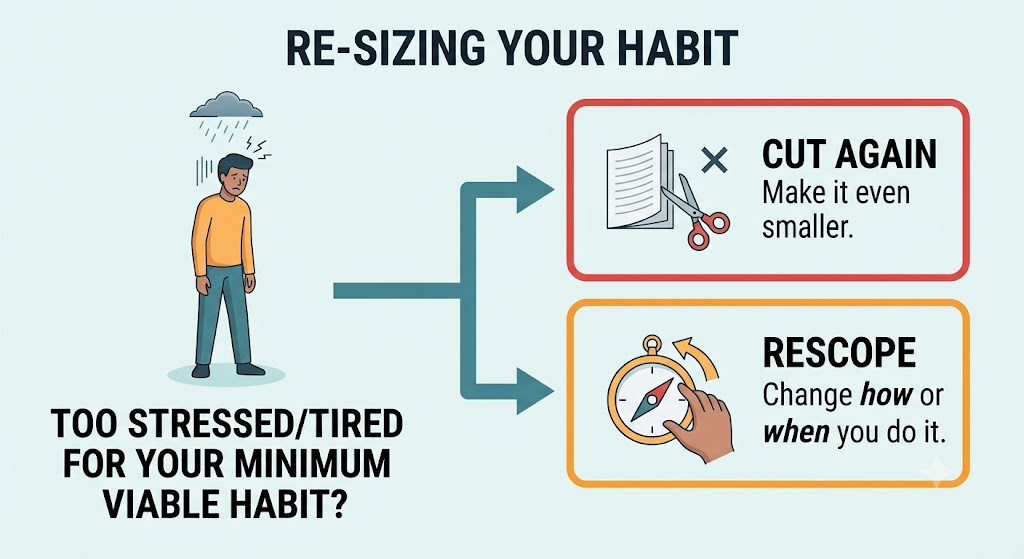
The Minimum Viable Habit Principle is the alternative: when capacity drops, reduce the habit to the smallest version that still preserves the identity claim and continuity, never to zero. Three phrases are load-bearing there. "Smallest" means genuinely small, not a lightly trimmed version of your normal habit. "Identity claim" means the shrunken version still supplies evidence for the same statement: one page still proves you're a reader. "Never to zero" means the behavior keeps happening on some scale, because a habit at 10% is alive and a habit at 0% is a memory.
Two tests keep you honest. First, could you do this version on the worst day of the coming period, not an average one? Second, if a stranger watched you do it, would it still look like the thing you claim to be? If the answer to either is no, cut again or rescope.
Prioritizing Against Available Energy, Not Available Intentions
Once you accept that things shrink, the next question is what shrinks and what goes. Most people triage against intentions: the habits they meant to build, ranked by how much they wanted them. That produces a list where everything survives at 70%, which is just capacity overload with extra steps.
Triage against energy instead. For each habit, name the real cost in time and, more importantly, in attention. A ten-minute habit that requires planning, decisions, or cleanup costs far more than ten minutes during a crunch. Then sort into three buckets: one habit protected at minimum viable size, one or more paused with a named restart date, and the rest dropped outright. A pause without a date is a drop pretending to be a plan.
Protect the habit with the most reliable cue and the widest cascade—the one that makes subsequent good decisions easier or "unlocks" the rest of your day—not the one you feel most sentimental about.
- Milo: You've got four running. Which one survives the next six weeks?
- Dan: Journaling, probably. It's the one I care about most.
- Milo: Care isn't the criterion. What time does its cue fire?
- Dan: Whenever I get to bed. Lately that's anywhere from ten to one. The morning walk, though, that's pegged to the coffee. Same moment every day.
- Milo: Then the walk is your protected habit, cut to five minutes around the block. Journaling pauses until the fifteenth, with a date in the calendar.
Notice that Dan's favourite habit lost to the one with the reliable cue. That's the trade you make when capacity is the binding constraint.
Redesigning a Stale Reward and Reviving the Celebration
Shrinking the habit solves demand but often exposes a second problem: the tiny version feels like nothing. The celebration you built has gone flat because it became mechanical, and the behavior has quietly disconnected from any felt payoff.
The repair has one hard constraint: nothing you add can increase demand. You're in a crunch, so a reflection journal or a tracking ritual is off the table. What you can do is change the timing and the truth of the payoff. Timing means it lands within seconds of finishing, not later that evening. Truth means naming what the behavior actually gives you right now, in the present tense, rather than what it's supposed to produce eventually. "I feel clearer after the walk" is a payoff. "It's good for my health" is a forecast, and forecasts don't reinforce anything.
Say it out loud after you finish and see whether it sounds true. If it doesn't, you've named the wrong payoff, not the wrong habit.
Here's the core of it: when capacity drops, shrink to the smallest version that still counts as evidence and still fires reliably, then make sure that small version pays you something you can feel within seconds. Next you'll do a quick recall check on the principle itself and produce minimum versions for a few overloaded scenarios, then write the triage that decides which of four habits survives, and finally rebuild a flat celebration live with a coach. Before that, try this: after your next rep, say the payoff out loud in the present tense and listen to whether you believe it.
