Reconstructing Disrupted Habits
Reconstructing Habits After Environmental Disruption
You've diagnosed the cause. If the answer came back environmental disruption, the fix is not more resolve, it's re-engineering. This unit gives you the three moves that rebuild a habit whose context walked out from under it: identify exactly what was removed, build a version that travels, and install a trigger that doesn't live in a room.
Analyzing What the Change Actually Removed
"Travel broke it" is too coarse to act on. Your cue context is made of four separable parts, and a disruption rarely takes all of them. There's the space (the kitchen, the spare room, the corner of the office), the object (the notebook, the mat, the shoes by the door), the time slot (the twenty minutes between waking and the first meeting), and the surrounding routine (the coffee you make first, the school drop-off you return from). Name which of the four this specific change took, because each one has a different repair.
A ten-day trip usually takes the space and the routine but leaves the time slot intact. A new shift pattern takes the time slot and leaves space and object untouched. A new baby takes the routine and shreds the time slot while your kitchen stays exactly where it was. Consequently, a fix that replaces the wrong element does nothing.
- Jessica: You said the trip killed it. Which part of the setup was actually missing?
- Dan: The whole thing, really. I couldn't do it at all.
- Jessica: Try again with the four parts. Space, object, time slot, routine.
- Dan: The notebook was in my bag, so I had the object. But there was no counter to leave it on, and I wasn't making my own coffee.
- Jessica: So space and routine went, object survived, time slot survived. That's a two-part problem, not a total loss. You only need to solve two things.
Notice how the problem shrank the moment it was itemized. "I couldn't do it at all" is not a design brief; "no counter, no coffee" is.
Designing a Portable Version of the Habit
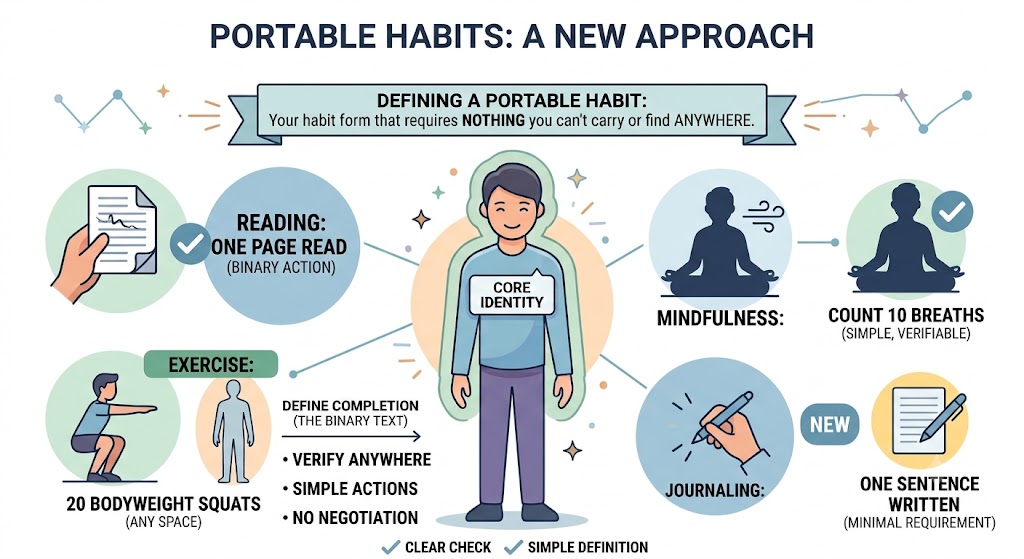
A portable version is the form of your habit that relies only on universal constants—things you can find anywhere or always have on your person. The test is subtraction: strip one support at a time and ask whether the behavior still exists. No kitchen. No floor space. No privacy. If the version dies at step two, it wasn't portable, it was your normal habit with optimism attached.
Two rules keep this honest. First, the identity claim stays fixed while the form changes. If the identity is "I am someone who reads," the portable version can be one page on a phone rather than a chapter in an armchair, because it still supplies evidence for the same claim. Second, prioritize universal availability over packability. If the version requires a specific physical object you have to pack (like a specific journal or your own yoga mat), one forgotten bag ends the streak. A truly portable version works even if your luggage is lost—think bodyweight exercises, digital notes, or counting breaths.
Then define completion in terms you could verify in an unfamiliar room at 6 a.m., half awake, with no interest in negotiating. Not "do something," not "spend a bit of time on it." One page turned. Ten breaths counted. Twenty bodyweight squats. Something binary, so there's no judgment call available at the exact moment you're least equipped to make one.
Architecting an Environment-Independent Backup Trigger
Solving the behavior still leaves the harder half open: the cue. Your original trigger was probably bolted to a place, which is precisely why the trip broke it. A backup trigger is a second cue that fires regardless of city, room, or schedule, and it works because it's attached to something you do rather than somewhere you are. Unlocking your phone for the first time each day, sitting down to your first meal, putting your feet on the floor after waking: these travel with you.
Additionally, pre-decide two fallbacks rather than improvising them. One for the day with no morning at all (a delayed flight, an overnight shift), and one for the room where nothing is where you expect it. Pre-decided means written down before you leave, in trigger form: "When I sit down in my seat on the plane, I do my one page." An intention is "I'll find a time." A trigger names the moment.
Finally, plan re-entry. Disrupted habits die in the week after the disruption ends, not during it, so pick which original cue you restore first and attach it to a specific moment: the notebook back on the counter before you unpack anything else.
The core takeaway: environmental disruption removes specific parts of a cue context, so name the parts, rebuild the behavior to need none of them, and give the cue a home that travels. Next you'll do a quick pattern-spotting check on which element various disruptions actually remove, then work through stripping supports live with a coach, then write the travel protocol you'd genuinely follow. Before your next trip, try itemizing the four parts and see how much smaller the problem gets.
