Diagnosing Habit Lapses
Welcome to the Course
You've built a habit. At some point it will break, and the moment it does you'll feel a strong pull to explain it with a character judgment: you got lazy, you lost discipline. That explanation is useless, because it doesn't tell you what to change. This course treats every lapse as a diagnosis rather than a verdict.
By the end of this course, you'll be able to:
- Distinguish the four failure types behind any lapse and diagnose which one you're actually facing
- Select the recovery protocol matched to the diagnosis instead of defaulting to "try harder"
- Design a portable version of your habit that survives travel, schedule shifts, and life transitions
- Apply the Minimum Viable Habit Principle to protect continuity during overloaded periods
- Rebuild a stale reward so the payoff lands within seconds of completion
- Stress-test your habit in advance with backup triggers and redundant supports
This first unit is the diagnostic layer: four failure types, how to trace a real lapse against them, and why the recovery route depends entirely on the cause.
Distinguishing the Four Failure Types
The Lapse Diagnosis Framework sorts breakdowns into four types, each with a different recovery route. These are categorized along two axes: whether the failure stems from the System or the Behavior, and whether the cause is External (originating in your environment) or Internal (arising from your own shifting state). Getting the type right is the whole job, because the fix that works for one is close to useless for the others.
The first two are about the system around the habit. Environmental Disruption means the context holding your cue changed: you moved, travelled, switched offices, and the trigger that used to fire reliably no longer exists in the same form. Capacity Overload means you attempted too much at once: the habit didn't fail on its own merits, it got crowded out by three other commitments and a demanding month.
The other two are about how the behavior lands on you. Reward Disconnection means the behavior stopped feeling good: you kept doing it, but the payoff went flat, and eventually you stopped paying a cost with no return. Identity Misalignment means the habit now conflicts with your self-image or your shifted priorities: you're maintaining something built for a version of you that has moved on.
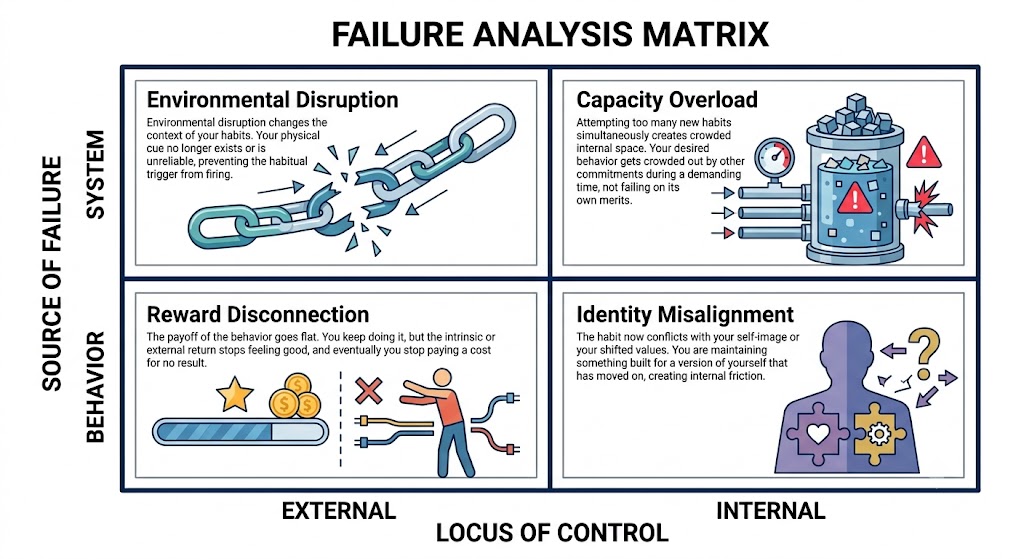
The rule that makes the framework work is simple: always diagnose before prescribing. Skip that and you'll apply an environmental fix to a reward problem, or add intensity to something that broke from overload.
- Milo: So the streak ended. What's your read on why?
- Dan: Honestly, I just stopped caring enough. I need to be stricter with myself.
- Milo: Walk me back. What was different in the week it broke?
- Dan: We were at my in-laws' for eight days. There was no kitchen counter to leave the notebook on.
- Milo: So the cue disappeared. That's environmental disruption, not caring less. Being stricter wouldn't have put the counter back.
Watch how "I need to be stricter" evaporated the moment a specific week got examined. The vague verdict survives only in the absence of detail.
Diagnosing a Real Lapse
To diagnose, trace four things in order. First, context: what physically changed around your cue in the days before the break? A room, an object, a time slot, a routine that used to precede it. Second, demands: what spiked on you at that time, including cognitive load, not just hours. Third, payoff: had the behavior stopped feeling like anything by the time you dropped it? Fourth, identity fit: does the identity statement behind the habit still describe who you're trying to be?
Use dates and specifics, not impressions. "Work got busy" isn't evidence; "three deadlines landed the week of the 12th and I was up past midnight four nights" is. Then name a single failure type and, just as importantly, name the runner-up you ruled out and why. Two types often show up together, and choosing between them is where the diagnosis earns its value.
Selecting the Matched Recovery Protocol
Each failure type has its own route. Environmental disruption calls for rebuilding the cue: a portable version of the behavior and a trigger that doesn't depend on location. Capacity overload calls for reduction, not addition: shrink to a minimum viable version and pause competing habits with a restart date. Reward disconnection calls for redesigning the payoff and reviving the celebration so it lands immediately. Identity misalignment calls for values work: either rebuild the bridge from behavior to a value you currently hold, or retire the habit deliberately.
The default you're guarding against is "try harder," usually dressed up as doubling the habit or setting an earlier alarm. That's a prescription for a diagnosis nobody made. If your lapse came from overload, more volume makes the next break faster and more demoralizing.
Here's the takeaway to hold onto: the recovery you choose is only as good as the diagnosis underneath it, and diagnosis requires specifics from the actual week things stopped. Next you'll do quick pattern-spotting on short lapse stories to lock in the four types, then write a real post-mortem on a habit of your own, then defend that diagnosis live against someone who thinks the answer is simply more intensity.
