Realigning Identity and Resilience
Realigning Identity and Engineering Resilience
The fourth failure type is the one people misdiagnose most often, because it wears the same clothes as laziness. Identity misalignment means the habit is fine mechanically but the self-image it was built to serve no longer feels true. No amount of shrinking or re-cueing fixes that. This unit handles the repair, then closes the course by building the habit so the next disruption bends it instead of breaking it.
Running a Values Clarification Before You Conclude Misalignment
Start with a suspicion test, because "this doesn't fit who I am anymore" is also the most comfortable exit ever invented. Two questions separate real misalignment from a habit that's simply hard right now.
First: what specifically changed in your life, with a date? Genuine misalignment has a source event, a new caregiving schedule, a role change, a season that ended. If nothing changed except your enthusiasm, you're looking at reward disconnection. Capacity overload requires a verifiable spike in demand; if your schedule is the same but the "spark" is gone, check your rewards first.
Second: if the demand dropped to thirty seconds, would you want to do it? Aversion that survives a tiny version is aversion to the meaning, not the effort. If you'd happily do the small version but resent the full one, that's load, not identity.
Then name what you actually care about today, in plain words, not aspirational ones. Ask what you'd protect if this week got cut in half. Whatever survives that cut is a currently held value, and it becomes the raw material for the next step.
Rebuilding Across the Habit-to-Identity Bridge
Once you've confirmed the identity has shifted, you face a choice. If the underlying value is no longer one you hold, use the protocol for deliberate retirement. However, if the value remains relevant but the old framing feels "borrowed," you re-route the behavior.
The Habit-to-Identity Bridge has three links, stated in order: the behavior connects to a value you currently hold, and that value connects to an identity you still want to reinforce.
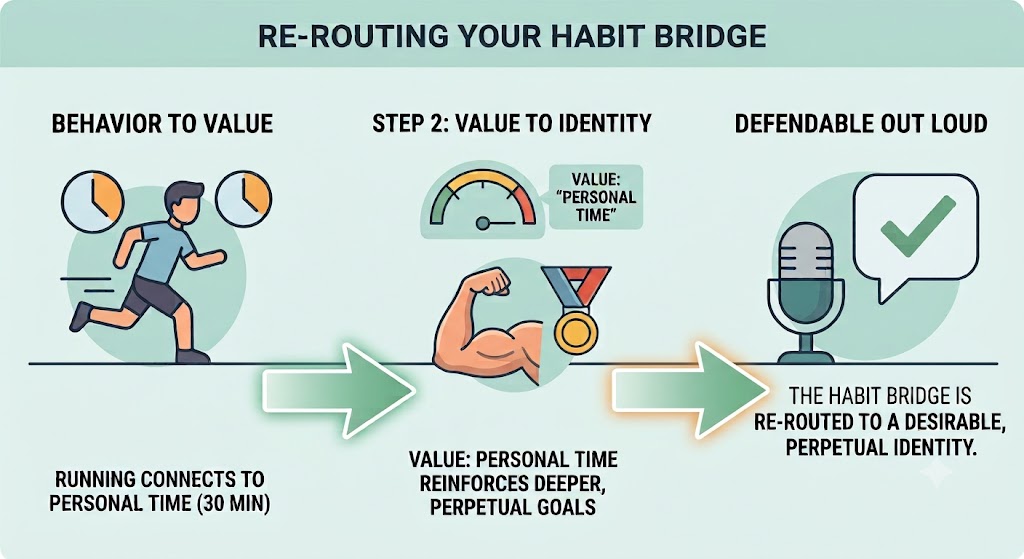
Every link has to be one you'd defend out loud. "Running connects to health connects to being an athlete" fails if the athlete identity is the thing that died. But running connects to having thirty minutes that nobody can claim, which connects to being someone who stays steady under pressure—that bridge holds, and it survives the season ending.
- Ryan: So you're admitting the running habit was a mistake.
- Jessica: No, the identity was. "I am an athlete" was true when I was racing. It's borrowed now.
- Ryan: Same thing. You stopped wanting it.
- Jessica: Then why do I still guard that half hour? What I actually value is having time nobody else can book. That's the middle link. The identity it feeds is someone who stays steady under load.
- Ryan: And the running?
- Jessica: Becomes a walk, some mornings a run. Done is thirty minutes outside with no phone. Same value, honest identity.
Notice the behavior changed form and the identity changed name, but the middle link is what made the rebuild credible rather than a retreat.
Stress-Testing the Habit and Coaching Someone Else Through It
The rebuilt habit is untested, which is exactly the moment to run Proactive Resilience Design: stress-test against likely scenarios, install backup triggers, add redundant supports, and preserve flexibility through environmental insurance.
Stress-testing means naming three specific, dated disruptions, not "work gets busy." Backup triggers are the environment-independent cues you already practised: something that fires regardless of room or schedule. Redundant supports mean a second path to the same behavior, so one broken link doesn't end the chain. Environmental insurance is the pre-placed gear, the duplicate set, the version that needs nothing you'd have to remember.
Coaching a partner through the same test is where your own understanding gets audited. The move that works on a sceptic isn't explaining the framework; it's asking, "what will you do the morning it happens, exactly?" and holding out for a physical action.
The core of this unit: when a habit stops fitting, rebuild the bridge from behavior to a value you hold today to an identity you still want, then engineer the result so it survives the disruptions you can already name. Three practices follow: a quick check on telling misalignment from difficulty, a written rebuild you could genuinely act on this weekend, then a live session where you explain your design and coach someone through theirs. Before that, name the three disruptions most likely to hit your habit in the next four months, with dates.
