Welcome back to Real-World and 3D Applications! We are now on lesson five of seven in this course, well past the halfway mark. So far, we have used the converse of the Pythagorean theorem to test for right triangles, spotted common Pythagorean triples, constructed square corners with the 3-4-5 rule, and modeled everyday 2D distance problems like ladders and screen diagonals. Every one of those skills lived on a flat surface. Today, we step off the page and into three dimensions.
In this lesson, we will explore the inside of a rectangular box and discover two types of diagonals hiding within it: face diagonals and space diagonals. More importantly, we will see how each diagonal is the hypotenuse of its own right triangle, and how those two triangles connect to each other in a surprisingly clean way.
From Flat Rectangles to Solid Boxes
As you may recall from the previous lesson, the diagonal of a rectangle splits it into two right triangles. We used this idea to find a TV screen's diagonal and a parking-lot shortcut. A rectangular box is simply a solid shape whose every face is a rectangle, so each face already contains the same kind of diagonal we have worked with before.
The new twist is that a box also has a diagonal that cuts through the interior of the solid, from one corner all the way to the farthest opposite corner. Understanding that interior diagonal requires two right triangles instead of one. Let's start by getting comfortable with the box itself.
Labeling the Rectangular Box
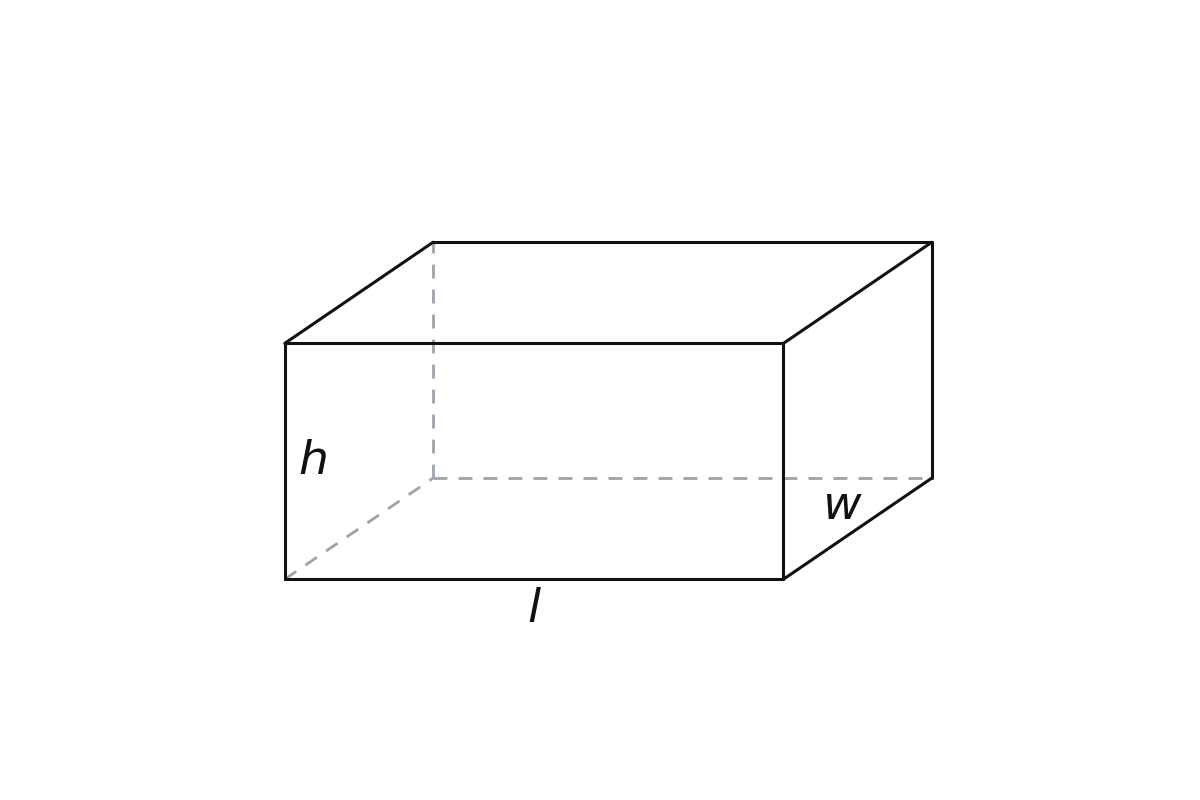
A rectangular box (also called a rectangular prism) has three measurements:
Length (l): how far the box extends along one direction of the base.
Width (w): how far the box extends along the other direction of the base.
Height (h): how tall the box stands.
Every edge of the box matches one of these three values, and every face is a rectangle formed by two of them. For instance, the bottom face is a rectangle with sides l and w, while a side face might be a rectangle with sides w and h. Keeping these labels clear will make it easy to describe the diagonals and triangles we are about to explore.
Join the 1M+ learners on CodeSignal
Be a part of our community of 1M+ users who develop and demonstrate their skills on CodeSignal
Face Diagonals
The Space Diagonal
Two Connected Right Triangles
Tracing Both Triangles in a Shipping Box
Conclusion and Next Steps
In this lesson, we moved from flat, two-dimensional problems into the interior of a three-dimensional box. We learned that a face diagonal lies on a single face and serves as the hypotenuse of a right triangle formed by two edges, while a space diagonal cuts through the box's interior and serves as the hypotenuse of a second right triangle whose legs are a face diagonal and the box's height. The critical takeaway is how these two triangles share a side: the face diagonal bridges them together.
Up next, you will get hands-on practice identifying face and space diagonals, matching them to their right triangles, and tracing both triangles inside a box. These exercises will lock in the spatial reasoning you need before we start crunching numbers in the upcoming lessons — let's jump in!
A face diagonal is a line segment that connects two opposite corners of one face. Because it lies entirely on that face, it never passes through the interior of the box. Every rectangular box has six faces, and each face has two diagonals, but they all work the same way.
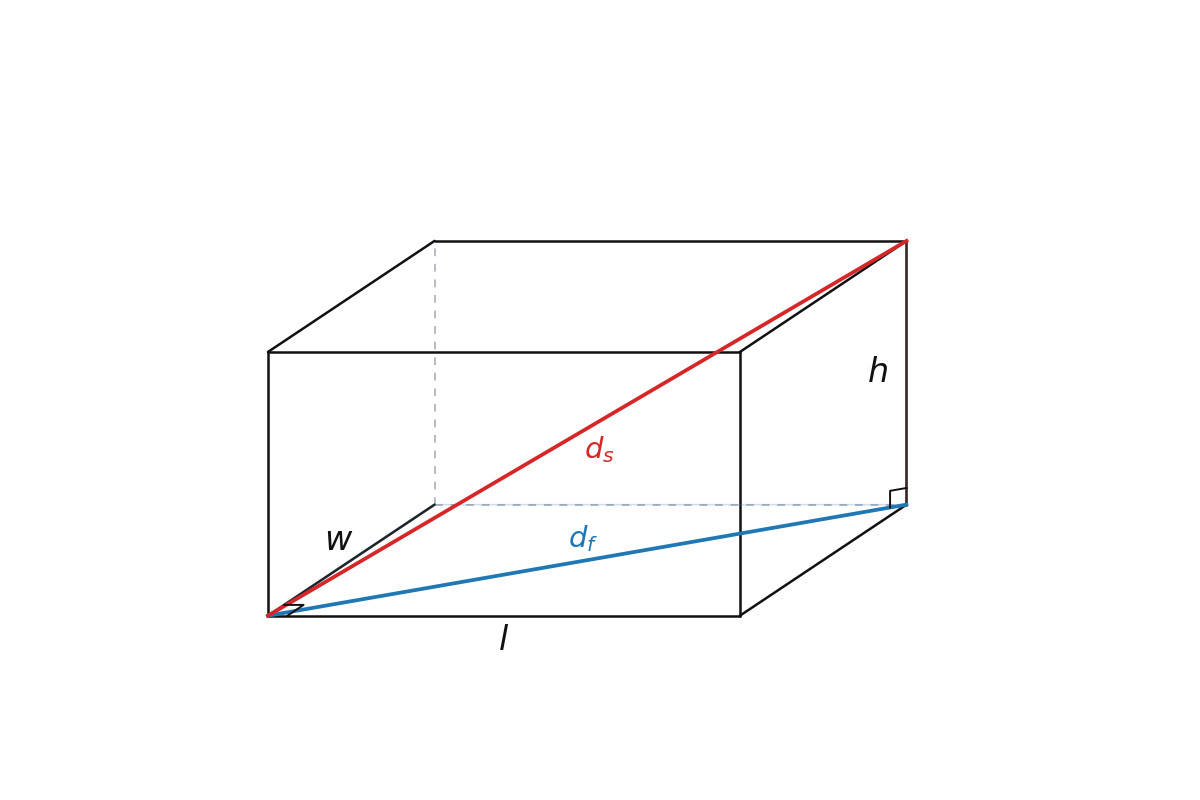
Consider the bottom face, which is a rectangle with sides l and w. Drawing a line from one corner to the opposite corner creates a diagonal that splits the face into two right triangles. In each of those triangles:
The two legs are the edges l and w.
The hypotenuse is the face diagonal, which we can call df.
This is exactly the rectangle-diagonal setup we used in Lesson 4. The only difference is that this rectangle happens to be one face of a 3D box rather than a standalone flat shape.
A space diagonal connects two corners of the box that do not share any face at all. It cuts straight through the interior of the box, passing through empty space inside. If you imagine standing at one bottom corner and looking toward the farthest top corner on the opposite side, the straight line between those two corners is the space diagonal.
Every rectangular box has exactly four space diagonals (one from each bottom corner to its opposite top corner), and they are all the same length. We will call this length ds. Unlike a face diagonal, which lies flat on a surface, the space diagonal cannot be seen by looking at any single face of the box — that is what makes it a new challenge.
Here is the key insight of this lesson: the space diagonal is the hypotenuse of a right triangle whose legs are a face diagonal and an edge of the box. This means we need two right triangles, and they share a side.
Triangle 1 — The Face Triangle. Start at a corner of the bottom face. Draw the diagonal across the bottom to the opposite corner. This diagonal, df, is the hypotenuse of a right triangle with legs l and w:
df2=l2+w2
Triangle 2 — The Interior Triangle. From the far end of that bottom diagonal, go straight up by the height h to reach the opposite top corner. The segment from our starting corner to that top corner is the space diagonal, ds. It forms the hypotenuse of a second right triangle whose legs are df (lying flat on the base) and h (pointing straight up):
ds2=df2+h2
The right angle in this second triangle sits at the bottom corner where df meets h, because the base of the box is flat and the height rises vertically from it, forming a 90-degree angle.
Notice how the face diagonal df plays a double role: it is the hypotenuse of Triangle 1 and a leg of Triangle 2. This shared side is what links the two triangles together and will eventually let us calculate the space diagonal in a two-step process.
Let's walk through the full picture one more time using a concrete example. Imagine a shipping box with length 12 in, width 4 in, and height 3 in.
Triangle 1 (bottom face): The legs are 12 and 4. The hypotenuse is the bottom-face diagonal df. The right angle is at the corner of the base where the length and width meet.
Triangle 2 (interior): The legs are df and 3 (the height). The hypotenuse is the space diagonal ds. The right angle is at the bottom corner where df meets the vertical edge.
We are not computing any numbers in this lesson. The goal right now is to clearly see which sides belong to which triangle and where the right angles sit. Once that spatial picture is solid, the calculations in the next two lessons will follow naturally.