Finding a Face Diagonal
Introduction
Welcome back to Real-World and 3D Applications! We have reached lesson six of seven, so the finish line is in sight. Last time, we stepped inside a rectangular box and mapped out the two types of diagonals hidden within it — face diagonals that lie flat on a single face and space diagonals that cut through the interior. We also traced the two connected right triangles that link those diagonals together. Today, we pick up where that spatial picture left off and start computing. Our target is the face diagonal: the straight-line distance from one corner of a rectangular face to the opposite corner.
The Face Diagonal Is a 2D Problem
Here is some encouraging news: computing a face diagonal does not require any new math. A face diagonal lies entirely on one rectangular face of the box. That face is simply a rectangle, and its diagonal splits it into two right triangles. The two edges bordering that face serve as the legs, and the diagonal is the hypotenuse.
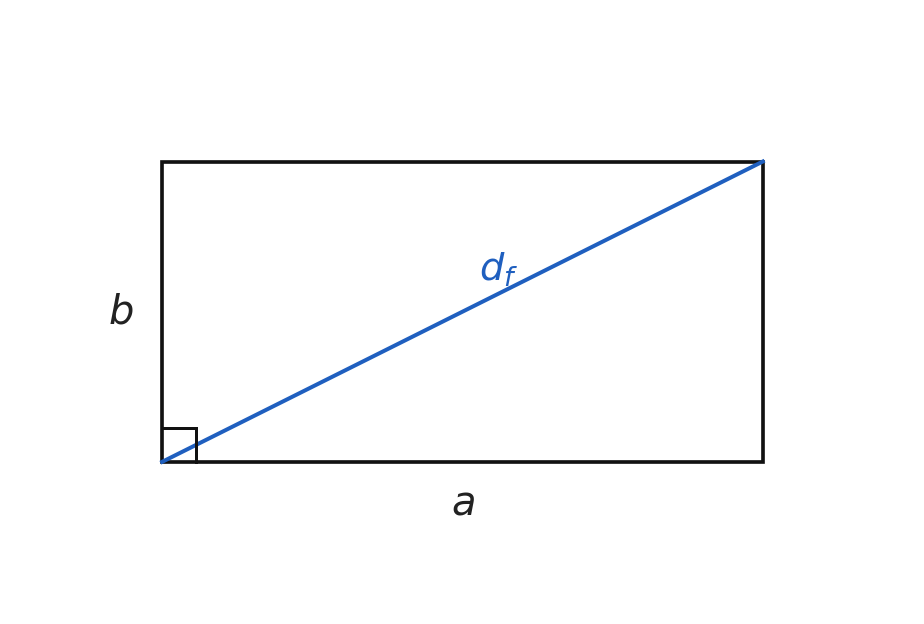
This is the same flat-rectangle setup we used in Lesson 4 when we found screen diagonals and walking shortcuts. The only thing that changes is the context — instead of a standalone rectangle, the rectangle is now one face of a three-dimensional box. The calculation itself is identical.
The Step-by-Step Procedure
Suppose a rectangular face has edge lengths and . The face diagonal is the hypotenuse of a right triangle with legs and , so by the Pythagorean theorem:
The process breaks into three quick steps:
- Square each edge length.
- Add the two squares.
- Take the square root of the sum.
Let's try this with a bottom face measuring by . We square each edge: and . We add: . We take the square root: . The face diagonal is 15 units long.
If you recognize as the 3-4-5 Pythagorean triple scaled by , that is a great shortcut straight from Lesson 2!
When the Answer Is Not a Whole Number
