Using Clothing Size Charts
Introduction
Welcome back to Reading Everyday Measurements! In our first two lessons, we built a strong foundation: we learned how to spot the value, unit, and attribute in any measurement, and then we used those skills to navigate Nutrition Facts labels and scale nutrient amounts to what we actually eat. Now, in this third lesson — the midpoint of our five-lesson course — we are stepping away from the pantry and into the fitting room. Here, we will learn how to read clothing and shoe size charts, choose the right size when a measurement falls between two listed options, and use conversion charts to translate sizes across the US, EU, and UK systems.
Why Sizes Need a Chart
On a nutrition label, grams and milligrams mean the same thing no matter which brand we pick up. Clothing sizes work very differently. A Medium at one store might fit like a Large at another, and a US size 10 shoe carries a completely different number in Europe. There is no universal standard that forces all brands to assign the same label to the same body dimensions.
This is exactly why retailers provide size charts — tables that connect our real body measurements (in inches or centimeters) to the labeled size for that specific brand or product. The good news is that reading a size chart relies on the same core skill we have been practicing since lesson one: find a number, note its unit, and understand what is being measured. The only new step is matching our measurement to a range in a table rather than reading a single fixed value off a label.
Reading a Single-System Size Chart
A size chart is organized as a table where each row represents a labeled size and each column shows a body measurement. Here is a simplified chart for women's tops:
| Size | Bust (in) | Waist (in) |
|---|---|---|
| S | 34 – 35 | 26 – 27 |
| M | 36 – 37 | 28 – 29 |
| L | 38 – 40 | 30 – 32 |
| XL | 41 – 43 | 33 – 35 |
To find the right size, we take our actual body measurements and scan the table for the row where our numbers fit. Suppose our bust measures inches and our waist measures inches. Both values land in the M row, so Medium is our size.
But what happens if two measurements point to different rows? For example, a bust of inches fits M, while a waist of inches fits L. When measurements suggest different sizes, the standard advice is to choose the larger size for a comfortable fit — in this case, L.
Some charts also note which measurement to prioritize for a given garment (bust for fitted tops, waist for skirts), so it is always worth reading any guidance printed near the chart.
Handling Between-Size Cases
Sometimes a measurement does not land neatly inside any row at all. Consider this men's dress shirt chart:
| Size | Neck (in) | Sleeve (in) |
|---|---|---|
| S | 14 – 14.5 | 32 – 33 |
| M | 15 – 15.5 | 33 – 34 |
| L | 16 – 16.5 | 34 – 35 |
| XL | 17 – 17.5 | 35 – 36 |
Suppose our neck measures inches. That value falls between the M range (up to ) and the L range (starting at ):
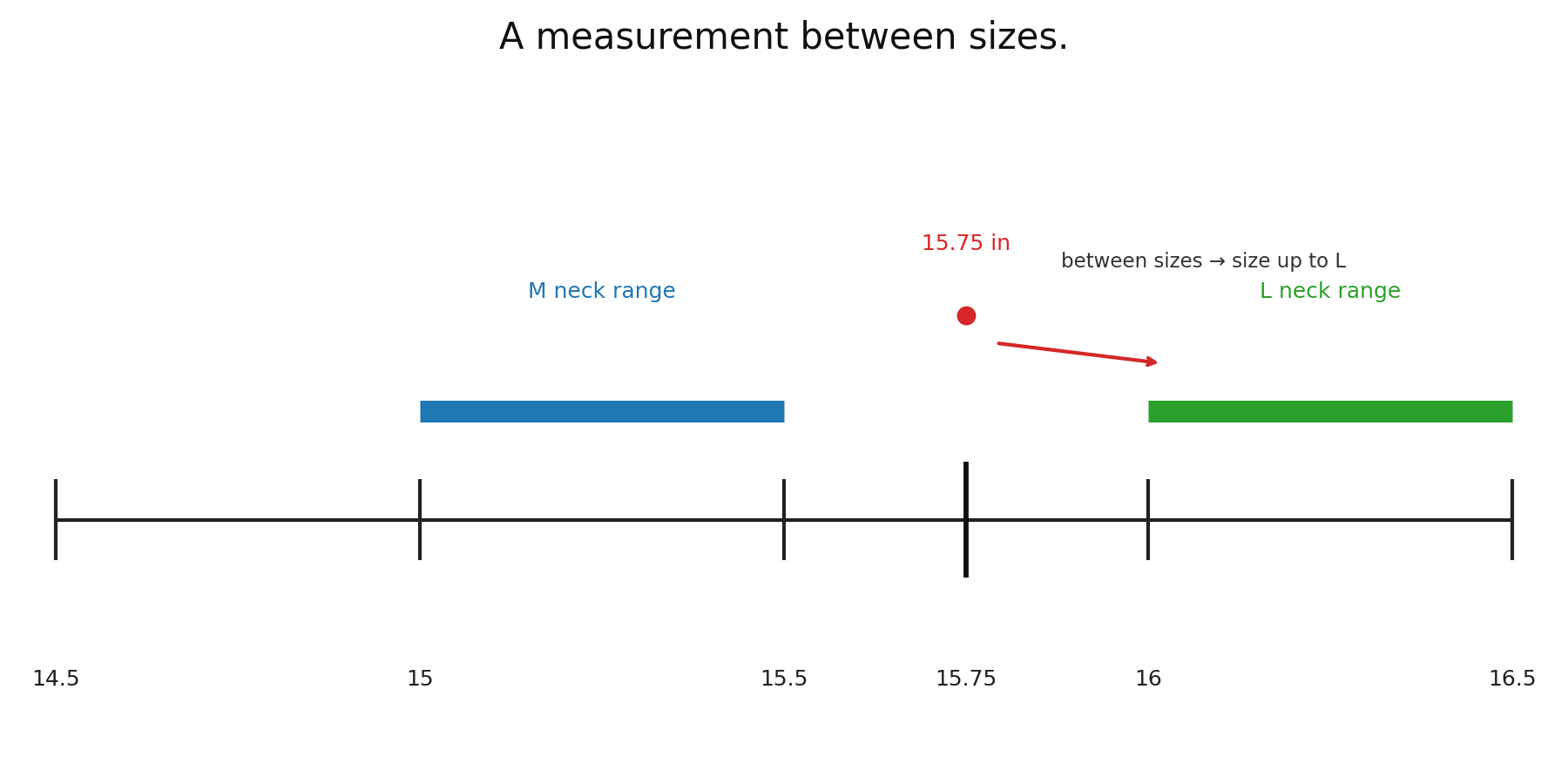
The measurement sits above M's upper limit but below L's lower limit — it is in the gap.
Why are there gaps between the ranges? Gaps often exist because brands design clothes for specific "standard" body types rather than every possible measurement. Since fabric doesn't always stretch, these gaps represent the space between the maximum limit of one size and the minimum of the next.
The widely recommended rule here is to size up, choosing the next larger size. In this case, that means L. A slightly roomy shirt collar is far more comfortable than one that is too tight. Choosing the larger size ensures the garment isn't too restrictive.
This "size up when in doubt" guideline applies across most clothing and shoes. If a child's foot measures cm and the shoe chart jumps from cm (size 11) to cm (size 12), picking size 12 gives a little extra room — usually the safer and more comfortable choice.
Converting Sizes Between Systems
When shopping from international retailers, we often need to translate a size we already know into a different numbering system. This is where conversion charts come in. Below is a typical men's shoe conversion chart:
| US | EU | UK |
|---|---|---|
| 7 | 40 | 6 |
| 8 | 41 | 7 |
| 9 | 42 | 8 |
| 10 | 43 | 9 |
| 11 | 44 | 10 |
| 12 | 45 | 11 |
The reading process is the same table-lookup skill we have been building: find our known size in one column and read straight across to the target system. If we wear a US size , we locate in the US column and read across to find EU 43 and UK 9.
The same approach works for clothing. A women's dress conversion chart might show that a US size 6 corresponds to EU 36 and UK 10. There is no special formula to memorize — we simply locate our size in one column and read the equivalent in the other. The key is to make sure the chart matches both the garment type (shoes, tops, pants) and the gender category, since each combination uses its own set of numbers. A men's shoe chart and a women's shoe chart will give very different EU equivalents for the same US number.
Common Mistakes to Avoid
A few pitfalls come up often when working with size charts. Keeping them in mind will save time and prevent frustrating returns:
- Skipping the measurement step. Thinking "I'm always a Medium" can backfire because sizing varies between brands. Starting from actual body measurements is always more reliable than relying on memory.
- Using the wrong chart. Men's, women's, and children's charts use completely different scales. A size 8 in men's shoes is not the same as a size 8 in women's shoes — always confirm the chart matches the product.
- Mixing up sizing systems. Ordering EU when we meant US (or the other way around) leads to a very wrong fit. Before placing an order, double-check which system the retailer displays.
- Choosing the smaller size when between rows. When a measurement falls in the gap between two sizes, picking the smaller option often results in an uncomfortable or unwearable item. When in doubt, size up.
Conclusion and Next Steps
In this lesson, we learned how to read clothing and shoe size charts by matching body measurements to the correct table row, how to handle the common case where a measurement lands between two listed sizes by sizing up, and how to use conversion charts to translate sizes across the US, EU, and UK systems. These skills turn what often feels like guesswork into a simple, structured table lookup.
In the exercises ahead, you will look up sizes on real charts for different garment types, decide what to do when measurements fall between rows, and convert sizes for an international shopping scenario. Let's find the perfect fit!