Reading Nutrition Labels
Introduction
Welcome back to Reading Everyday Measurements! In our first lesson, we learned how to break any measurement into three parts: the value, the unit, and the attribute. Now, in this second lesson, we are putting that skill to work on one of the most common measurement displays you will ever encounter: the Nutrition Facts label found on packaged food in the United States. By the end of this lesson, we will be able to find the key numbers on a nutrition label, understand what they describe, and calculate our actual intake when we eat more or less than a single serving.
Why Serving Size Is the Starting Point
Before we look at a full label, let's build some intuition around one idea that trips many people up: everything on a Nutrition Facts label describes one serving, not the entire package. The serving size is not a recommendation of how much to eat — it is simply a standard reference amount so that different products can be compared fairly.
This means a bag of chips labeled "230 calories" might contain three servings, giving us calories for the whole bag. If we ignore serving size, we might believe we are eating 230 calories when we are really consuming nearly 700. That single detail — the serving size — shapes every other number on the label.
Anatomy of a Nutrition Facts Label
A standard US Nutrition Facts label reads from top to bottom in a predictable order. Knowing this layout lets us find what we need quickly, no matter which product we pick up.
| Section | What It Tells Us |
|---|---|
| Servings per container | How many servings are in the whole package |
| Serving size | The amount that counts as one serving (e.g., 1 cup, 3 cookies) |
| Calories | Energy per serving |
| Nutrients | Amounts of fat, sodium, carbohydrates, protein, vitamins, and minerals per serving |
| % Daily Value | How much one serving contributes toward a 2,000-calorie daily diet |
The serving size appears as a familiar household measure (such as cups, tablespoons, or pieces) followed by the metric equivalent in grams. As you may recall from our first lesson, recognizing the unit next to a number is the first step in reading any measurement. That same skill applies here: when a label says "Serving size 2/3 cup (55 g)," the value is , the unit is cup, and the parenthetical is the metric equivalent.
Below the calories, the label lists mandatory nutrients — including total fat, cholesterol, sodium, total carbohydrates (with fiber and sugars broken out), and protein — along with a handful of vitamins and minerals. Here is a simplified example showing where those parts appear on a standard label:
![[Annotated Nutrition Facts label showing where serving size, servings per container, calories, nutrients, and % Daily Value appear]](https://k3-production-bucket.s3.us-east-1.amazonaws.com/uploads/xmpLj269sQ5GNGNW2_image.png)
Reading the Key Numbers
Now that we know the layout, let's walk through a sample label for a box of cereal. Our goal is to locate the four pieces of information we care about most:
- Servings per container: 8
- Serving size: 1 cup (39 g)
- Calories: 150
- Selected nutrients (per serving): Total Fat 2 g · Sodium 230 mg · Total Sugars 12 g · Protein 3 g
Every one of these values applies to exactly one serving of 1 cup. If we pour a bigger bowl, we need to adjust every number accordingly. Notice that the nutrients use units we already know: grams (g) for macronutrients like fat and protein, and milligrams (mg) for items like sodium.
Scaling Per-Serving Values to Actual Intake
Here is the core math skill of this lesson. When we eat more or less than one serving, we multiply each label value by the number of servings we actually consumed:
The "number of servings consumed" does not have to be a whole number. It can be (half a serving), , or even when we eat an entire multi-serving package. Let's try several cases using our cereal example (150 calories and 12 g of sugar per serving).
Case 1 — Eating 2 servings (2 cups)
Case 2 — Eating half a serving (½ cup)
Case 3 — Eating the whole box (8 servings)
The pattern is always the same: multiply. The only thing that changes is the factor.
Handling Non-Integer Servings
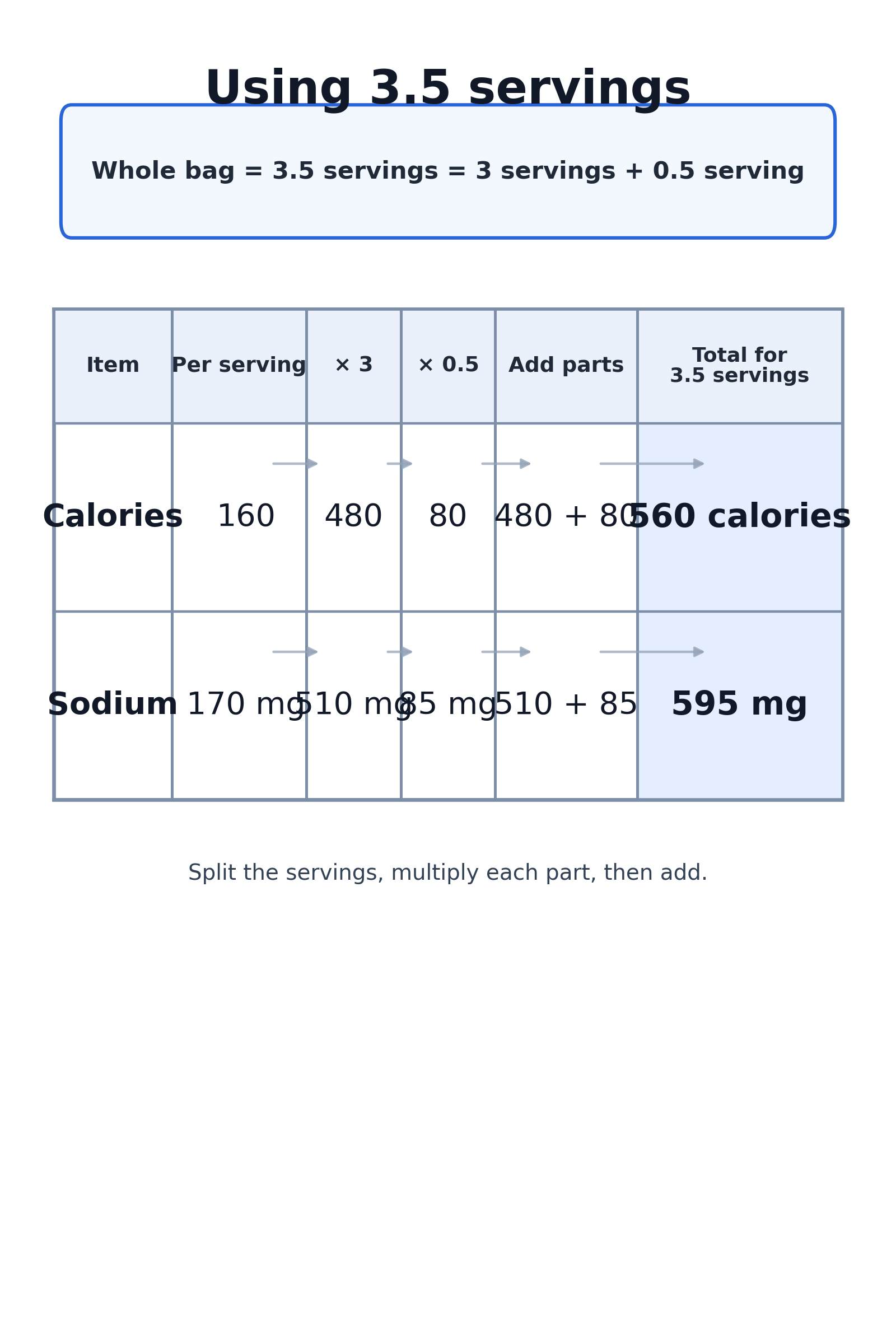
Packages do not always contain a tidy whole number of servings. A bag of chips, for instance, might list 3.5 servings per container. Some newer labels include a second column showing per-package totals, but many products still show only the per-serving column — so we need to be comfortable multiplying by numbers like or .
Imagine that bag of chips has these per-serving values:
- Calories per serving: 160
- Sodium per serving: 170 mg
If we eat the entire bag, our factor is :
A helpful way to handle a number like is to split it into . Multiply by first, then by , and add the results:
This split-and-add trick works for any non-integer factor like , , or , making mental math much easier.
Common Mistakes to Avoid
Even with a straightforward formula, a few pitfalls come up regularly when reading nutrition labels:
- Ignoring servings per container. A small bottle of juice might look like a single drink but contain or servings. Always check this line before trusting the calorie count at a glance.
- Mixing up serving size and servings per container. The serving size tells us how big one serving is; the servings per container tells us how many servings fit in the package. Confusing the two leads to wrong calculations.
- Forgetting to scale every nutrient. If we multiply calories by our factor, we must also multiply fat, sugar, sodium, and every other nutrient by the same factor.
Conclusion and Next Steps
In this lesson, we learned how to navigate a US Nutrition Facts label from top to bottom: find the serving size and servings per container first, then read the calories and nutrient amounts that go with one serving. The key calculation is straightforward — multiply each per-serving value by the number of servings we actually eat, whether that number is whole, fractional, or somewhere in between.
Now it is time to put these skills into action. In the practice section ahead, you will orient yourself on real labels, extract values from different products, calculate totals for various portion sizes, and explain the scaling process in your own words. Let's dive in!