Identifying Measurement Parts
Introduction
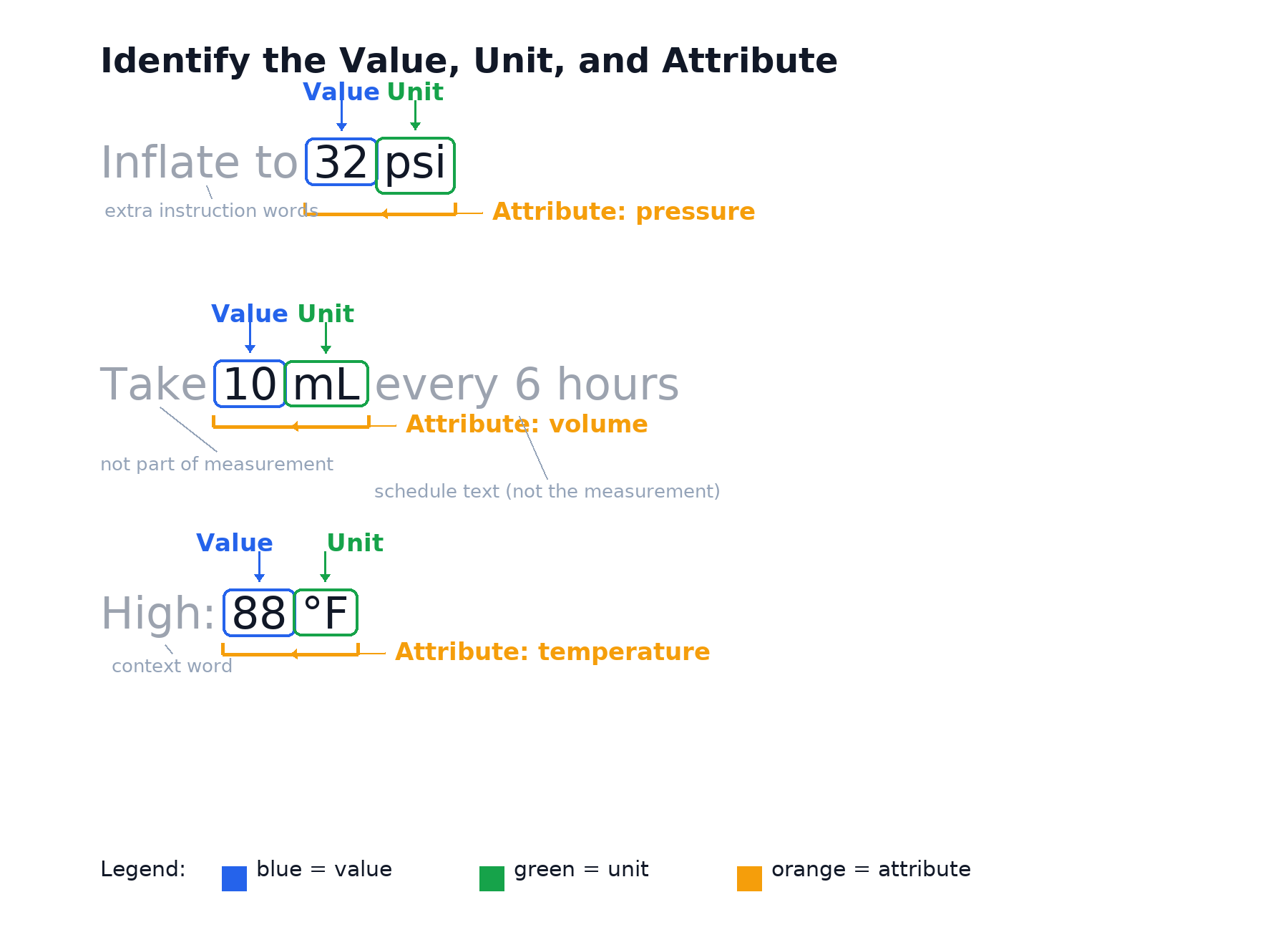
Welcome to Reading Everyday Measurements, the first course in your learning path! Since this is our very first lesson together, we are starting right at the beginning with one of the most useful everyday skills: pulling apart a measurement statement into its basic pieces. Whether we are checking a food label, reading a tire sidewall, or glancing at a thermostat, we encounter measurements constantly. By the end of this lesson, we will be able to look at any common measurement and confidently name three things: the numeric value, the unit, and the attribute being measured.
Measurements Are All Around Us
Before we get technical, let's take a moment to notice something. In a single morning, we might see "72 °F" on a weather app, "64 fl oz" on a juice carton, and "500 mg" on a vitamin bottle. Each of these little snippets tells us something specific about the world — how hot the air is, how much juice is in the container, or how much active ingredient is in a tablet.
Our goal in this lesson is to learn how to decode these snippets quickly and accurately, without worrying about converting anything. Once we can reliably pull apart a measurement into its pieces, every later topic in this course — from nutrition labels to tire pressure — will feel much more approachable.
The Three Parts of a Measurement
Common Units and Their Attributes
Now that we know the three parts, the next step is learning which units belong to which attributes. The table below lists units we will see throughout this course and beyond.
| Attribute | Common Units | Where We See Them |
|---|---|---|
| Weight | oz, lb, g, kg, mg | Food labels, shipping boxes |
| Volume | mL, L, fl oz, cups, gal | Beverages, medicine syringes |
| Length | in, ft, cm, m | Furniture tags, height charts |
| Pressure | psi, kPa, bar | Tire sidewalls, blood pressure |
| Temperature | °F, °C | Thermostats, weather apps |
| Dosage | mg, mL, mcg | Pill bottles, prescription labels |
Notice that some units, like mg and mL, appear under more than one attribute. Context helps us decide: "500 mg" on a vitamin bottle refers to dosage, while "500 g" on a bag of rice refers to weight.
It is important to note that Dosage is a special category. While we treat it as an attribute for practical reading, it is technically a measurement of weight (like mg) or volume (like mL) used in a medical context. Whenever a unit could fit more than one category, look at the source — a medicine label, a food package, a weather screen — and let that guide you.
Reading Measurements in Everyday Contexts
Handling Tricky Formatting
Isolating a Measurement from Surrounding Text
Conclusion and Next Steps
In this lesson, we learned that every everyday measurement breaks down into three parts: a value (the number), a unit (the scale), and an attribute (the property being measured). We also practiced spotting these pieces in real labels, instructions, and readouts, even when extra words or unusual formatting get in the way.
Up next, you will put this skill to work in a set of hands-on practice tasks. You will identify units in quick-fire quizzes, match units to their attributes, extract values from realistic label text, and write your own breakdowns of measurements from grocery receipts, medicine bottles, and weather apps — so get ready to flex your new measurement-reading muscles!