Reading Points on Axes
Introduction
A map pin placed directly on a main street has no offset across that street. That clue is the focus of the second lesson in Reading and Plotting Points: a point on an axis has a zero coordinate, and the origin has two. Building on your first lesson’s work with scales and ordered pairs, you’ll identify the zero slot, then read the point’s position along the axis.
An Axis Reveals Which Coordinate Is Zero
An ordered pair gives horizontal position first and vertical position second. A point on the horizontal -axis is not above or below it, so ; a point on the vertical -axis is not left or right of it, so . At their intersection—the origin—both coordinates are zero. At any other point on an axis, the nonzero coordinate gives the position along that axis and may be positive or negative, expressed as an integer, fraction, or decimal.
| Point lies on | Coordinate that equals zero | Ordered-pair pattern |
|---|---|---|
| -axis | ||
| -axis | ||
| Origin | and |
Read a Point on the x-Axis
First, confirm that the point lies on the horizontal -axis. Read its left-right position using the labeled scale, then put in the second slot. If a shop is three one-unit blocks west of a map’s central intersection, then , , and its ordered pair is .
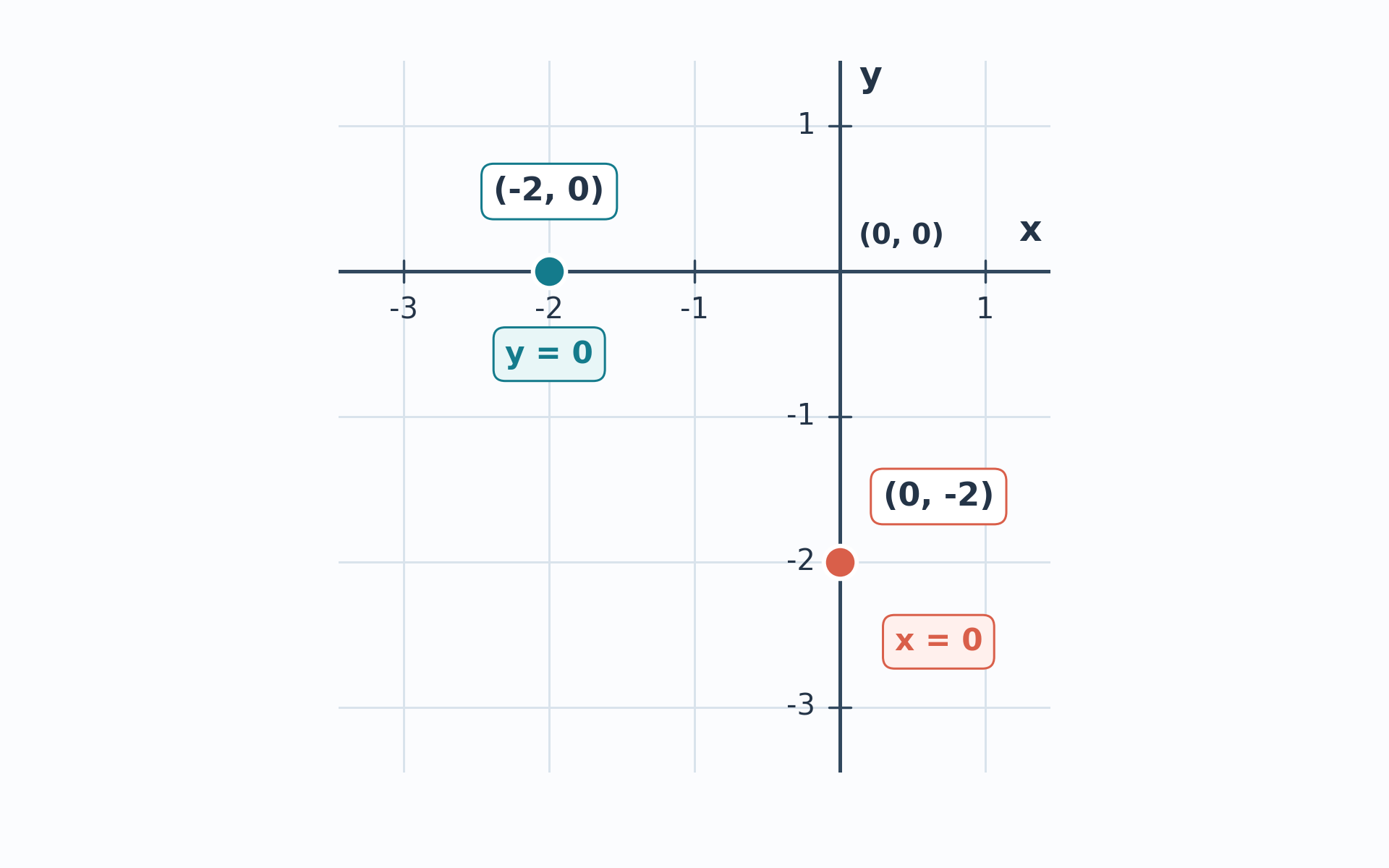
Keep zero in the second slot because comes first and comes second. The diagram contrasts , left of the origin, with , below it: the same nonzero value appears in different slots and marks a different location.
Read a Point on the y-Axis
On the vertical -axis, a point has no left-or-right displacement, so . Read its up-or-down position for : two units below the origin means , giving . The zero stays in the first slot, even when the point is below the origin.
Read Half-Unit Points on an Axis
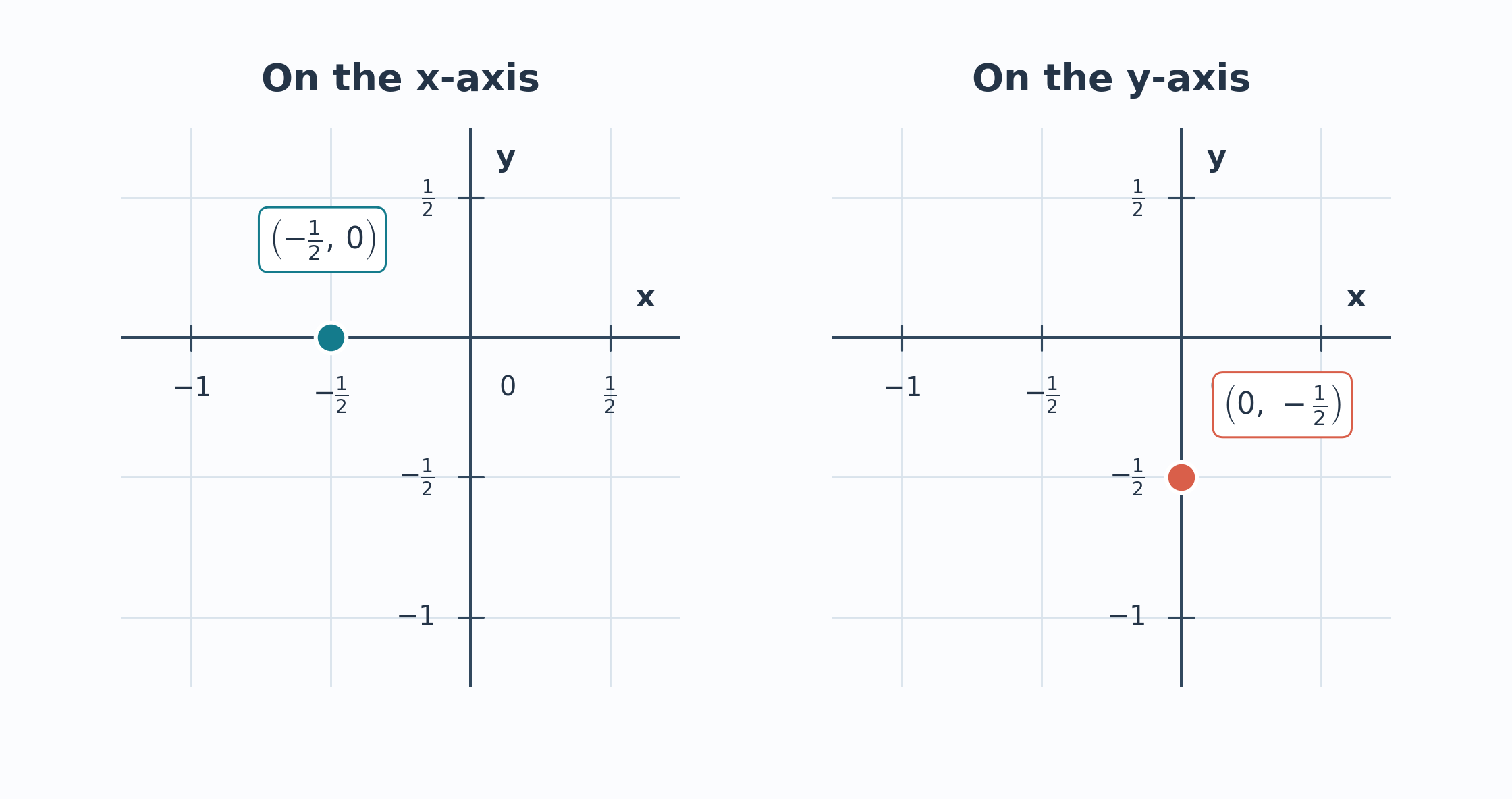
Use the labeled intervals, as in the previous lesson. If the interval from to is split into two equal spaces, its halfway mark is , or . Moving left along the -axis or down along the -axis makes the value negative.
On the -axis, halfway from to gives the pair . On the -axis, the same halfway distance below the origin gives .
The Origin and a Floor Plan
On a floor plan, let the crossing halls mark the axes and their intersection be the origin, . Before reading a doorway along the center hall, check its direction: a horizontal hall has , while a vertical hall has . For example, a doorway units above the origin on a vertical hall has and , so its pair is .
Conclusion and Next Steps
A point on the -axis has the form ; one on the -axis has the form ; the origin is . Read the position along the axis from its scale, keep its sign, and place zero in the correct slot.
In the practice that follows, you’ll identify the zero coordinate on a street map, complete axis pairs, and read a negative half-unit point. You’ll then locate the origin and read a doorway’s position on a floor-plan hall.
