Reading and Plotting Points
Introduction
Welcome to Reading and Plotting Points. This is the first lesson in the course, and you’ll practice turning plotted dots into exact ordered pairs, including points that fall between whole-number marks. Think of a coordinate grid as a map: before naming a location, you need to know what its scale measures.
A Point Is a Two-Part Address
A plotted point acts like a location on a map. Its ordered pair gives the horizontal position first and the vertical position second, as you learned in The Coordinate Plane. On a warehouse layout, for example, the two values could locate a bin across and along the aisles; swapping them would point to a different location. To read either value exactly, begin by checking the scale on its axis.
Read the Scale Before the Point
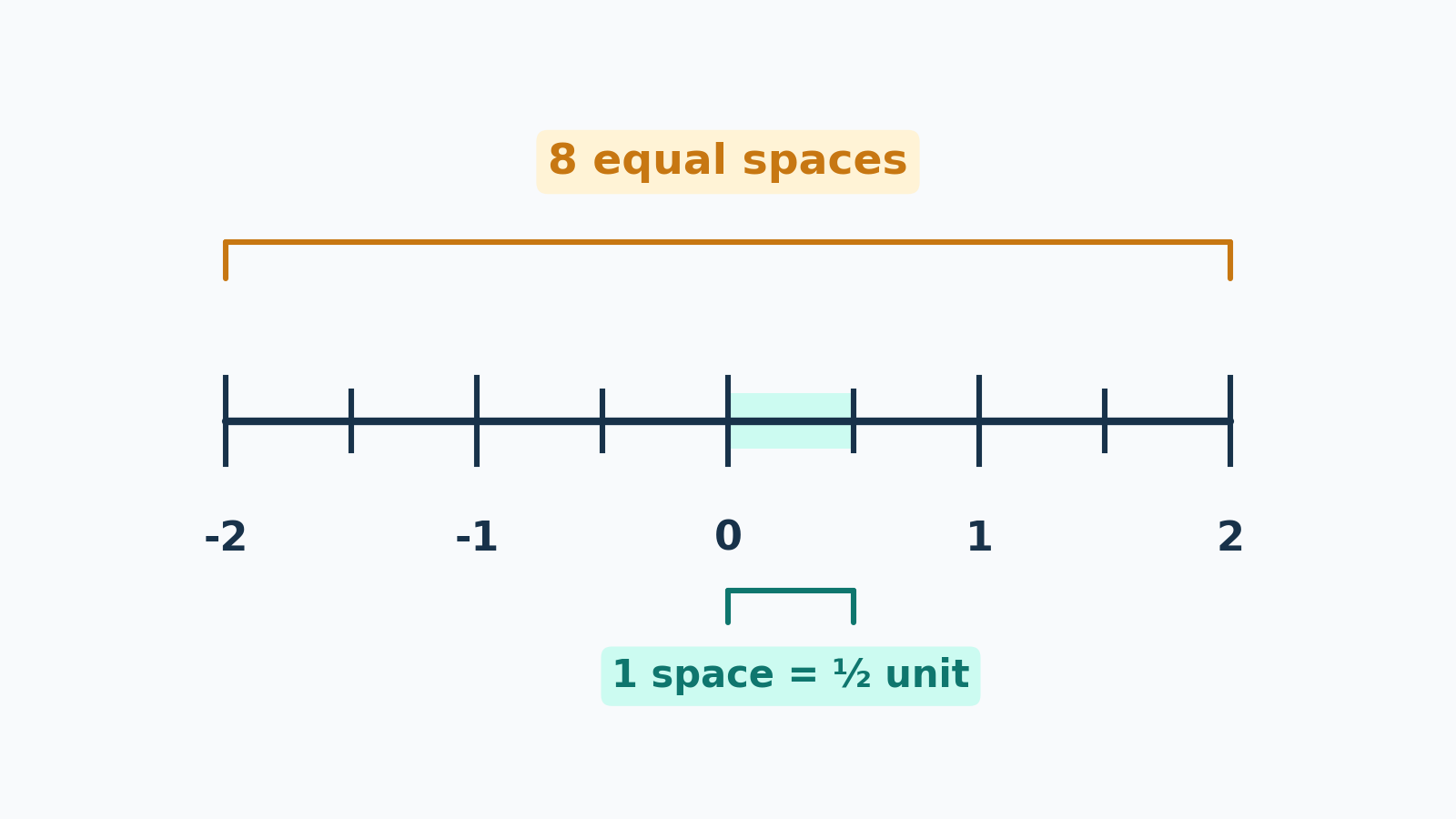
Before assigning numbers to a plotted point, find two labeled tick marks on an axis. If they mark and , where , and there are equal spaces between them, each space represents:
For example, if and are separated by eight equal spaces, each space represents:
Count the spaces between labeled tick marks, not the marks themselves, and check the - and -axes separately because their scales may differ.
Read x First, Then y
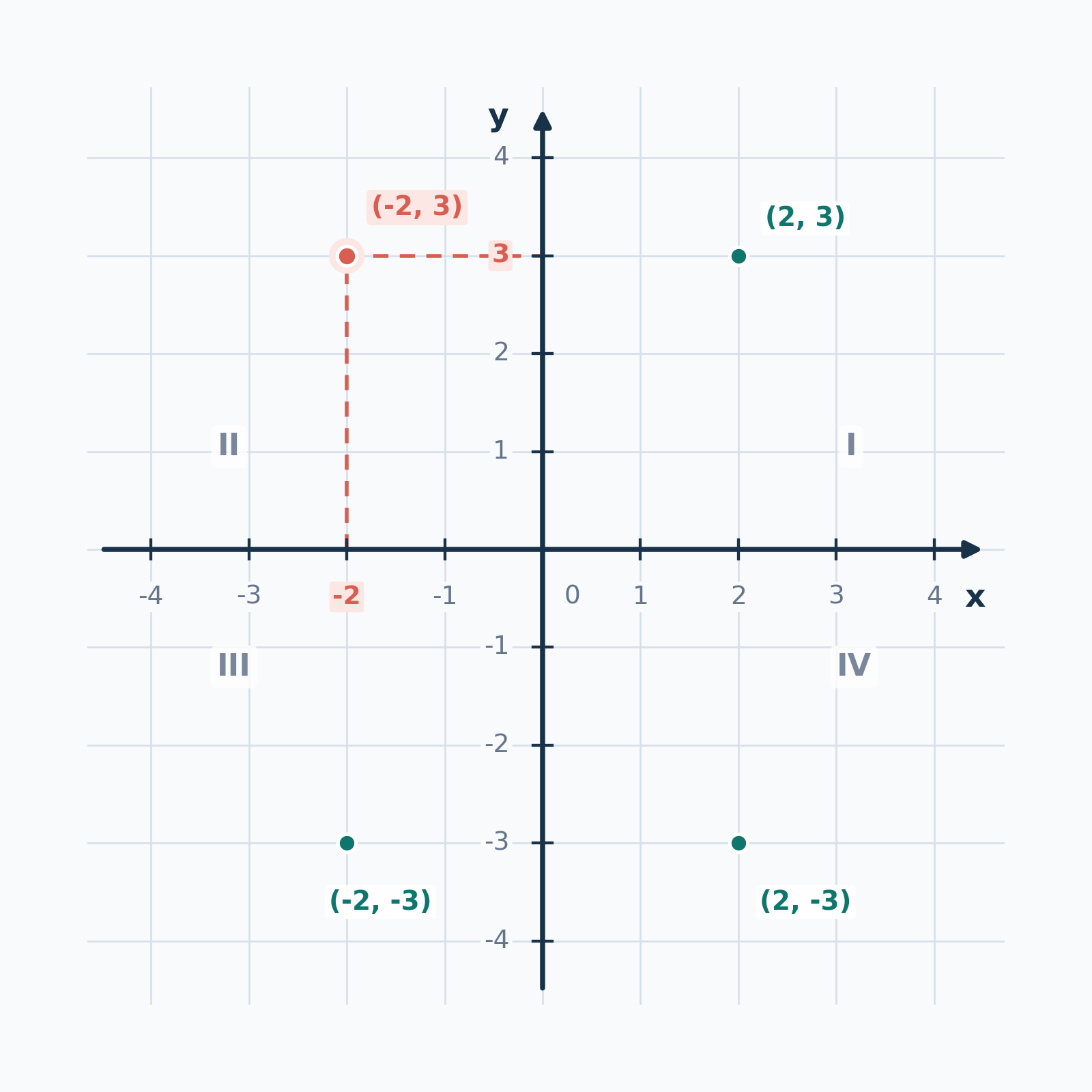
Once you know the scale, trace guide lines from the point. A vertical guide reaches the -axis to show , and a horizontal guide reaches the -axis to show . Record the values in that order: .
Use the quadrant to check the signs:
| Quadrant | sign | sign | Example |
|---|---|---|---|
| I | Positive | Positive | |
| II | Negative | Positive | |
| III | Negative | Negative | |
| IV | Positive | Negative |
The quadrant gives a sign check, not the exact values; read those from the axis labels and spaces.
Read Half- and Quarter-Unit Positions
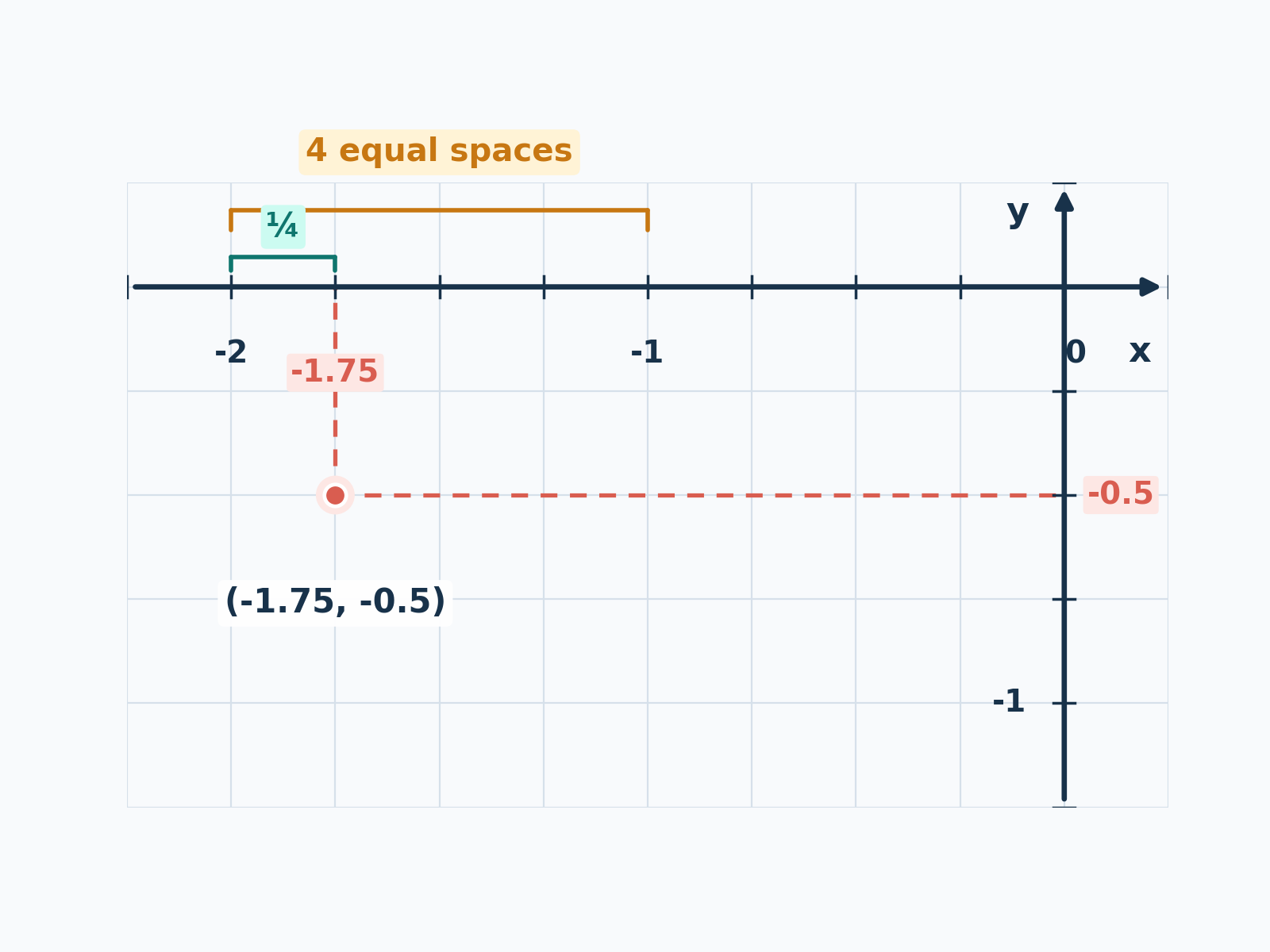
Now that you know how to count each space, use the same method when a unit is subdivided. On a warehouse map, if a bin’s -coordinate is halfway between and , its coordinate is , or . Since values increase as you move right, falls between and .
For a quarter-unit example, imagine a café one small space to the right of on an interval from to divided into four equal spaces. Each space is unit, so . If the café is also halfway between and vertically, then , and its ordered pair is , or , in Quadrant III.
Check the Pair Before You Finish
Before recording a coordinate, check three things:
- Order: The first value comes from the -axis; the second comes from the -axis.
- Signs: The signs match the point’s quadrant.
- Scale: You counted spaces between labeled tick marks and used the scale on each axis.
These checks help catch common errors, such as counting tick marks instead of spaces or reading the -value first.
Conclusion and Next Steps
By using the axis labels to find each space’s value, then reading before , you can name a point exactly in any quadrant. The quadrant checks the signs, while counting subdivisions gives whole-number, half-unit, or quarter-unit values in fraction or decimal form.
Next, you’ll practice reading points with whole-number and negative coordinates, then use half-unit warehouse and quarter-unit café grids. For each point, enter the ordered pair in the form requested and use its quadrant as a final sign check.
