Plotting Points in Quadrants
Introduction
On a machine diagram, a sensor may sit left or right of a reference point and above or below it; both offsets are needed to locate it. In this third lesson of Reading and Plotting Points, you’ll build on ordered pairs and points on the axes to plot points in all four quadrants.
Each Coordinate Has a Fixed Job
An ordered pair gives the horizontal position first and the vertical position second: controls left and right, while controls up and down. The order never changes, even if you move vertically first; the route is flexible, but the coordinate roles are fixed. Because both coordinates in this lesson are nonzero, each point lies inside a quadrant rather than on an axis or at the origin.
Use the Signs to Identify the Quadrant
Combine the signs of and to predict the direction and quadrant:
| Quadrant | Coordinate signs | Direction from the origin |
|---|---|---|
| I | Right and up | |
| II | Left and up | |
| III | Left and down | |
| IV | Right and down |
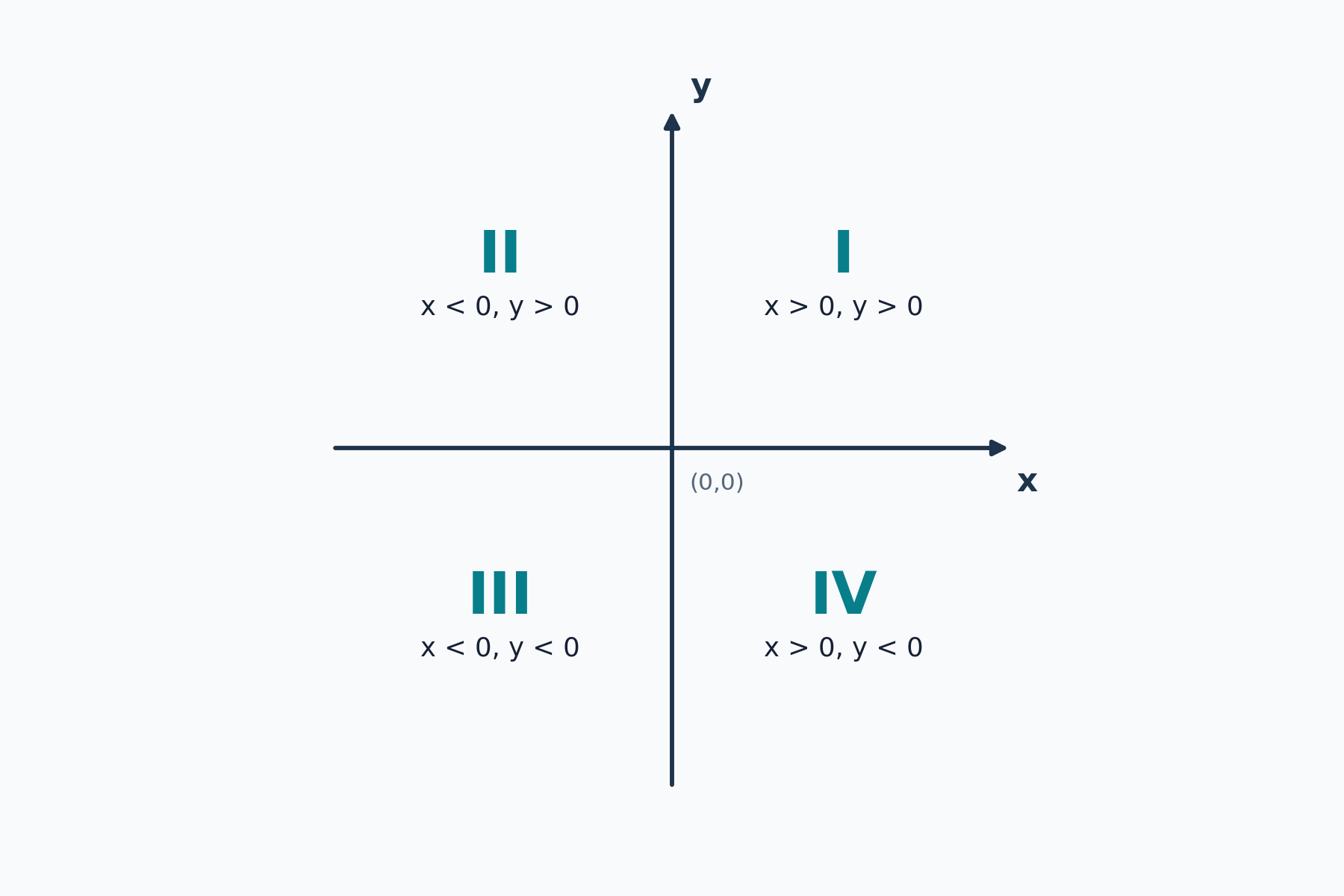
The signs select the quadrant; coordinate sizes and grid subdivisions determine the exact position within it.
Plot by Following the Coordinates
A horizontal-first path gives you a dependable scaffold:
- Start at the origin, .
- Follow horizontally: move right by the coordinate’s value if it is positive, or left by its absolute value if it is negative.
- From there, follow vertically: move up by the coordinate’s value if it is positive, or down by its absolute value if it is negative.
- Mark the endpoint; it represents .
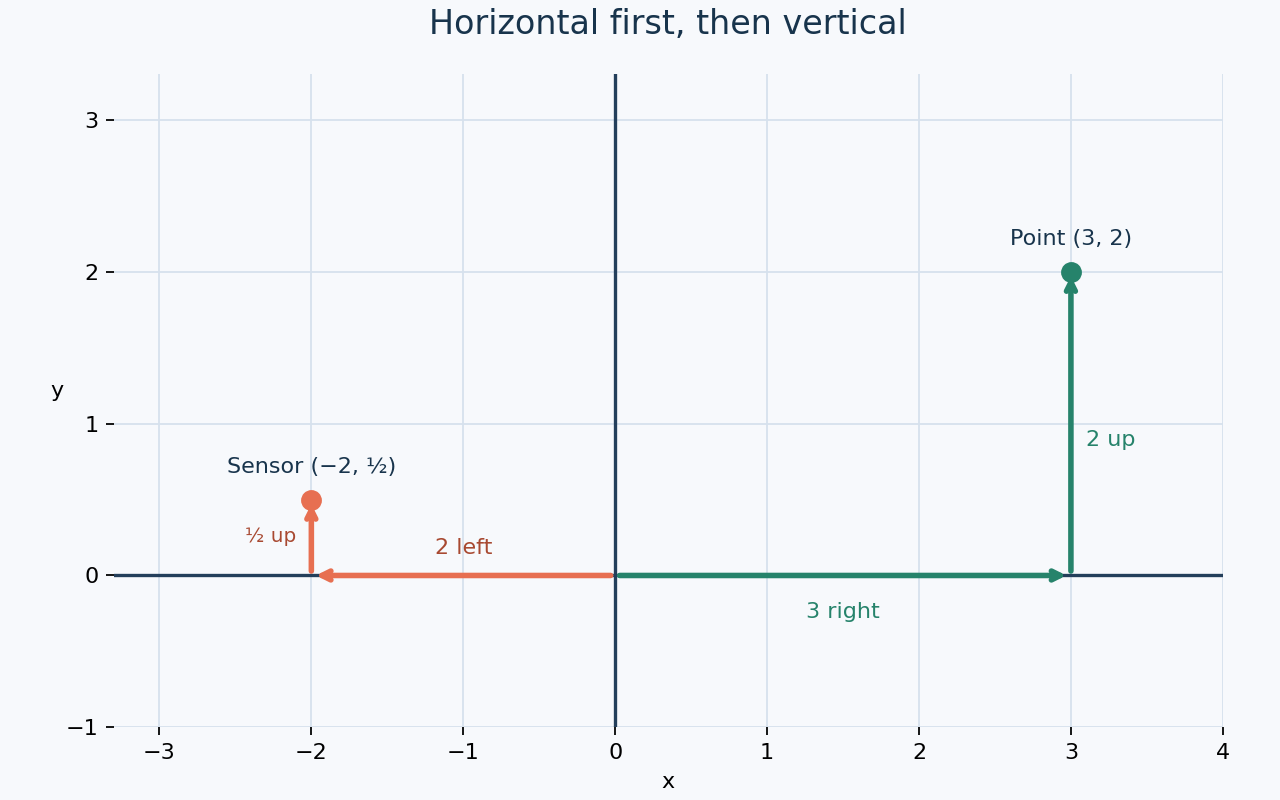
For a sensor at on a machine diagram, move units left, then half a unit up; the point is in Quadrant II. A point such as uses the same process— units right and up—placing it in Quadrant I. You may also move vertically first or place the sensor where the vertical line meets the horizontal line ; each method gives the same endpoint.
Use Subdivisions for Fractions and Decimals
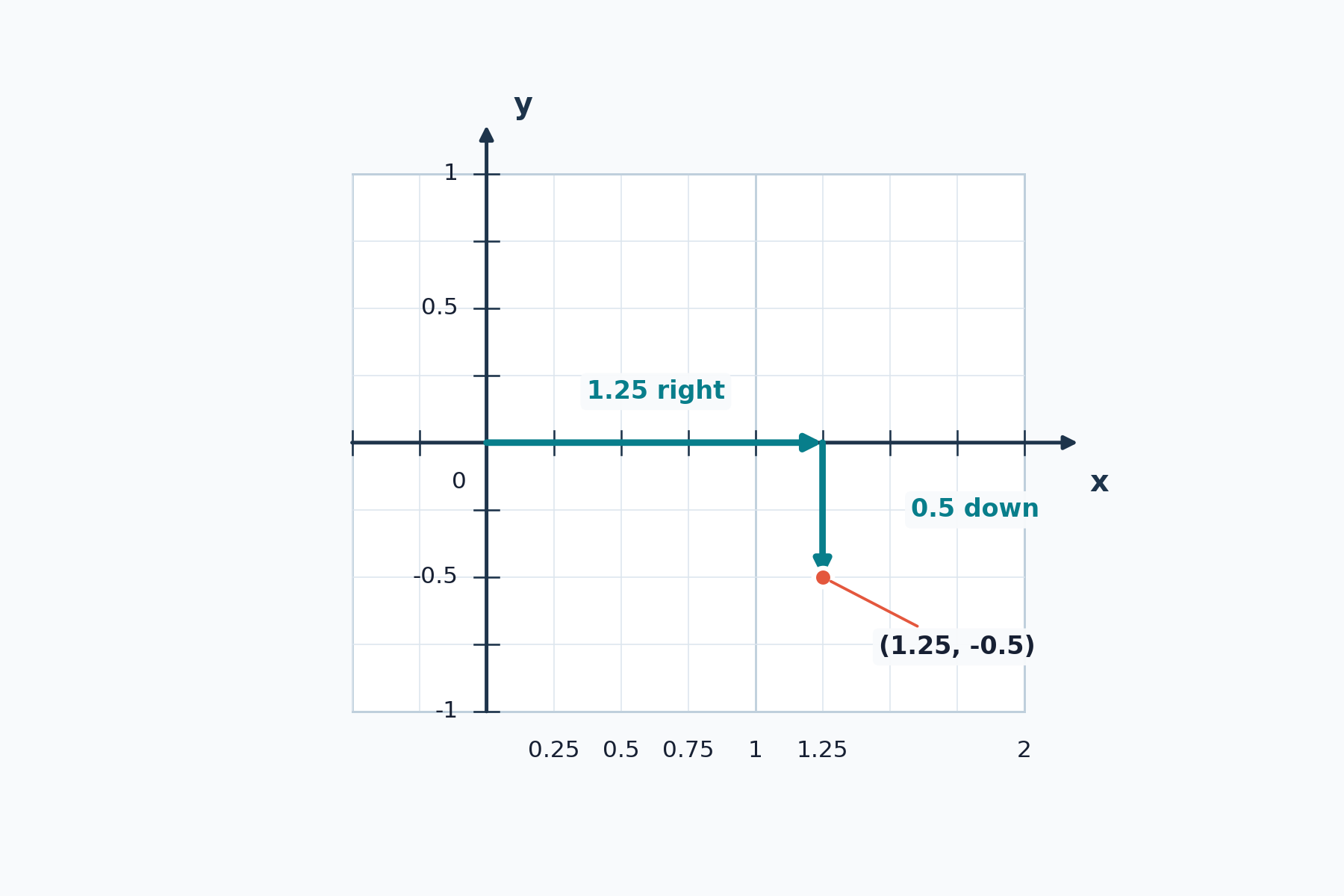
Use the labeled scale to measure each coordinate’s distance. If the interval from to is split into two equal spaces, the middle mark is ; if it is split into four, the marks between and are , , and , or , , and . Use the same spacing on negative sides, and check the labeled intervals rather than assuming every small gap represents a whole unit.
On a grid with four equal spaces per unit, plot . Since , move one and a quarter units right; since , move half a unit down, or two quarter-unit spaces. The point lies in Quadrant IV.
Check the Finished Point
Check the endpoint—not the path—to make sure the ordered pair has been plotted correctly:
- Does its left-right position match ?
- Does its up-down position match ?
- Do the signs put it in the expected quadrant, and do fractional values land on the correct subdivisions?
The plotted point is correct when both coordinates match; a different movement order is fine.
Conclusion and Next Steps
To plot a point away from the axes, use for horizontal position and for vertical position, follow the signs into the correct quadrant, and count subdivisions for exact placement. Your point is correct when both coordinates match, whether you moved horizontally first, vertically first, or placed it directly.
Next, you’ll identify what each coordinate controls, complete a half-unit plotting path, and plot whole-, half-, and quarter-unit points across all four quadrants. Compare each final position with its ordered pair as you work through the practice.
