Plotting Points on Axes
Introduction
Imagine placing a marker on a neighborhood map where a street follows one of the coordinate axes. The marker may be left or right of the origin with no vertical offset, or above or below it with no horizontal offset. This is the final lesson in Reading and Plotting Points: after plotting points with two nonzero coordinates in the quadrants, you’ll plot points on the axes and at the origin, including a signed half-unit position.
Let the Zero Identify the Axis
The pair uses for horizontal position and for vertical position. A zero means there is no movement from the origin in that coordinate’s direction, so it keeps the point on an axis. Use the nonzero coordinate to find the point’s position along that axis.
| Ordered pair | Location | How to plot |
|---|---|---|
| , where | -axis | Move units horizontally; do not move vertically. |
| , where | -axis | Move units vertically; do not move horizontally. |
| Origin | Mark the axes’ intersection. |
The sign tells you which direction to go: positive is right, negative is left, positive is up, and negative is down. A point with one zero coordinate lies on an axis, not inside a quadrant.
Plot a Point on the X-Axis
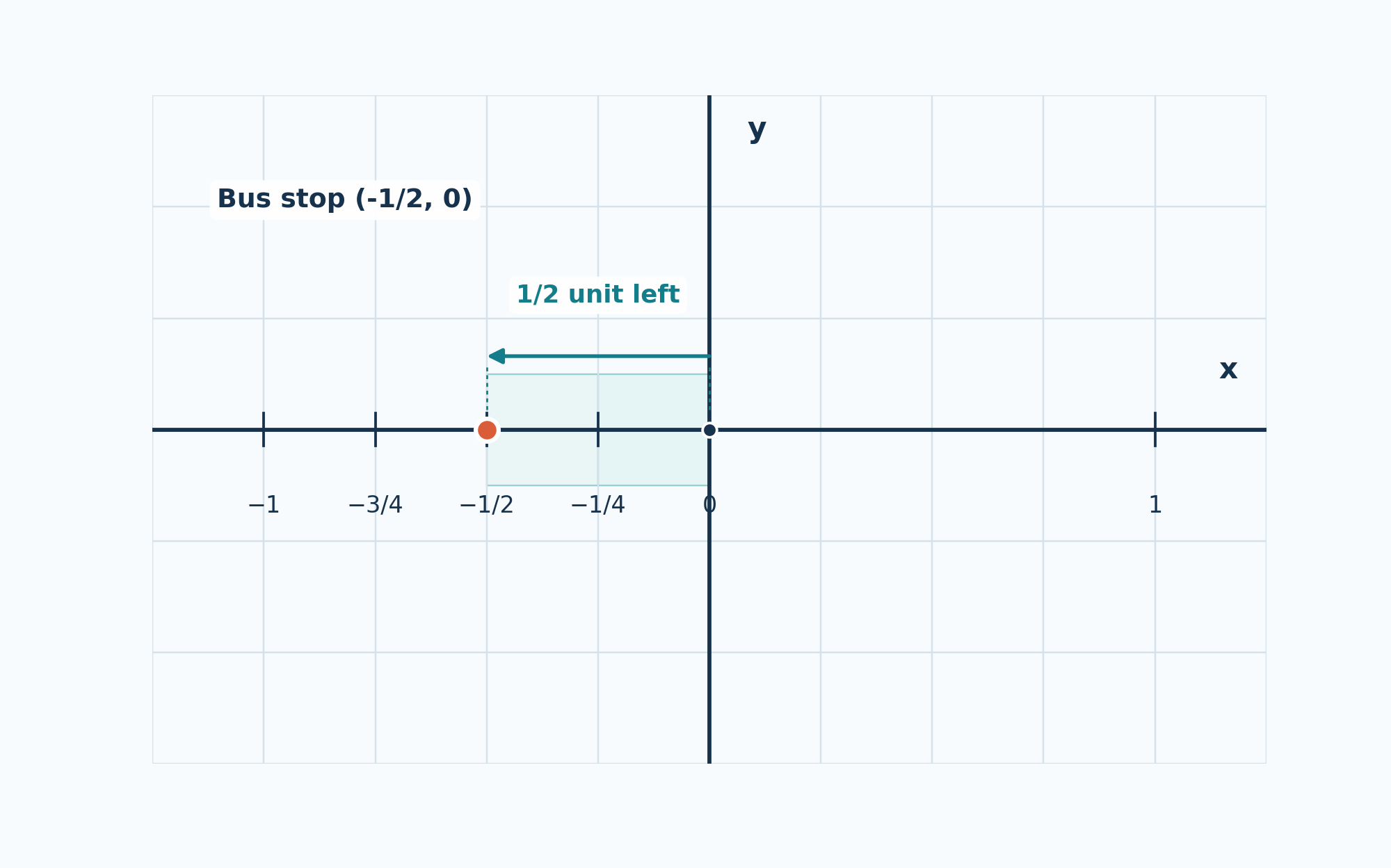
Suppose a bus stop is at on a neighborhood map. Move half a unit left from the origin; because , make no vertical move. The stop lies halfway between and on the horizontal axis. If each unit is split into four equal spaces, the half-unit mark is two spaces from the origin.
Plot a Point on the Y-Axis
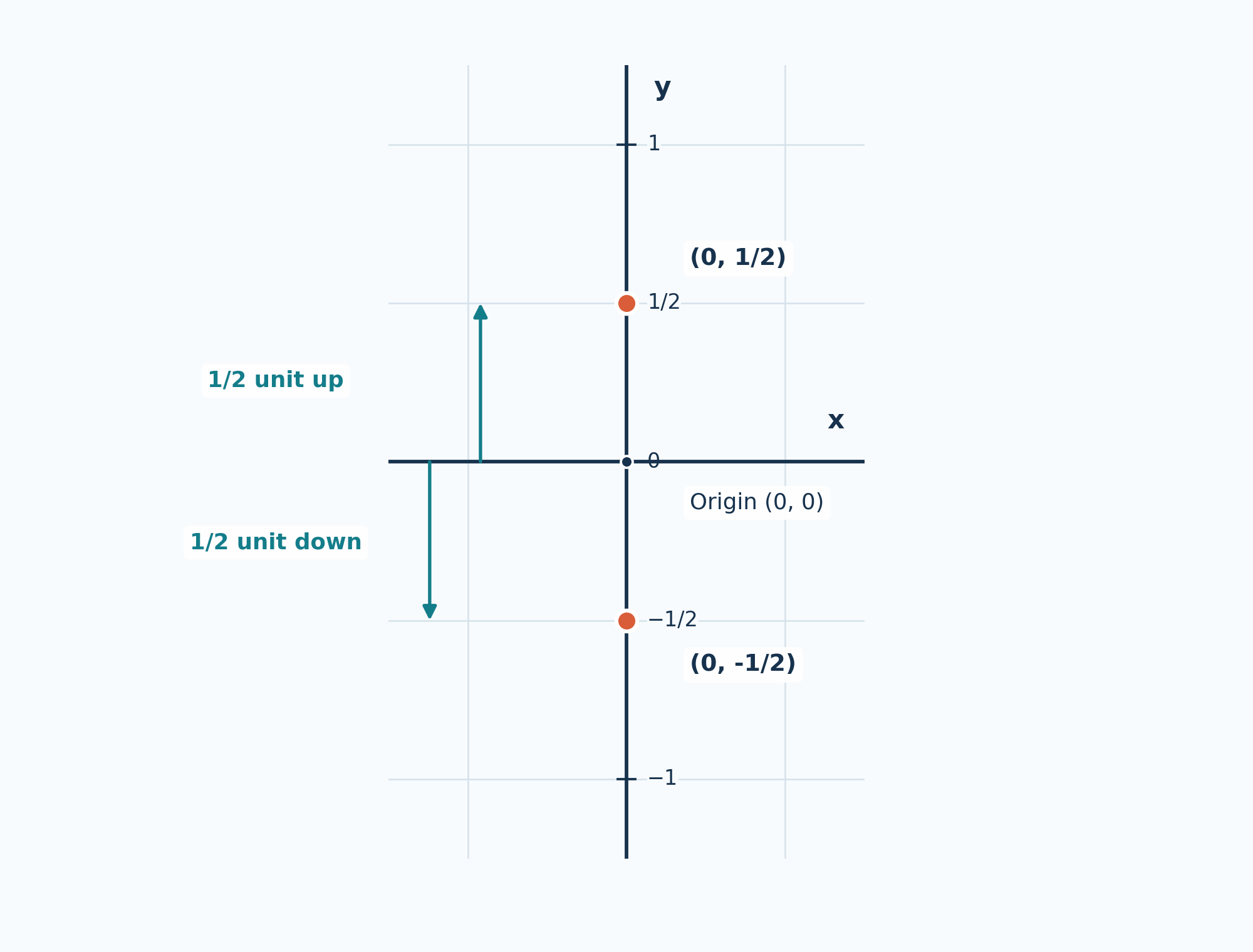
For a floor-plan marker at , means no horizontal move. Move half a unit up along the vertical axis and mark the point halfway between and . If the coordinate is instead, move the same distance down; the point remains on the -axis.
Plot the Origin
For , neither coordinate calls for movement. Mark the point exactly where the two axes intersect. Do not use a nearby tick mark: at the origin, both coordinates are exactly zero.
Check Your Placement
Before you finish, check the point itself:
- Does the zero coordinate keep the point on the correct axis: for the -axis or for the -axis?
- Does the other coordinate set the correct direction and distance, including any fractional subdivision?
- If both coordinates are zero, is the point at the axes’ intersection?
Conclusion and Next Steps
Use to place a point on the -axis, to place it on the -axis, and for the origin. Follow the remaining coordinate’s sign and size, using labeled subdivisions to place signed half-units accurately.
In the practice, you’ll identify the zero and name the matching axis before plotting. Then you’ll place a bus stop and floor-plan points—including the origin and a signed half-unit location—to check that each point lands in the right place.
