Personal To Professional Translation
From Personal Instinct to Professional Behavior
The last unit established that buyers feel before they reason. But that feeling never stays private. By the time it reaches you, it has passed through a job title, a mandate, and an organization watching over the buyer's shoulder. This unit traces how a personal emotion becomes a professional behavior, and how your messaging has to speak to both at once.
How Personal Emotional Patterns Adapt at Work
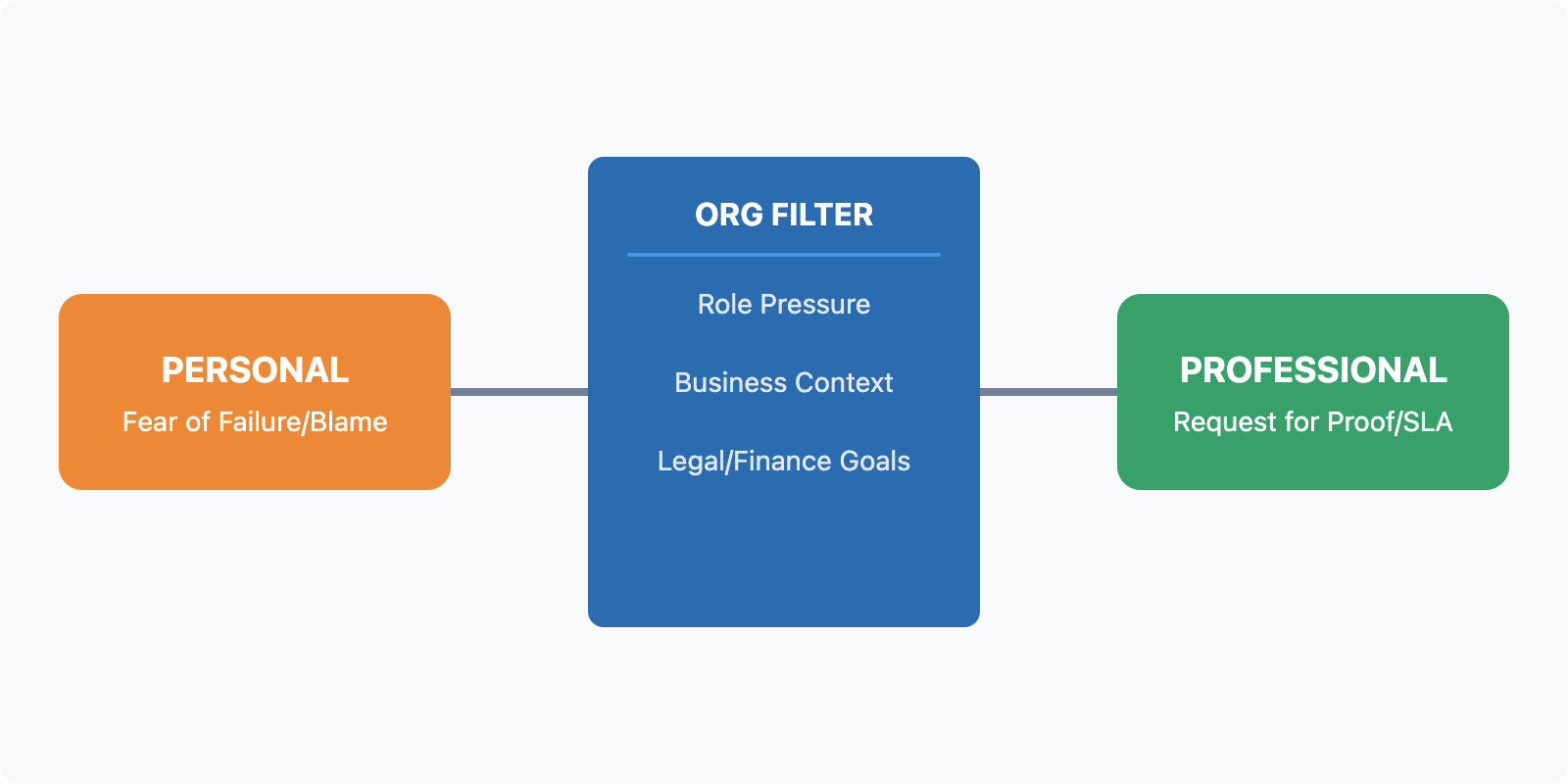 The emotions that drive personal decisions do not disappear at the office door; they put on a costume. Fear of loss, the desire for control, the need for approval: these are the same drivers whether someone is buying a house or a security platform. What changes is the expression. A buyer's private fear of looking foolish rarely gets voiced as "I'm scared." It surfaces as a professional-sounding demand for more peer references, a longer pilot, or a tighter SLA. The personal-to-professional translation is the process by which a raw emotion gets rewritten into workplace-acceptable language and behavior.
This matters because most demand content is written to answer the professional expression while ignoring the emotion underneath it, so it never fully lands.
- Natalie: This buyer keeps asking for more customer references. We've already sent five.
- Milo: So at this point it isn't really about the references.
- Natalie: Right. Personally, she's terrified of being the one who championed a vendor that flops.
- Milo: And professionally that comes out as "show me who else like us bought it," because peer proof is what she can defend upward.
- Natalie: So the fear is personal, but the ask is shaped by who's watching her.
Notice the driver is a single thing (fear of blame) appearing in two costumes: the private feeling and the defensible professional request.
Reading Role Pressure, Business Context, and Organizational Expectations
Once you accept that personal emotion gets translated, the next task is reading what does the translating. Three forces do most of the work. The first is role pressure: what the buyer is personally accountable for, which sharpens certain fears (a director who owns an audit finding fears being blamed far more than a peer who does not). The second is business context: deadlines, budget scrutiny, and market conditions that make some priorities urgent and others irrelevant.
The third force is organizational expectations: the demands of other functions the buyer must satisfy, such as finance policing cost, legal policing risk, and executives demanding speed.
These forces reshape both what the buyer prioritizes and, just as importantly, how they will justify the decision internally. A buyer might personally prefer the most elegant product, but under budget scrutiny and a compliance deadline, they will prioritize the option they can most easily defend to finance and legal. Reading these three forces tells you which emotions get amplified and which get suppressed, so you stop treating the buyer as a lone decision-maker acting on personal taste.
Designing Messaging for Both the Person and the Organization
Effective professional-context messaging works on two layers simultaneously. The first layer speaks to the individual: it reassures the person, protects them from blame, and gives them a sense of control. The second layer arms them for the organization: it supplies the compliance proof legal wants, the cost justification finance demands, and the consensus-building material executives expect. Miss the personal layer and your message feels cold and generic; miss the organizational layer and it stalls the moment the buyer has to defend it in committee.
The discipline is to pair them deliberately. If the personal driver is fear of being blamed, the individual reassurance is "you'll have control and a safety net," and the organizational ammunition is documented peer outcomes the buyer can forward to their boss without editing. One message element, two jobs.
The takeaway to carry: a buyer's professional behavior is a personal emotion filtered through role, context, and organizational pressure, so your messaging has to reassure the person and equip them to win the room. Next you'll run a quick pattern-spotting check, sorting buyer motivations into personal, professional, or organizational drivers, which sharpens the eye you'll need for the deeper analysis and messaging review that follow.
