Trust Based Influence Architecture
The Trust-Based Influence Architecture
You've traced how a private emotion becomes a professional behavior filtered through role, context, and organizational pressure. But there's a step underneath all of it: before a buyer acts on anything you say, they first decide whether to believe you at all. This unit is about engineering that belief deliberately, mapping the signals that build trust onto the shifting states a buyer moves through on the way to a decision.
Diagnosing the Credibility Markers That Move Buyer Confidence
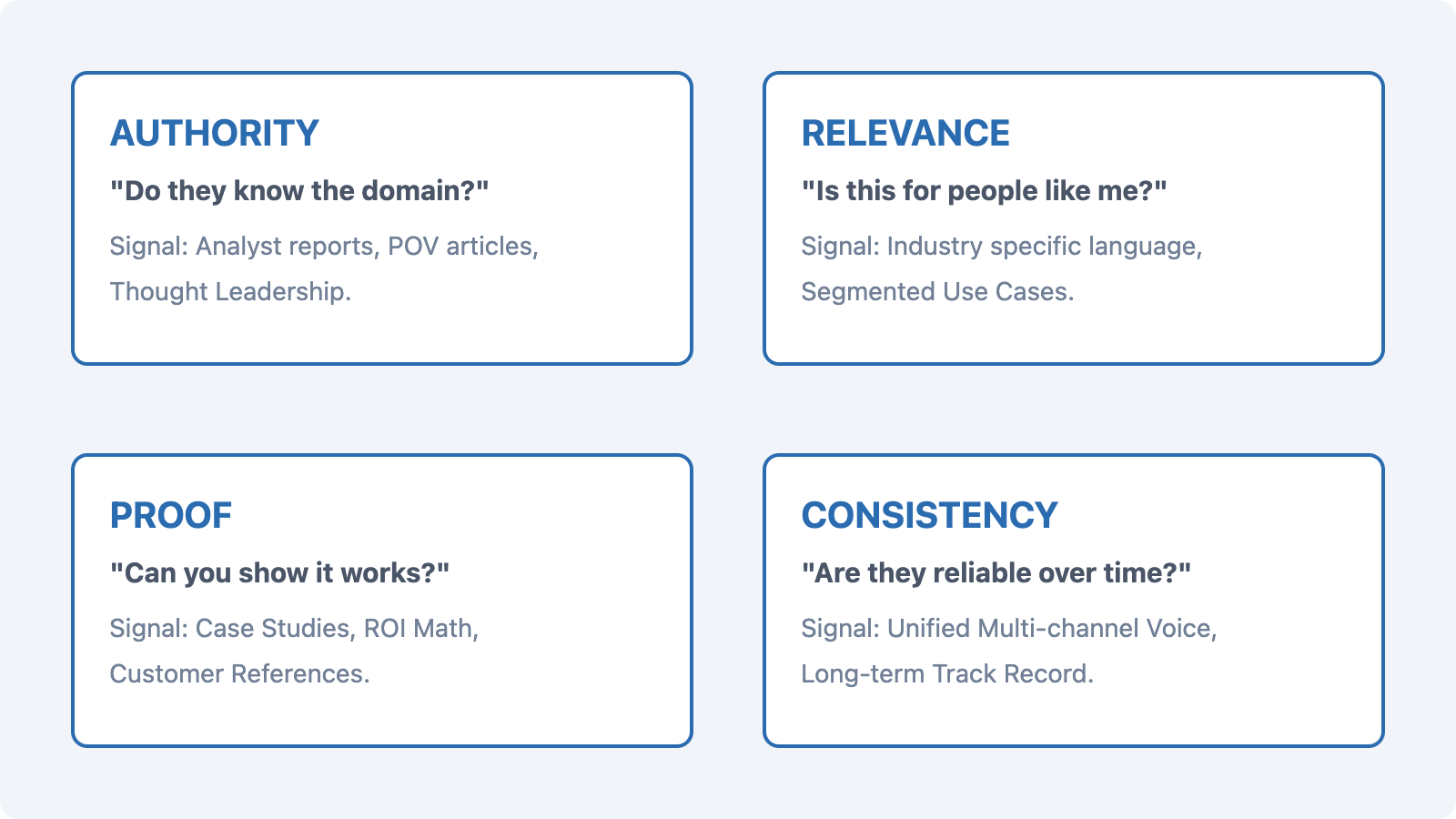
Trust isn't one switch that flips; it's assembled from distinct signals, and buyers read them almost unconsciously. Four credibility markers do most of the work. Authority answers "does this source actually know the domain?" and shows up as analyst recognition, named expertise, or a defensible point of view. Relevance answers "is this for someone in my exact situation?" and comes from segment-specific language and use cases that mirror the buyer's world. Proof answers "can you show it worked, not just claim it?" and lives in case studies, benchmarks, and peer references. Consistency answers "do you show up the same way over time?" and is signaled by a coherent message across channels and a track record that doesn't wobble.
The practical skill is diagnosis: figuring out which marker is thin when a buyer stalls. Content can be abundant and still fail because the wrong marker is missing for that particular buyer.
- Ryan: Our nurture stream has tons of content and the buyer still won't book the call.
- Chris: What's the content actually doing? Is it more thought leadership or more proof?
- Ryan: Almost all authority pieces. Big-idea articles, our POV on the category.
- Chris: So they probably believe we know the space. They just don't believe it works for a team like theirs yet.
- Ryan: Right, we've never shown a peer in their segment succeeding. It's a proof and relevance gap, not an authority gap.
Notice they didn't reach for more content; they diagnosed which marker was absent.
Mapping Trust Touchpoints to Changing Buyer States
Once you can name the markers, the next move is placing them where they matter. A buyer's cognitive and emotional state is not fixed; it changes as they progress, and the same asset that lands early feels irrelevant later. The Psychological Influence Architecture uses different channels and content types to serve the specific need at each stage of the Psychology-Based Demand Funnel: Problem Recognition, Consideration, Decision, and Retention.
At problem recognition, the buyer is barely aware anything is wrong, so authority does the heavy lifting: a strong point of view, delivered through thought-leadership content, search, and social, that makes the latent problem feel real. In consideration, the buyer is comparing options and managing uncertainty, so relevance and proof matter most, carried by segment-specific case studies, webinars, and comparison guides. At decision, the dominant emotion is fear of a wrong call, so proof and consistency take over through peer references, ROI documentation, and security or implementation evidence delivered close to sales. In retention, consistency sustains confidence via onboarding content, QBRs, and community. The discipline is to map each touchpoint to the marker the state demands rather than scattering assets evenly.
Architecting a Psychology-Based Demand Funnel
The payoff is a sequence, not a pile. When you architect the funnel deliberately, each touchpoint meets the buyer's state at that moment and hands them forward with the right marker already in place. This is where the "education is slow" objection tends to surface, and the answer is that education is not a detour from conversion; in a low-trust category it is the thing conversion depends on. Authority-building content early is what earns the buyer's willingness to weigh your proof later. The craft is to preserve that trust while still adding decision-accelerating proof at the bottom, so momentum never rests on pressure.
The takeaway to carry: trust is built by matching the right credibility marker to the right buyer state, and a demand funnel works when it sequences those markers into a coherent path rather than dumping them all at once. Ahead of you sits a quick pattern-check matching tactics to the markers they signal, then a touchpoint plan you can actually put in front of a stakeholder, and finally a live conversation where you'll defend that sequence as a funnel, not a detour.
