Understanding Cloud Costs

What Drives Your Cloud Bill 🧭

This lesson shows you how to trace cloud-cost changes to concrete causes and select controls that keep spending predictable.

In this lesson, you will learn to:

  • Identify the common drivers of cloud costs, including idle resources, oversized machines, egress, storage tiers, and cross-region traffic.
  • Diagnose a sudden bill increase by tracing it to a service, resource, and change.
  • Apply practical cost controls such as tagging, alerts, right-sizing, autoscaling, and lifecycle rules.

In the last lesson you learned how the meter runs: compute hours, gigabytes stored per month, gigabytes transferred, and requests, all priced pay-as-you-go. Knowing how the meter works is one thing. Explaining why the number at the bottom of the invoice went up is another, and it is the question you will actually be asked. A finance business partner rarely wants a lecture on pricing models; she wants to know what moved and whether it will move again. So in this lesson we look at the handful of things that reliably drive a cloud bill, how to trace an increase to a specific cause, and the everyday controls that keep the number predictable.

The Five Usual Suspects 🔎

Most surprising cloud bills come down to five drivers, and it helps to hold them in mind as a short mental checklist.

  1. Idle resources: things that are switched on and billed but doing nothing. A test virtual machine spun up in March that nobody has logged into since, storage disks left behind when someone deleted the servers they were attached to, three staging environments from a project that closed. The cloud bills for existence, not usefulness. Nothing tells the provider that a machine has been forgotten.

  2. Oversized machines: somebody picked a large instance "to be safe," and it now runs at 8% processor use around the clock. You are paying for capacity you never touch.

  3. Data transfer out, sometimes called egress: data leaving the provider toward the internet. Inbound data is normally free, outbound is charged per gigabyte. This is the line that catches people out, because nobody provisions it. It rises quietly when more visitors download the same brochure, video, or report.

  4. Storage tier choice: an earlier course on storage showed that a lower storage price buys you slower, per-gigabyte-charged retrieval. The reverse is also true: 500 GB of client photos sitting in a hot, instantly-available tier when they are opened twice a year is money spent on speed nobody uses.

  5. Cross-region traffic: data moves between one region and another, or in some cases between availability zones. Each hop is metered.

Notice that only some of these are waste. A production database running continuously and customers downloading reports they paid for are expected costs. The skill is separating the two rather than treating every large line as a problem.

Tracing a Sudden Increase ⚖️

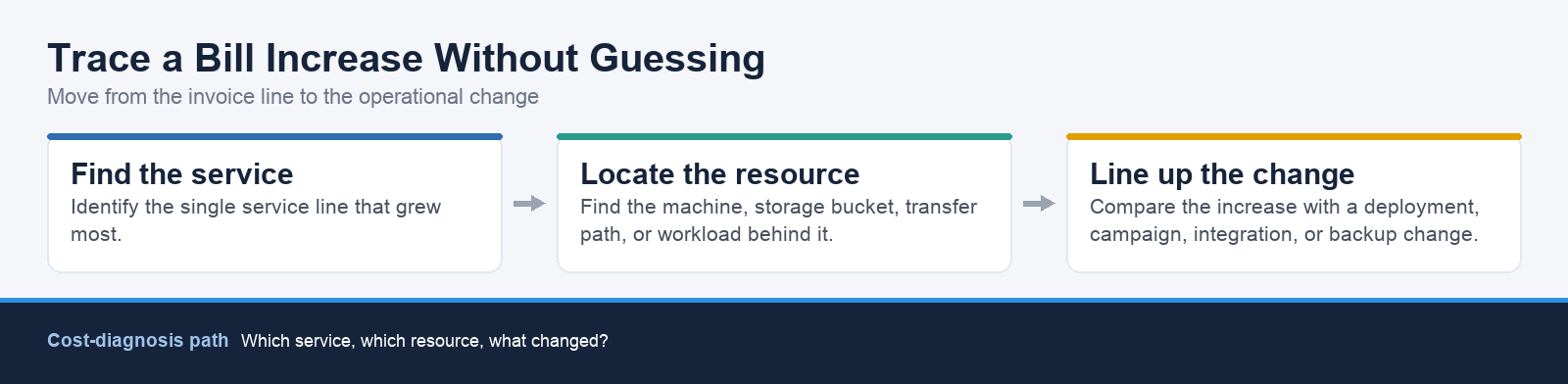
When a bill jumps, resist the urge to guess. The discipline is to narrow the question in three steps: which service, which resource, and what changed.

Every provider gives you a cost breakdown by service, so start there and find the single line that grew most. If compute grew, someone probably started machines or made them bigger. If storage grew, data accumulated or a tier changed. If data transfer out grew and no new servers were created, the cause is almost always traffic, not infrastructure. Then drill into the individual resource, and finally line the increase up against a date: a deployment, a campaign launch, a new integration, a backup job that started copying to a second region.

A three-step path for tracing a cloud bill increase from service to resource to change

Here, Matt, who runs operations at an unrelated online retailer, asks Milo, a cloud adviser, to explain a cost increase.

  • Matt: The bill is up $2,300 and nobody told me we bought anything. What did you buy?
  • Milo: Nothing, and that is the useful clue. The compute line is flat month on month, the same machines running the same hours.
  • Matt: So where is the $2,300?
  • Milo: Almost all of it sits in data transfer out, which is data leaving the provider toward your shoppers' browsers. Traffic roughly doubled during the seasonal sale.
  • Matt: Which is exactly when we discounted everything.
  • Milo: Right. It is not a fault, it is more people downloading the same product images and videos. Which means the right response is to make that cost visible and owned, not to stop the sale.

Notice that Milo eliminated compute before he named a cause, and that he framed the finding as behaviour rather than blame. Both matter when the person asking is worried about being held responsible.

Controls That Keep the Number Predictable 💡

The controls that work in practice are unglamorous. Tagging comes first: labelling every resource with an owner, an environment, and a project so the bill can be split by team rather than arriving as one undifferentiated number. Without tags, no other control has anything to attach to. Budgets and alerts come next, giving you an email in week one when spend is tracking above plan instead of a shock in week five.

Then come the physical adjustments. Right-sizing means shrinking machines to match observed usage, while autoscaling adds servers during a surge and removes them afterwards, so you are not paying peak capacity at 3 a.m.

Two further habits do a surprising amount of work. Storage lifecycle rules automatically move objects to a cheaper tier after a set period, which is how you stop those twice-a-year photos sitting in hot storage forever. And simply shutting down non-production environments overnight and at weekends often removes two thirds of their compute hours, since a machine used for ten hours on weekdays is billed for all 168 hours in a week if nobody turns it off.

The through-line is this: a cloud bill is not a mystery, it is a record of decisions, and almost every surprise traces back to something running that nobody needed, or data moving further than it had to. Two quick checks come next, sorting real line items into waste and expected cost and then diagnosing a spike from the evidence. After that you will explain a bill to a non-technical director live, which is where knowing the difference between a fault and expected behaviour really earns its keep.

Sign up

Join the 1M+ learners on CodeSignal

Be a part of our community of 1M+ users who develop and demonstrate their skills on CodeSignal