Comparing Cloud Ownership Costs
Total Cost of Ownership 🧭
This lesson shows you how to compare cloud and on-premises options fairly before a funding decision is made.
In this lesson, you will learn to:
- Define total cost of ownership and identify the costs it includes beyond a purchase price.
- Compare cloud and on-premises costs over a three-year horizon.
- Evaluate assumptions and non-cost factors that can change a recommendation.
You have spent the last lesson reading bills after the fact. Now comes the question that arrives when ageing servers are due for replacement: with some of the firm's systems already running in the cloud, is it cheaper to keep buying and running our own hardware for what remains on-premises, or to move the rest across? It is the question a finance director will put to you, and it is almost always asked with the wrong number attached. Someone compares a hardware quote to a monthly cloud estimate, or a single month of cloud charges to a single month of doing nothing, and declares a winner. The honest answer needs a wider frame, and that frame has a name.
What Total Cost of Ownership Actually Includes 🔎
Total cost of ownership, usually shortened to TCO, is the full cost of running a system over its life, not the price on the invoice you sign first. When you buy a server, the purchase price is only the opening line. You also pay for the software licences that run on it, the electricity to power it, the cooling to stop it overheating, the rack space and physical security of the room it sits in, and the network connection into that room.
Then there are the costs that never appear as a line item at all. Staff time is the largest of them: hours spent patching, replacing failed disks, testing backups, and being on call at two in the morning. Downtime is real money too, in lost bookings or idle employees, even though nobody invoices you for it. And when a system moves, whether to new hardware or to a provider, migration effort is a genuine one-off cost that people routinely leave out because it is awkward to estimate.
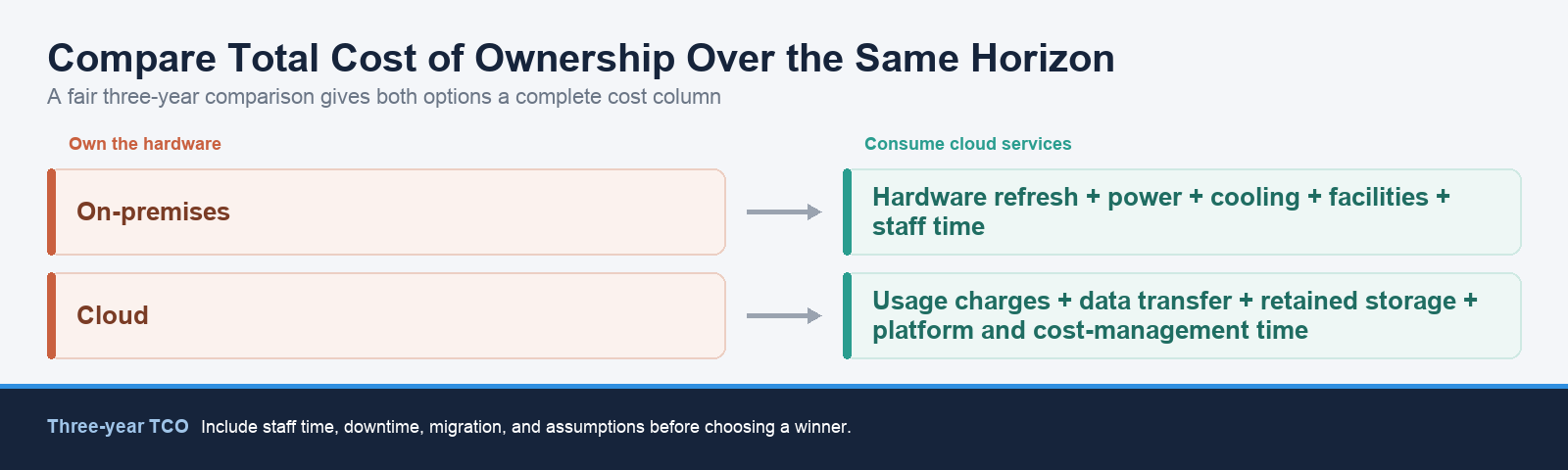
So the definition to hold on to is simple: total cost of ownership counts hardware, licences, power, facilities, staff time, downtime, and migration, over a defined period, on both sides of the comparison. The last part matters. A TCO figure with no time period attached means nothing.
Comparing On-Premises and Cloud Over Three Years ⚖️
Three years is the conventional horizon, and there is a reason for it. Servers are typically refreshed on a three to five year cycle, so a shorter window hides the refresh entirely and flatters the on-premises option. A single month is worse still, because in any given month owned hardware has already been paid for, while the cloud invoice keeps arriving.
Spread across three years, the two shapes look different. On-premises concentrates its spending at the start, in capital expenditure, then adds a steady drip of power, cooling, rack space, and staff time, before a lump for the refresh. Cloud has almost no starting cost but a monthly usage charge that never stops, plus data transfer out charges and the storage you keep for backups and retention. Software licences and staff time sit on both sides, though the cloud side usually trades hardware maintenance hours for platform and cost-management hours rather than removing work altogether.

Here, Meredith, the firm's operations partner, challenges Marcus, a cloud adviser, about the comparison horizon.
- Meredith: Our finance director ran the numbers. One month on-premises is basically zero, one month in the cloud is nine thousand dollars. He says the argument is over.
- Marcus: It is over for that month, and he is right about that month. But the servers were bought two years ago, so the purchase is invisible in his window.
- Meredith: Meaning what, exactly?
- Marcus: Meaning if we stay, we buy again next year. Stretch the comparison to thirty-six months and put the refresh, the power and cooling, the rack space, and the two days a month our team spends on hardware into the same column. Then both options carry all their costs.
- Meredith: And if it still comes out cheaper to stay?
- Marcus: Then it comes out cheaper to stay, and we say so. The point is that both columns are complete, not that one wins.
Notice that Marcus did not tell Meredith the finance director was wrong. He changed the horizon and the scope, which lets the other person update without losing face.
Assumptions and the Non-Cost Factors That Override Price 💡
Every TCO comparison is a set of assumptions wearing the costume of a calculation. How many hours a day do the machines run? Does usage grow? Do the existing software licences transfer to the cloud, or must they be repurchased? Does headcount change? Because these assumptions drive the result, the professional move is to list them openly so the person reading can substitute their own figures. A number you cannot audit is a number that gets ignored.
Moreover, some factors sit outside the spreadsheet and can override the cheaper option entirely. Confidentiality and compliance obligations may require data to stay in a particular country or on infrastructure the organization controls. The skills of a small internal team matter, because an approach nobody can operate is expensive in a way no cost model captures. And recovery targets count: if the business can tolerate four hours of downtime and the on-premises setup would realistically take two days, that gap is a risk with a price. Express those factors as consequences rather than preferences and they will actually be weighed.
The single idea worth carrying out of this lesson is that a fair cost comparison needs a matching horizon, a complete scope on both sides, and its assumptions written down where they can be challenged. Two quick checks come first, defining total cost of ownership in your own words and then matching real costs to on-premises, cloud, or both. After that you will write the recommendation itself, the kind of one-page document a partner group would actually read before approving a capital request.