Model Accountability to Inspire Others
Show Accountability by Setting the Example 🧭
The best way to encourage accountability on your team is to show it yourself, every day. When you take responsibility for your actions—both the good and the not-so-good—your teammates notice. Anyone can set the tone by being honest, reliable, and open about what they’re working on.
Accountability is something you build together, and it works best as a cycle that keeps going. Here’s a simple way to think about it:
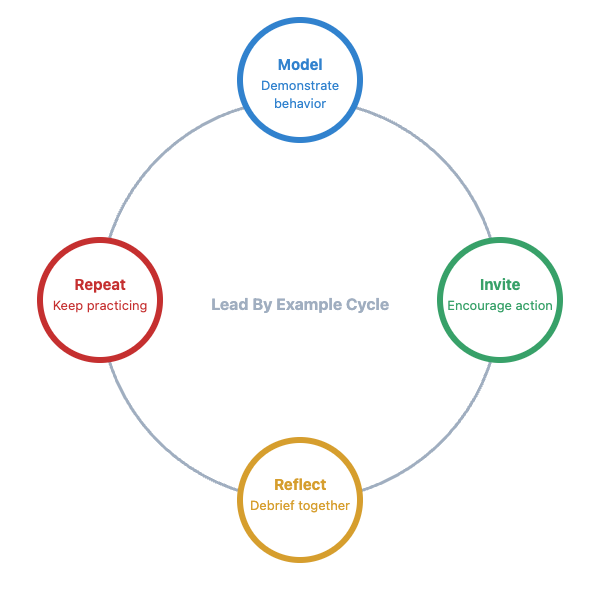
- Model: Show accountability through your own actions.
- Invite: Encourage others to join in and do the same.
- Reflect: Talk together about what worked and what could be better.
- Repeat: Keep the cycle going to build a strong team culture.
Personal accountability starts with owning your decisions and their outcomes completely, without deflection or excuse-making. For example, if you make a mistake, you might say, “I missed a step in the calculation. I’m going to double-check my work next time to make sure it doesn’t happen again.” By modeling this honesty, you invite others to be open about their own mistakes. Afterward, you can reflect together as a team on what helped you catch the issue and how to prevent it in the future. Then, you repeat the process by continuing to share openly and encourage everyone to keep learning and improving together.
You can also model accountability by:
- Giving regular updates on your progress, like, “I’m halfway done with my part and will finish by tomorrow.”
- Thanking teammates who help you, for example, “Thanks for catching that error! I appreciate your attention to detail!”
- Asking for feedback or help when you need it, such as, “I’m learning a new tool. If anyone has tips, I’d love to hear them.”
By being open and responsible, you make it safe for everyone to do the same.
💪 Support Each Other to Stay on Track
Accountability works best when everyone helps each other succeed. This means checking in, offering help, and making sure no one feels alone when things get tough. This doesn't mean covering for teammates who don't deliver or enabling poor performance; rather, it means establishing structures and norms that help everyone succeed.
If you see a teammate struggling, you might say, “I noticed you have a lot on your plate. Want a hand with anything?” Or, you can set up regular check-ins, like, “Let’s touch base every Friday to see how we’re doing on our tasks.” These small actions help everyone stay on track and feel supported.
Here’s an example:
- Marcus: I’m running behind on my part of the project. I’ve only finished two out of five tasks.
- Jessica: Thanks for letting us know, Marcus. Is there something slowing you down?
- Marcus: I’m having trouble figuring out the new software.
- Jessica: I can walk you through it after lunch if you want!
This conversation shows how being honest about challenges and offering support helps everyone stay on track and builds trust within the team.
You can also celebrate when someone follows through, like, “Shoutout to Emil for finishing all their tasks this week! Great job!” These little moments of support and recognition help everyone feel like they belong and want to keep doing their best.
Notice and Appreciate Accountability in Others 🌟
When you see someone being reliable or honest, let them know you noticed! Appreciation doesn’t have to be fancy—a simple, specific thank you is enough. This helps everyone feel valued and encourages more of the same behavior. This encourages people to keep showing up and doing the right thing, even when it’s not easy.
Instead of just saying, “Nice work,” try something like, “Thanks for letting us know about the issue right away, Hari. That helped us fix it quickly.” Or, “I appreciate how you always keep us updated, Kaoru. It makes planning so much easier.”
You might notice that people show reliability and integrity in different ways, such as always following through on promises, being honest about mistakes, or quietly helping others behind the scenes. Try to spot these moments and give them a shout out when you see them. Over time, you’ll start to see more of these positive behaviors popping up all around your team. Even a quick message or a friendly comment can make someone’s day and remind everyone that showing up, being honest, and doing the right thing really does matter. When you make it normal to recognize these actions, you help create a team where trust and dependability are just part of how you work together.
When you make it a habit to notice, appreciate, and recognize reliability and integrity, you help build a team where everyone feels respected and motivated to do their best. These small, friendly actions turn accountability into something positive and natural for your team. Next, you’ll get a chance to practice these skills with real-life scenarios by spotting accountability, giving specific recognition, and helping your team build a culture where everyone feels valued.
