Computing Relative Frequency
Introduction
Welcome to Probability from Experiments! In the previous course, we built a solid foundation by exploring sample spaces, the 0-to-1 probability scale, and how to calculate the probability of simple events. Now we take the next step: rather than reasoning about idealized scenarios, we will learn to estimate probability directly from data collected in real experiments.
This lesson introduces relative frequency, a practical concept that connects everyday observations to the language of probability. By the end, you will be able to compute relative frequency from trial data and understand why it serves as a meaningful estimate of probability.
From Theory to Real-World Data
In Course 1, we learned to calculate probability using the formula
This approach works well when every outcome is equally likely, such as flipping a fair coin or rolling a standard die. But not every situation comes with that guarantee.
Think about something less tidy, like estimating whether your bus will arrive on time, whether a product coming off a manufacturing line will pass inspection, or whether a basketball player will make a free throw. In these cases, we cannot simply count outcomes on paper. Instead, we run the process repeatedly, observe what happens, and use those recorded results to estimate probability. That is the spirit of experimental probability, and it is what this entire course is about.
What Is Relative Frequency?
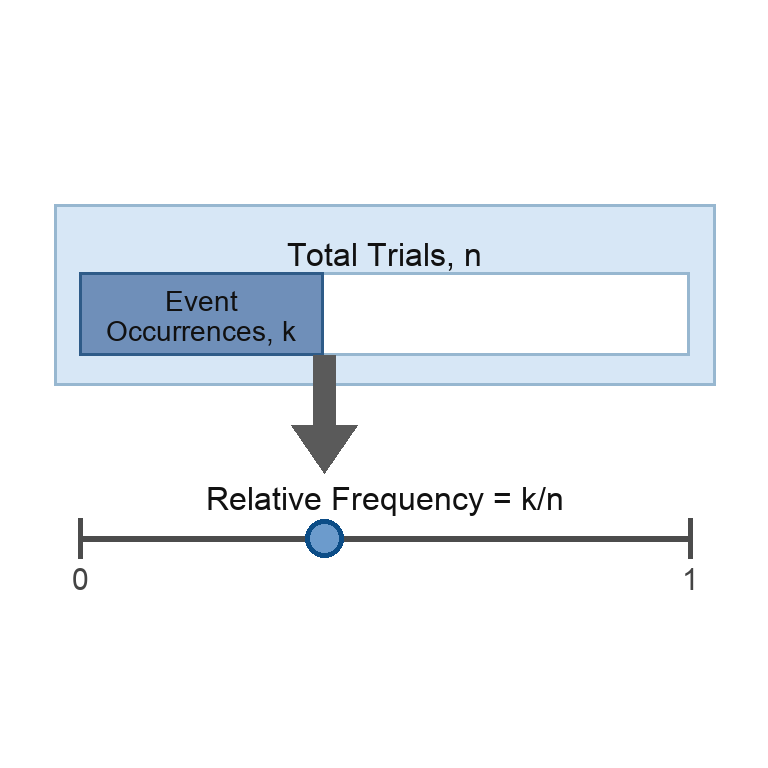
Relative frequency is the proportion of trials in which a specific event occurred. If we conduct an experiment times in total, and the event we care about occurs times, then the relative frequency of that event is:
The word relative signals that we are measuring the event's occurrence in proportion to the total number of trials, not in isolation. Just like the theoretical probabilities from Course 1, relative frequency always falls between 0 and 1. A value of 0 means the event never occurred across all our trials, while a value of 1 means it occurred every single time.
Recording Experimental Results
Experiment results can be recorded in many forms, and the method for computing relative frequency stays the same no matter how the data is written down.
For example, results might be organized in a table:
| Coin flip result | Count |
|---|---|
| Heads | 12 |
| Tails | 8 |
| Total | 20 |
They might be tracked using tally marks:
| Bus arrival status | Tally | Count |
|---|---|---|
| On time | ││││╱ ││││╱ ││ | 12 |
| Late | ││││╱ | 5 |
| Total | 17 |
Or they might simply be written as a list of outcomes:
In every case, the goal is the same: count the total number of trials, count how many times the event happened, and divide.
Computing Relative Frequency Step by Step
The calculation always follows the same three-step pattern:
- Identify the total number of trials, : count how many times the experiment was run, or how many observations were recorded.
- Count the event occurrences, : go through the data and tally how many times the specific event happened.
- Divide by to obtain the relative frequency.
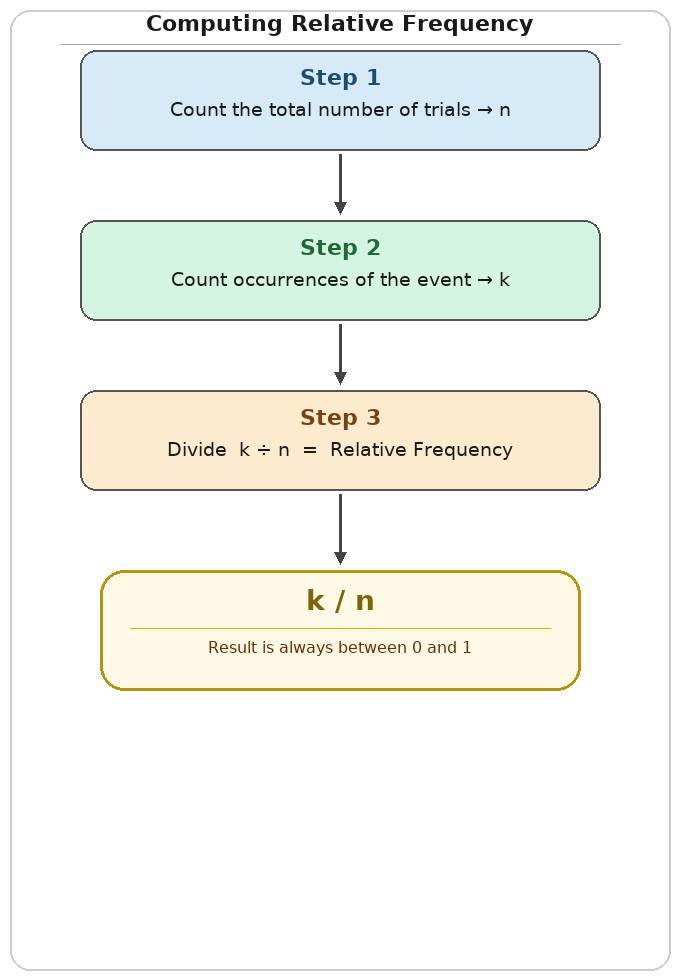
Each step is straightforward on its own. The key is being careful to count only the trials that match the event of interest, and to make sure reflects the total number of trials, not just the favorable ones.
Examples from Different Data Formats: Table
Let's see some quick examples using different ways of recording results.
A bag is checked 25 times at an airport, and 4 of those checks find an overweight bag.
| Result | Count |
|---|---|
| Overweight bag | 4 |
| Not overweight | 21 |
| Total | 25 |
So the relative frequency of "overweight bag" is
Examples from Different Data Formats: Tally marks
A store records whether a package arrived damaged.
| Package status | Tally | Count |
|---|---|---|
| Damaged | │││ | 3 |
| Not damaged | ││││╱ ││││ | 9 |
| Total | 12 |
So the relative frequency of "damaged" is
Examples from Different Data Formats: Written list of outcomes
Suppose a basketball player takes 10 free throws, and the results are recorded as
where means made shot and means missed shot.
The event "made shot" occurred 6 times out of 10, so the relative frequency is
A Worked Example
Suppose we roll a standard six-sided die 30 times and record each result. After all 30 rolls, the outcome "rolling a 3" appeared 7 times.
| Outcome | Count |
|---|---|
| Rolling a 3 | 7 |
| All other outcomes | 23 |
| Total trials | 30 |
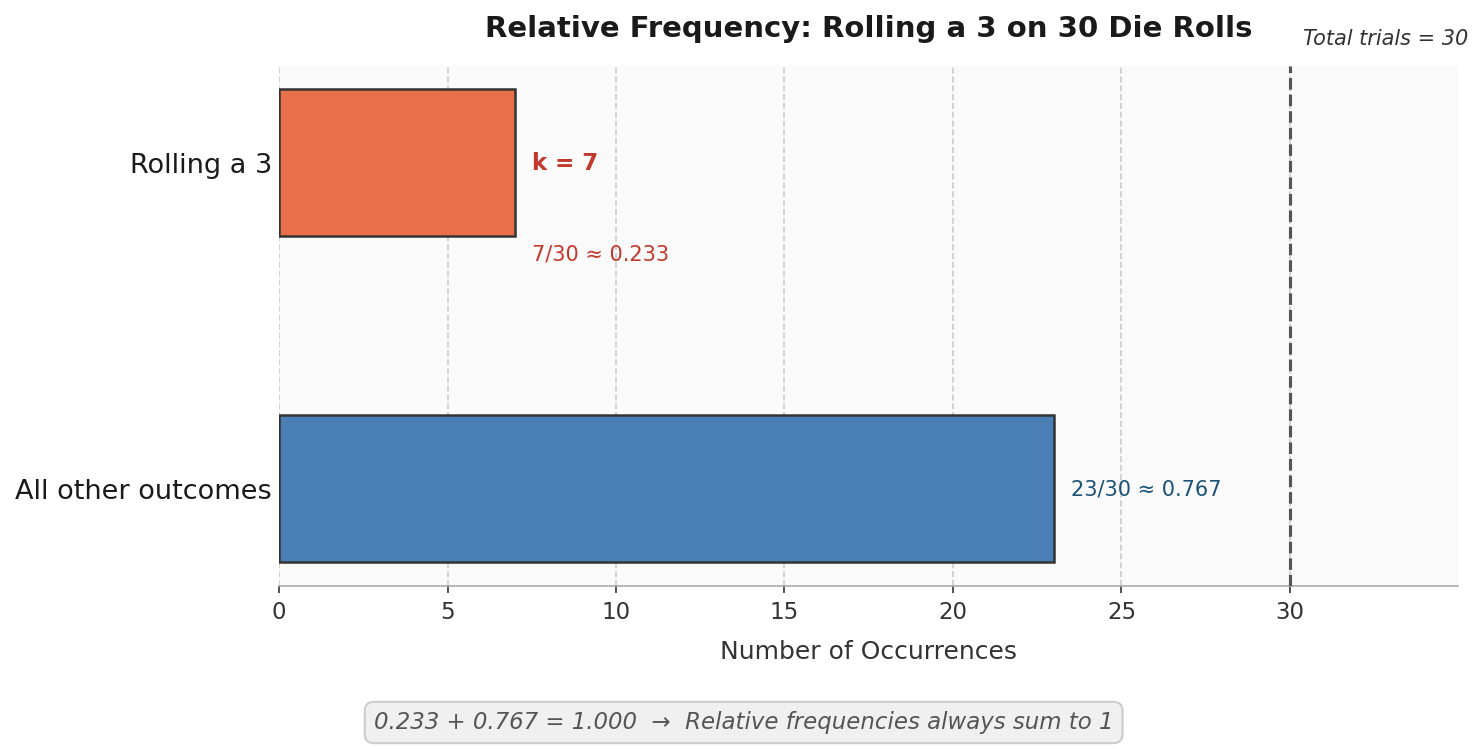
Applying the formula, the relative frequency of rolling a 3 is:
Notice a useful built-in check: the relative frequencies of all outcomes in an experiment must sum to 1. Here, the relative frequency of "not rolling a 3" is
and indeed
This mirrors the property we saw with theoretical probabilities in Course 1, and it makes a great way to catch arithmetic errors.
Relative Frequency as a Probability Estimate
Here is where relative frequency becomes especially meaningful. We do not use it only to describe what happened in the past — we also treat it as our best estimate of the probability that the event will happen in the future. That shift from description to prediction is what makes relative frequency so powerful.
In the die example, our experimental estimate of is approximately . If the die were perfectly fair, the theoretical value would be
The two values are close but not identical, and that gap is completely normal, especially when the number of trials is relatively small.
As we gather more data, the relative frequency tends to settle closer and closer to the true probability. We will explore that stabilization process in detail later in this course — for now, the essential takeaway is this: relative frequency from experimental data gives us a practical, data-driven estimate of probability.
Conclusion and Next Steps
In this lesson, you learned that relative frequency measures how often an event occurs in proportion to the total number of trials, computed as . Like theoretical probability, this value always falls between 0 and 1, and the relative frequencies of all outcomes in an experiment sum to 1. Most importantly, relative frequency is not just a description of past data — it is your best experimental estimate of the probability of a future event.
The practice exercises ahead will give you hands-on experience computing relative frequency across a range of real-world scenarios, from coin flips to bus arrivals to package deliveries. As you work through each one, pay attention to how the same three-step process applies regardless of context. In the next lesson, we will take a closer look at what happens when the number of trials is very small — and why that matters for the reliability of your estimates.
