Beware the Urgency Trap
Notice the Urgency Trap 🏃♂️
In fast-paced environments, the urge to move quickly can hijack your best thinking. Jesse Sostrin in the HBR Guide to Critical Thinking notes that leaders, especially people managers, often face a tricky balancing act: you want to respond fast, but rushing can lead to sloppy decisions, miscommunication, and lost trust. On the flip side, moving too slowly risks missing important windows or letting issues simmer. The key is practicing reflective urgency—the ability to maintain your momentum while building in brief, deliberate pauses to ensure your actions match your true priorities.
As a manager, it's natural to feel pulled in a dozen directions at once. Maybe a direct report makes a mistake that needs to be addressed immediately, or you’re tempted to cut corners to meet a looming deadline. You can’t eliminate urgency, but you can prevent it from making you reactive. Start by noticing: when pressure escalates, what do you tend to do automatically? Recognizing your typical “urgency trap” is the first step to regaining control.
Let’s look at how this might play out in real time:
- Matt: I just found out about a client issue, and my first instinct is to send a strongly worded email and jump on a call to take charge.
- Simone: I get it—it feels urgent! But how do you want the team to feel after you step in?
- Matt: Honestly, I want them to feel supported, not blamed. Maybe I should pause, check what agreements we already have in place, and then pick my next step.
- Simone: That sounds like a solid plan. Even a short pause can help you avoid acting on autopilot.
This kind of quick dialogue shows how reflective urgency works in practice. Even a moment of reflection, especially when prompted by a colleague, can disrupt your automatic urge to react. Sometimes, having someone else ask a simple question gives you the space to pause, rethink your first instinct, and choose a response that better supports your goals and your team. Brief check-ins like this can make the difference between reacting out of habit and responding with purpose.
Spot Your Own Urgency Traps 🔍
Everyone develops shortcuts under stress. Some are helpful, but others lock you in unproductive loops, such as jumping from meeting to meeting with loose ends, multitasking through important work, or committing to too many projects at once. When you can identify your urgency traps, you gain the ability to pause and break the habits that keep everything feeling unnecessarily urgent.
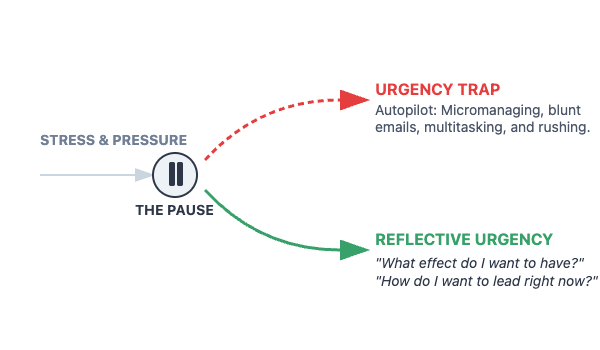
Take Sal, a newer manager. When workload spiked, their instinct was to take charge and control everything—acting as if every small problem was an all-hands emergency. This led them to micromanage, rush conversations, and push their team too hard, straining relationships and missing a chance to build trust.
Think about your own habits. When demands pile up and you’re stretched thin, what’s one thing you do that usually hurts more than it helps? Maybe you default to doing it all yourself, send blunt emails, or skip prep for high-stakes meetings. The moment you can name your go-to trap, you can start interrupting it.
Sal made a shift by resisting their urge to control. When tempted to step in or fire off a terse message, they instead paused for a few seconds and asked: What effect do I want to have right now? and How do I want the team to describe my leadership after this conversation? This tiny pause helped them move from autopilot to intentional presence, even under pressure.
Align Fast Action with Smart Reflection ⚡️
Awareness is just the beginning. To truly change your habits, you also need small, built-in checkpoints—moments in your day where you intentionally pause and check your instincts before urgency takes over. These checkpoints can be as simple as taking a breath before answering a message, reviewing your top priorities before tackling your inbox, or setting aside a minute to reflect before responding in a tense situation. By deliberately creating these pauses, you interrupt the cycle of automatic reactions and create space for more thoughtful, effective choices.
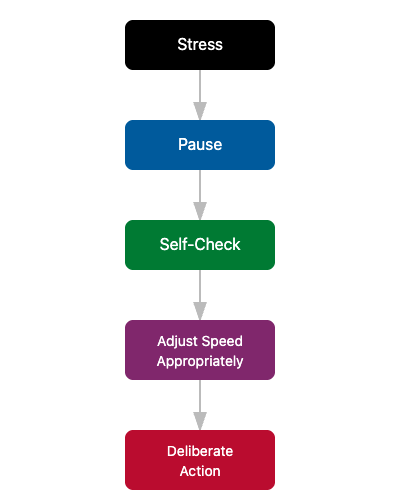
Here’s an example: Buhle, a senior leader, noticed that they unconsciously gravitated toward easy, familiar work (like clearing out old emails) when things got stressful. This seemed productive but meant they neglected the tough, high-impact priorities. To break this cycle, Buhle paused during transitions and filled in the blank: “I’m tempted to work on ___, but I know I should focus on ___.” This quick reality check revealed when they were letting busyness, rather than importance, guide their choices.
Try this quick self-check during your workday:
- When you notice urgency pulling you toward the easiest task, complete the sentence, “I’m tempted to work on ___, but I know I should focus on ___.” This often helps you spot when you’re avoiding what truly matters most.
- Adjust your mix of speed and reflection depending on what’s at stake. For fast-moving, routine tasks, it’s fine to act quickly. For complex or relationship-sensitive decisions, take a little extra time to pause and reflect, even if only briefly. You can clarify your reasoning to others by saying something like: “For this project, precision matters, so I’m slowing down; for that request, speed is more important.”
By learning to recognize your urgency traps and practicing reflective pauses, you can shift from automatic reactions to more intentional responses. As you continue, you’ll have opportunities to apply these approaches—spotting urgency traps as they happen and choosing actions that balance speed with thoughtful reflection. This will help you build better judgment and lead more effectively, even when the pressure is high.
