Identifying the Sample
Introduction
Welcome back to Populations, Samples, and Why We Sample! You are now on the third lesson of the course, and each step has been building on the last. In Lesson 1, we learned to recognize statistical questions by spotting the group and the characteristic that varies across it. In Lesson 2, we focused on precisely defining the population, the complete group a question or claim is about.
At the end of that lesson, we noticed something important: sometimes the data we actually collect comes from only a portion of the population. Today, we are going to give that smaller group a proper name and learn how to identify it in real situations. By the end of this lesson, you will be able to point to the sample in any described study and clearly separate it from the population it belongs to.
The Gap We Already Noticed
In the previous lesson, we saw cases where a claim targeted a full group but the data came from only part of it — a café owner surveying weekday-afternoon visitors while claiming something about all customers, or a principal emailing only parents with a registered address while reporting on all parents at the school. Each time, there was a gap between the full group the claim was about and the smaller group that was actually observed.
That gap keeps appearing because, in practice, examining every single member of a population is often impossible or impractical. Instead, we look at a portion of the group and use what we learn from it to say something about the whole. This idea sits at the heart of statistics, and it starts with recognizing exactly which portion was examined.
What Is a Sample?
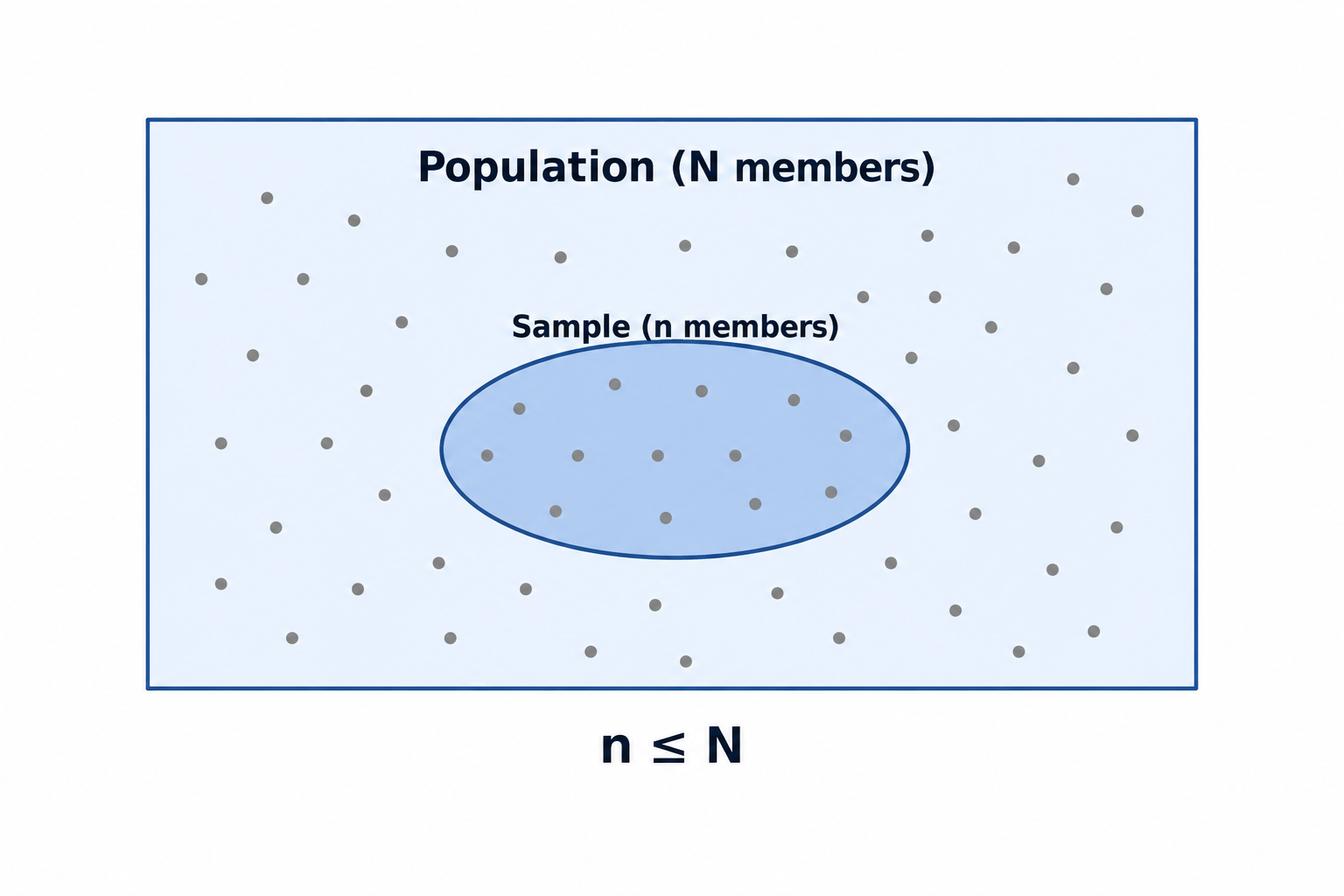
A sample is the subset of the population that is actually examined, measured, or observed. If the population is "all," then the sample is "the ones we actually looked at."
Think of it this way: the population is the full jar of marbles, and the sample is the handful you pull out to inspect. We study the handful, but our real interest is the entire jar.
Here are a few everyday examples, each paired with its population:
| Situation | Population | Sample |
|---|---|---|
| A teacher gives a reading quiz to 8 students picked from a class of 30 | All 30 students in the class | The 8 students who took the quiz |
| A warehouse manager opens 20 boxes from a shipment of 500 | All 500 boxes in the shipment | The 20 boxes that were opened |
| A city surveys 400 residents about park usage | All residents of the city | The 400 residents who were surveyed |
In every row, the sample is the group that someone actually collected information from. The population is the larger group the study cares about.