Identifying the Population
Introduction
Welcome back to Populations, Samples, and Why We Sample! This is the second lesson of the course, and you are building momentum. In the first lesson, you learned how to tell a statistical question from a fixed-fact question and how to name the characteristic that varies across a group. Now we are going to zoom in on that group itself.
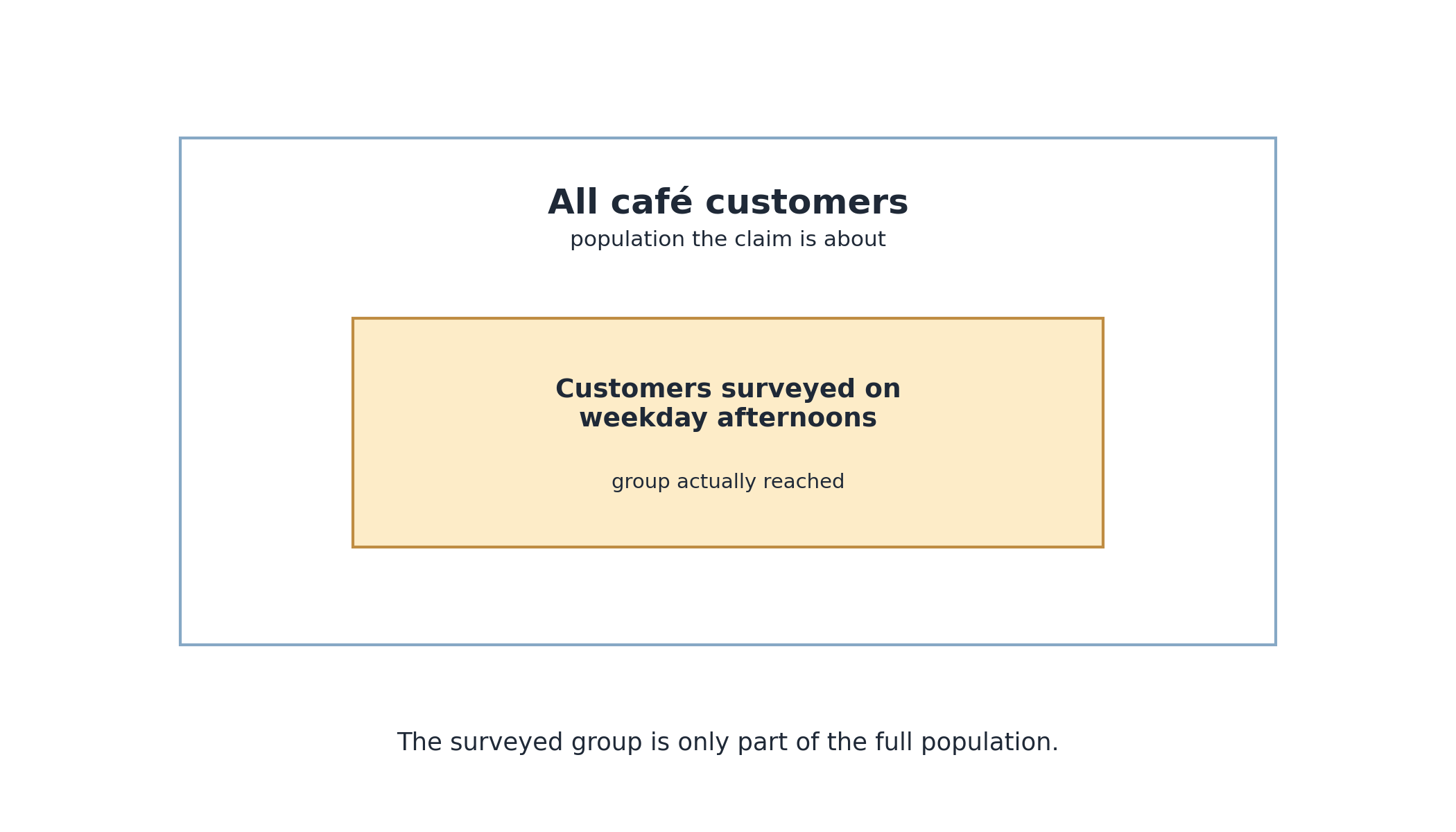
Today, you will learn how to identify the population behind a statistical question or claim and how to state it precisely. We will also look at situations where the wording of a question or claim mentions only part of the group it is really about. By the end, you will be able to pinpoint the full intended group and describe it clearly.
The Group Behind Every Statistical Question
Every statistical question points to a group whose members can give different answers. We used that group in the previous lesson to decide whether a question was statistical — but we never stopped to ask: how do we describe that group accurately?
Getting the group right matters more than you might expect. If someone asks, "How much do households in Austin spend on electricity each month?", the answer depends entirely on which households we are talking about. All households in Austin? Only households in a specific neighborhood? Households during the summer months? A loosely defined group leads to a loosely defined answer. That is why our next step is learning to state the group with care.
What Is a Population?
In statistics, the full group that a question or claim is about is called the population. This is not the everyday meaning of the word — a population does not have to be a group of people. It can be any complete collection of individuals, objects, or events that the question targets.
Here are a few examples:
- "How long do batteries produced at this factory last?" — The population is all batteries produced at this factory.
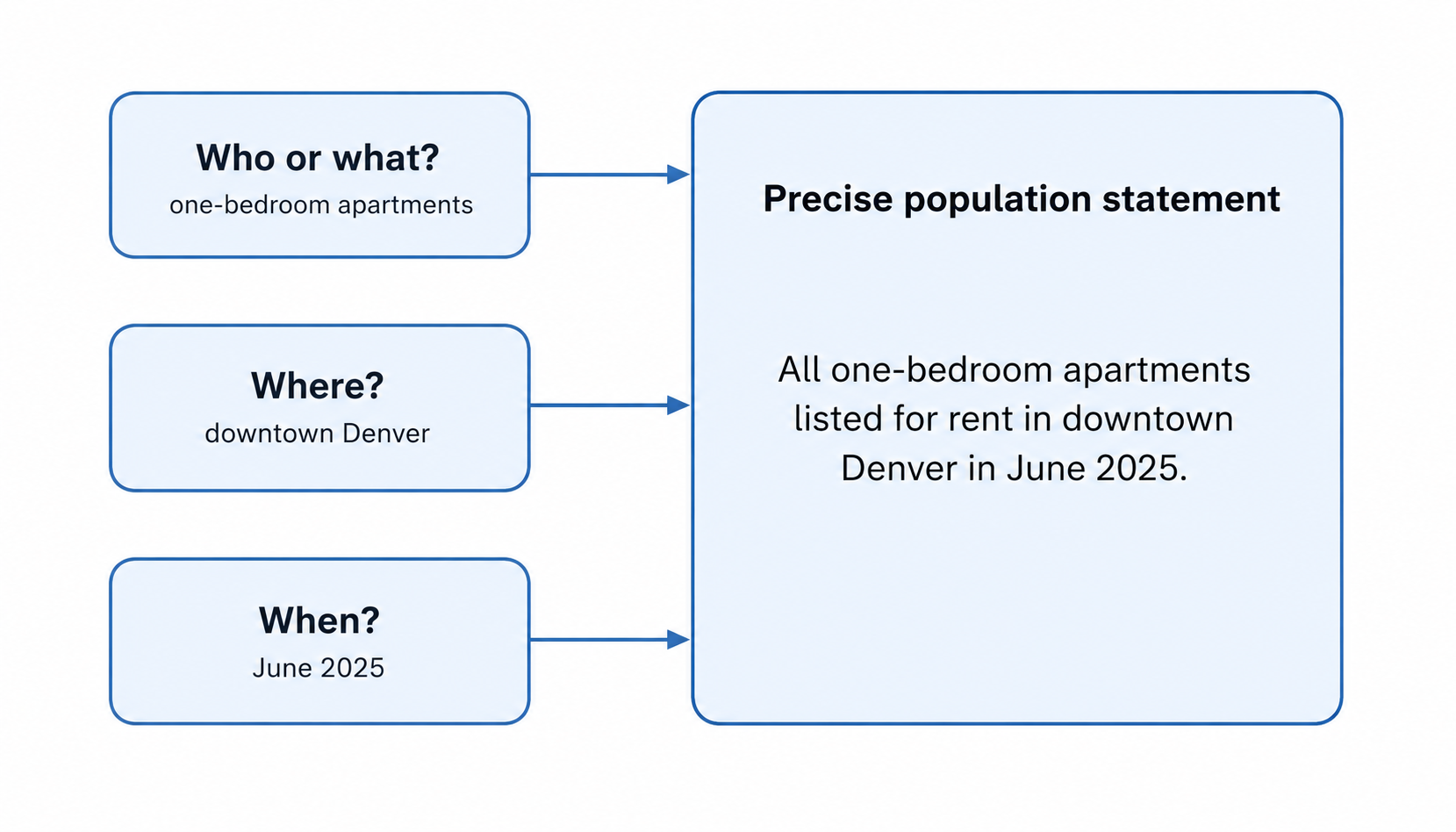
- "What is the average rent for apartments in downtown Denver?" — The population is all apartments in downtown Denver.
- "How satisfied are patients at City Hospital with their care?" — The population is all patients at City Hospital.
In each case, the population is the entire set the question asks about, not just a portion of it. The word all is doing real work here: it reminds us that the population includes every member that fits the description, without exception.