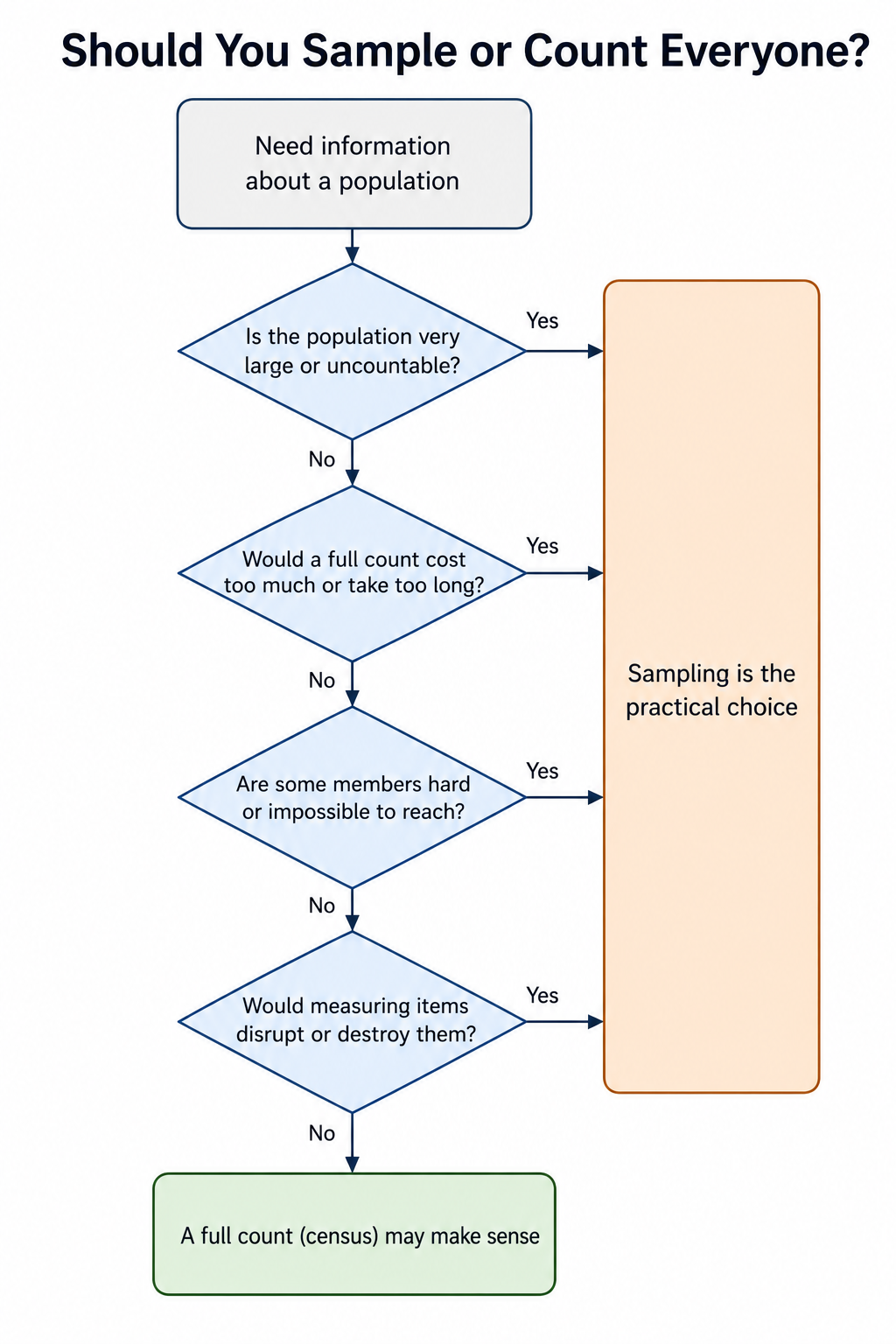
Why Sampling Is Practical
Introduction
Welcome back to Populations, Samples, and Why We Sample! This is the fourth and final lesson of the course, and you have come a long way. In Lesson 1, you learned to spot statistical questions. In Lesson 2, you practiced defining the population a question targets. In Lesson 3, you identified the sample, the subset that is actually observed. Together, those three lessons gave you a clear vocabulary for talking about who we study and what we measure.
One big practical question remains: why bother with a sample at all? If we care about the whole population, why not just examine every member? Today, we will explore the real-world reasons that make sampling the sensible choice in most situations and learn to recognize the specific factors behind that decision.
Why Not Just Count Everyone?
The most direct way to learn about a population is to examine every single member. This kind of full count is called a census. A census sounds ideal because it leaves no gaps, but in practice it is rarely the best option.
Think about a car manufacturer that wants to know whether its airbags deploy correctly. Testing every airbag means destroying every airbag, and there would be none left to install in vehicles. Even when destruction is not involved, reaching every member of a large population can cost too much money, take too much time, or simply be impossible. That is exactly why sampling exists: it gives us useful information about a population without requiring us to examine the whole thing.
Five Factors That Favor Sampling
Most decisions to sample come down to one or more practical obstacles. Let's look at the five most common factors.
Cost. Examining every member of a population can be expensive. Imagine a nationwide grocery chain that wants to measure customer satisfaction across all of its stores. Hiring enough interviewers to reach every single customer would require an enormous budget. Surveying a well-chosen sample of customers gives the chain useful answers at a fraction of the price.
Time. Even when money is available, a full count can take so long that the results arrive too late to be useful. A school district wanting feedback on a new lunch menu before the semester ends cannot spend months interviewing every student and parent. A sample can deliver timely results while the information still matters.
Population size. Some populations are simply too large to examine completely. Consider a biologist studying the health of honeybees across an entire country. There could be billions of individual bees, making a full count practically unthinkable. A sample of hives from different regions is the only realistic path.
Access. Sometimes members of the population are physically or logistically out of reach. A marine scientist studying deep-sea fish cannot capture and measure every fish living on the ocean floor. Only a sample from accessible locations can be collected.
Disruption or destruction. In some cases, the act of measuring an item damages or destroys it. Think of testing whether a batch of matches lights properly or checking the strength of concrete blocks by crushing them. If every item were tested, none would remain for actual use. Sampling is not just practical here; it is the only option.