Solve Real Boundary-Length Problems
Introduction 🎉
Welcome to Solve Real Boundary-Length Problems! This lesson focuses on solving real-world boundary-length problems. You will bring together everything from the previous lessons: perimeter formulas for squares and rectangles, side-summing strategies for triangles and irregular polygons, and the circumference formula for circles. Instead of learning one formula at a time, you will practice deciding which boundary-length method fits each situation.
In this lesson, you will learn to:
- Identify the shape described in a real-world problem.
- Choose the correct perimeter or circumference formula.
- Calculate boundary length accurately using the given measurements.
- Explain why boundary length — not area or another measurement — is the correct answer.
🧰 Your Boundary-Length Toolkit
Before you dive into problem-solving, let's gather every formula from this course into one place. Having them side by side makes it easy to compare and select the right one when a problem lands in front of you.
| Shape | Formula | When to Use |
|---|---|---|
| Square | All four sides are equal | |
| Rectangle | Two pairs of equal sides | |
| Equilateral triangle | Three equal sides | |
| Isosceles triangle | Two equal sides | |
| Triangle (any) | Three sides — add them all | |
| Irregular polygon | Sum every outer edge | |
| Circle | Curved boundary, no straight sides |
Every one of these formulas produces a linear measurement, so the answer is always in units like , , , or . Whether you are wrapping ribbon, installing fencing, or laying tile edging, the result tells you how much material runs along the boundary.
🔎 Matching Shapes to Real-World Objects
Real-world problems rarely say "find the perimeter of a rectangle." Instead, they describe objects — a garden, a stage, a picture frame — and it is your job to translate that description into a geometric shape. Once the shape is clear, the correct formula follows directly from the toolkit above.
Here are common cues to watch for:
- Four equal sides or the word "square" → square.
- Length and width (poster, room, yard) → rectangle.
- Three sides (triangular patio, sail, corner lot) → triangle.
- Multiple unequal sides (L-shaped garden, odd-shaped plot) → irregular polygon.
- Round, circular, or a radius/diameter mentioned → circle.
Reading carefully is the key. A problem about a "square courtyard with sides of " points to the square formula, while "a circular fountain with a radius of " points straight to circumference. Get the shape right, and the rest falls into place. Before calculating, underline or list the measurements given and ask what object’s boundary is being measured. This quick check helps you avoid choosing a formula just because a familiar number appears in the problem.
🛠️ Applying the Formulas to Realistic Scenarios
After identifying the shape, you will substitute the given measurements into the matching formula and work through the arithmetic. Let's practice this process with three common situations.
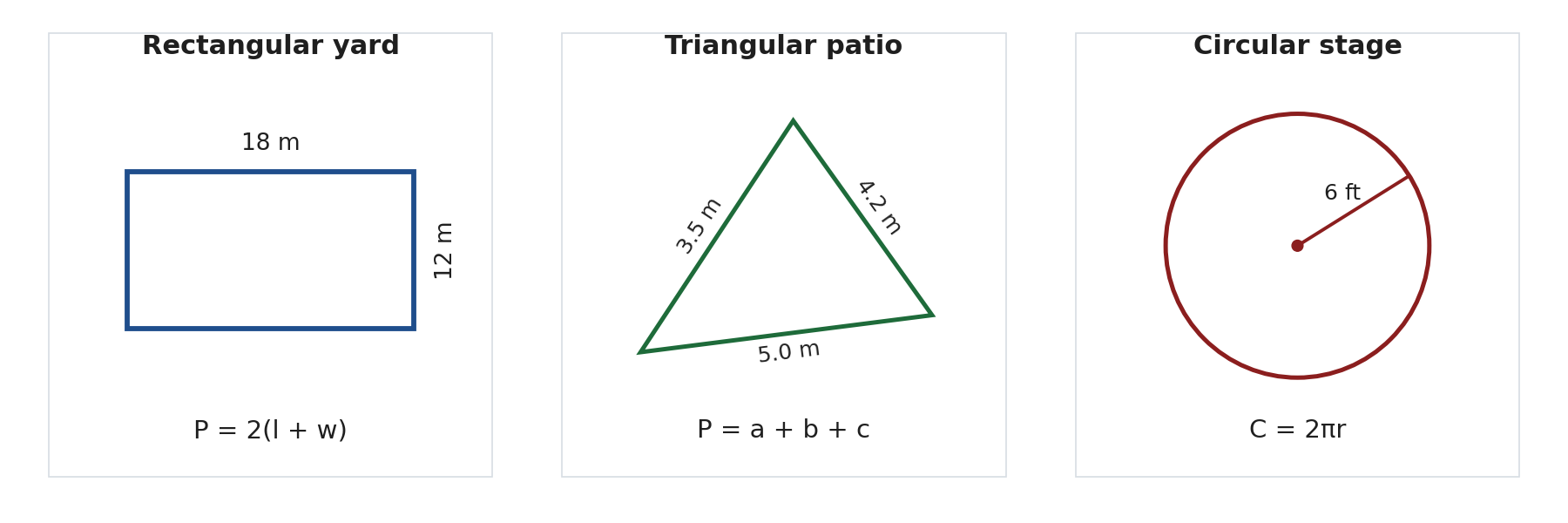
Scenario A — Fencing a rectangular yard. A homeowner needs fencing around a rectangular backyard that is long and wide. The shape is a rectangle, so:
The homeowner needs of fencing.
Scenario B — Edging a triangular patio. A landscaper is laying brick edging around a triangular patio with sides of , , and . The shape is a triangle, so we add all three sides:
The landscaper needs of brick edging.
Scenario C — Bordering a circular stage. A decorator is wrapping LED strip lights around a circular stage with a radius of . The shape is a circle, so we use :
The decorator needs of LED strip lights.
Notice that in every case the answer is a length with a linear unit.
🧱 Boundary Length vs. Surface Coverage
Before calculating, make sure the problem is asking for a boundary length. Perimeter and circumference measure the distance around a shape, such as the amount of fencing, edging, ribbon, or lights needed along the border.
A quick mental test helps:
- Going around the edge → perimeter or circumference, with linear units like or .
- Covering the inside → area, with square units like or .
Think back to Scenario B. Brick edging around a triangular patio is a perimeter question because the edging follows the outside boundary. But pouring concrete across the patio surface would be an area question. In this course, you are focusing on the first type: measuring the distance around.
🕵️ Spotting Common Errors
Even after choosing the right measurement type, boundary-length calculations can go wrong in a few predictable ways. Being aware of these pitfalls helps you catch mistakes before they become costly.
- Applying the wrong shape's formula. A circular fountain does not have a length and width. Using on it produces a meaningless number. Always match the formula to the actual shape.
- Forgetting a side on irregular shapes. With polygons that have more than three or four sides, it is easy to skip an edge. Tracing the outline in order and listing every segment — a strategy from Lesson 2 — prevents this.
- Omitting or miswriting the unit. An answer of with no unit is incomplete, and writing turns a perfectly good boundary length into an area measurement. Always attach a linear unit.
- Confusing radius and diameter for circles. Using the diameter in (or the radius in ) will double or halve the correct answer. Double-check which measurement the problem provides before substituting.
Conclusion and Next Steps
In this lesson, you combined every tool from the course into a single problem-solving workflow: identify the shape, select the matching formula, calculate the boundary length, and verify that perimeter or circumference is truly what the situation calls for. Whether the task involves fencing a yard, edging a triangular patio, or wrapping lights around a circular stage, this same approach applies every time.
Now it is time to put these skills to the test! In the practice section ahead, you will match real-world scenarios to the correct boundary-length procedure, spot faulty reasoning, and write out full calculations — including correct linear units — on your own. Let's see how confidently you can solve real boundary-length problems from start to finish!
