Testing and Optimization
Reading Experiments Without Fooling Yourself
Attribution let you argue about which channel deserves credit. A/B testing finally lets you settle an argument with evidence instead of opinion. But experiments carry a trap of their own: the instant one version pulls ahead, every instinct screams "ship it." This unit is about earning the right to that call, and recognizing the moments you haven't earned it yet.
Isolating One Variable With a Real Hypothesis
Here's a question worth sitting with: if you change the headline, the image, and the audience all at once, and conversions climb 15%, what exactly did you learn? Nothing you can reuse. You know something worked, but not what.
That is why a clean test isolates a single variable. The A/B Testing Steps give you the discipline: choose the element to test → create comparison variants → define the success metric → run the comparison → interpret results → keep, revise, or retest. Notice the third step. You define what "winning" looks like before a single impression serves, not after the data tempts you toward whichever number happens to look good. A hypothesis like "a benefit-led headline will lift CTR versus our feature-led control" tells you exactly what to change, what to measure, and what would prove you wrong.
Deciding: Keep, Revise, or Retest
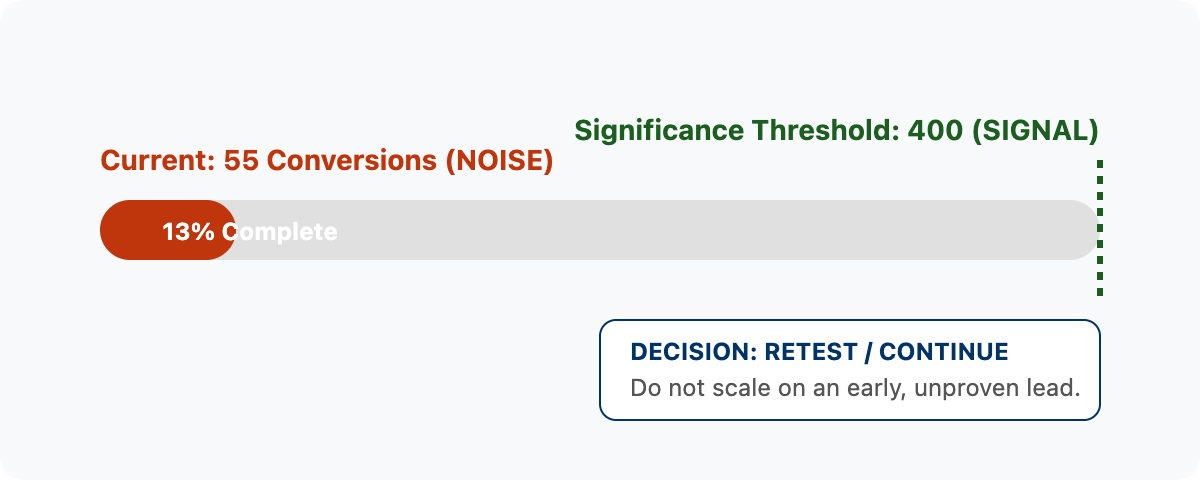
So a variant is up 12%. Do you keep it? The honest answer is that it depends on whether that 12% is signal or noise. A lead built on two hundred impressions over a weekend can evaporate by Wednesday. Before you crown a winner, ask whether the sample is large enough and the run long enough to trust the gap.
- Jessica: Variant B is beating the control by 12%, I think we call it and roll it out.
- Dan: Over how many conversions, though?
- Jessica: About forty so far, but it's been ahead the whole time.
- Dan: Forty is thin. That lead could be noise, and if we ship now and it regresses, we've scaled a fluke.
- Jessica: So we let it run to the sample we agreed on, then decide?
- Dan: Exactly. Keep if it holds, revise if it's close, retest if the setup was messy.
Watch how the decision splits three ways, not two. You keep when the result is clear and meaningful, revise when the direction is promising but the execution was flawed, and retest when the sample was too small or the conditions too noisy to trust either result.
Pulling the Right Optimization Lever
A verified winner is not the finish line, it's the input to your next move. The question becomes: which lever actually matches what the data is telling you? The Optimization Levers give you four. Budget reallocation shifts spend toward proven winners. Audience refinement tightens targeting when one segment converts far better than the rest. Creative rotation refreshes assets when performance decays from fatigue. Bid adjustment changes how aggressively your spend competes at auction.
The provocation here is resisting the reflex to pull all four at once. If you reallocate budget, swap creative, and re-cut the audience simultaneously, you've recreated the exact mess that made your test unreadable in the first place. Match the lever to the evidence: fatigue calls for rotation, not a bigger budget on tired ads.
The takeaway for this unit is blunt: a test only earns a decision when it isolates one variable and clears the bar of sample and time you set in advance, and even then the win is a starting point, not a conclusion. Next you'll spot the flaw in a broken test design, then step into a live session interpreting real results where the pressure to call a winner early is very real, and finally decide which levers to pull to scale. As you go, keep one question close: is this lead actually real, or do I just want it to be?
