Evaluating ROI and Attribution
Evaluating ROI and Attribution Models
Last unit closed on a single test: a number only matters if it changes a decision. Return sits at the top of that map, and the moment you try to prove return, two uncomfortable questions ambush you. How much did this spend actually earn? And which touchpoint deserves the credit? Neither answer is as clean as your dashboard makes it look, and this unit is about seeing through the tidiness.
Calculating ROI and ROAS to Connect Spend to Outcomes
Two formulas anchor the whole conversation. ROAS (Return on Ad Spend) is Revenue ÷ Ad Spend. ROI (Return on Investment) is (Revenue − Cost) ÷ Cost. They look like cousins, but they answer different questions, and confusing them is how managers talk themselves into losing money.
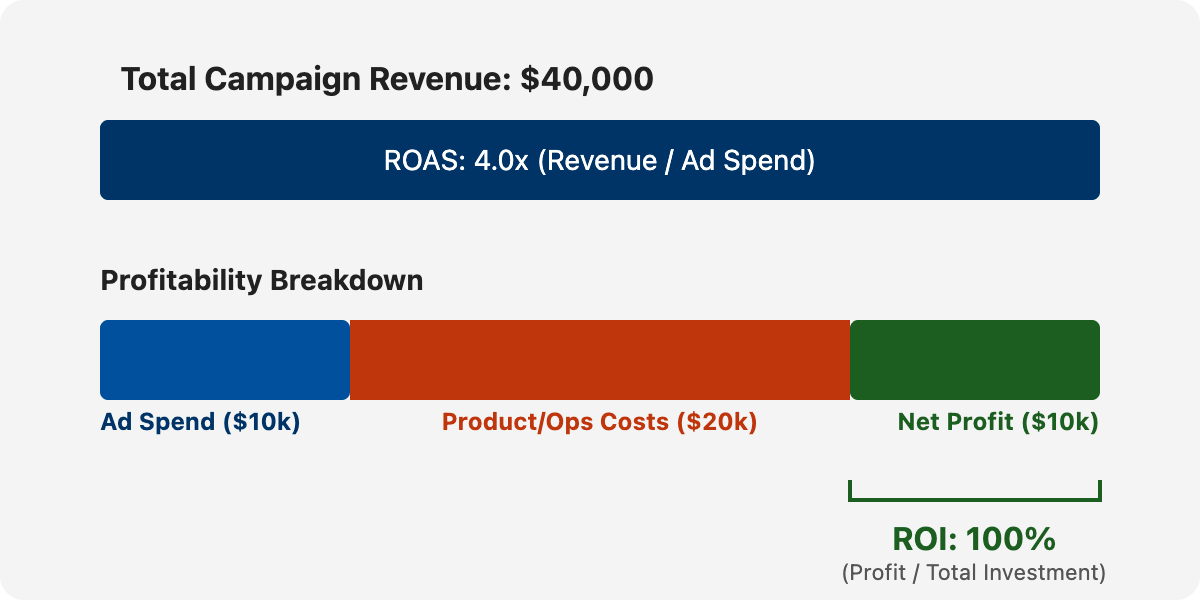
Say a campaign spends $10,000 and drives $40,000 in revenue. Your ROAS is 4:1, which reads like a clear win. But ask the harder question: what did that revenue actually cost to fulfill? If the product carries a 50% margin, the $40,000 is really $20,000 in gross profit, so your ROI is ($20,000 − $10,000) ÷ $10,000, or 100%. Still profitable, but half as impressive as the ROAS implied. Now layer in agency fees, creative production, and platform costs, and a "4:1 winner" can quietly slip underwater.
So which should you lead with? ROAS is a fast efficiency signal for optimizing in-flight, because you rarely have margin data per campaign in real time. ROI is the number that survives a conversation with finance, because it accounts for the full cost of doing business. The trap is quoting ROAS as if it were profit. It isn't.
Distinguishing First-Click, Last-Click, and Multi-Touch Attribution
Here's where the real fight starts. Suppose a customer discovers you through a display ad, comes back later via a social post, then finally converts after clicking a search ad. Three touchpoints, one sale. Who gets the credit?
That entirely depends on your attribution model. First-click hands the full credit to the discovering touchpoint (display). Last-click hands it all to the closing touchpoint (search). Linear, or multi-touch, splits the credit evenly across every touch. There are more refined variants, too: time decay weights touches nearer the sale more heavily, and position-based rewards the first and last touches most. None of these is "correct." Each is a lens that emphasizes a different part of the journey.
- Chris: Paid search is crushing it, last-click ROAS is 6:1. We should move budget there.
- Milo: Under last-click, sure. But how many of those buyers first met us through the display campaign?
- Chris: Honestly? Probably most of them.
- Milo: So last-click hands search the entire win and display gets zero, even though display started the journey.
- Chris: So if I switch to multi-touch, search's number drops and display finally shows up.
- Milo: Exactly. Same revenue, different story, depending on the model you pick.
Notice that no one is lying and no channel changed its performance. The model, not the channel, decided who looked like the hero.
Evaluating How Switching Models Reshapes Revenue Drivers
So when you switch a report from last-click to multi-touch, the revenue total doesn't move, but the drivers behind it do. Upper-funnel channels that introduce customers (display, awareness video, top-of-funnel social) gain credit they were invisibly earning all along. Closing channels (branded search, retargeting) lose the inflated share last-click was handing them.
This forces the question the whole unit is built around: does last-click overstate or understate true effectiveness? For the closing channel, it almost always overstates, because it takes full credit for demand that other touches created. For the assisting channels, it understates, sometimes to zero. If you fund your budget purely on last-click ROI, you'll starve the very channels that fill the top of the funnel and then wonder why your closers run dry.
The sharp takeaway: return is never one number, it's a number plus the assumptions behind it, and attribution is the biggest assumption you never chose on purpose. Before that becomes real, you'll run a quick calculation check, supplying the ROI and ROAS formulas and computing them from a spend-and-revenue snapshot. As you do, keep asking the question that separates a reporter from a strategist: if I changed the attribution model, would I still fund the same channels tomorrow?
