Reporting Results to Stakeholders
One Campaign, Three Very Different Reports
You finish a quarter of work, pull one report, and send the same deck to your CEO, your client, and your media buyer. Efficient? Maybe. But ask yourself who actually acts on it. Here's the harder truth this unit rests on: a report isn't a record of what you did, it's a tool for getting someone to decide something. Get the audience wrong, and even strong results go nowhere.
Matching the Report to Who's Reading It
So why does the same set of numbers need three different treatments? Because each reader is trying to answer a different question, and reports fail when you answer the wrong one.
An executive is asking, "Should I keep funding this?" They want outcomes, ROI, and a bottom line they can absorb in thirty seconds, plus one clear decision. A client is asking, "Is this working for my business, and what happens next?" They want results tied to their goals, honest context, and reassurance, at a moderate level of detail. Your media buyer or analyst is asking, "What do I change on Monday?" They want the granular layer: which ad set fatigued, which keyword bled spend, which audience converted.
The trap is defaulting to your own comfort zone. If you love the mechanics, you'll bury an exec in CPCs. If you dread detail, you'll starve your team of what they need. The discipline is to pick the depth the reader can act on, not the depth you happen to enjoy.
Building the Data Story: Results, Insights, Recommendations
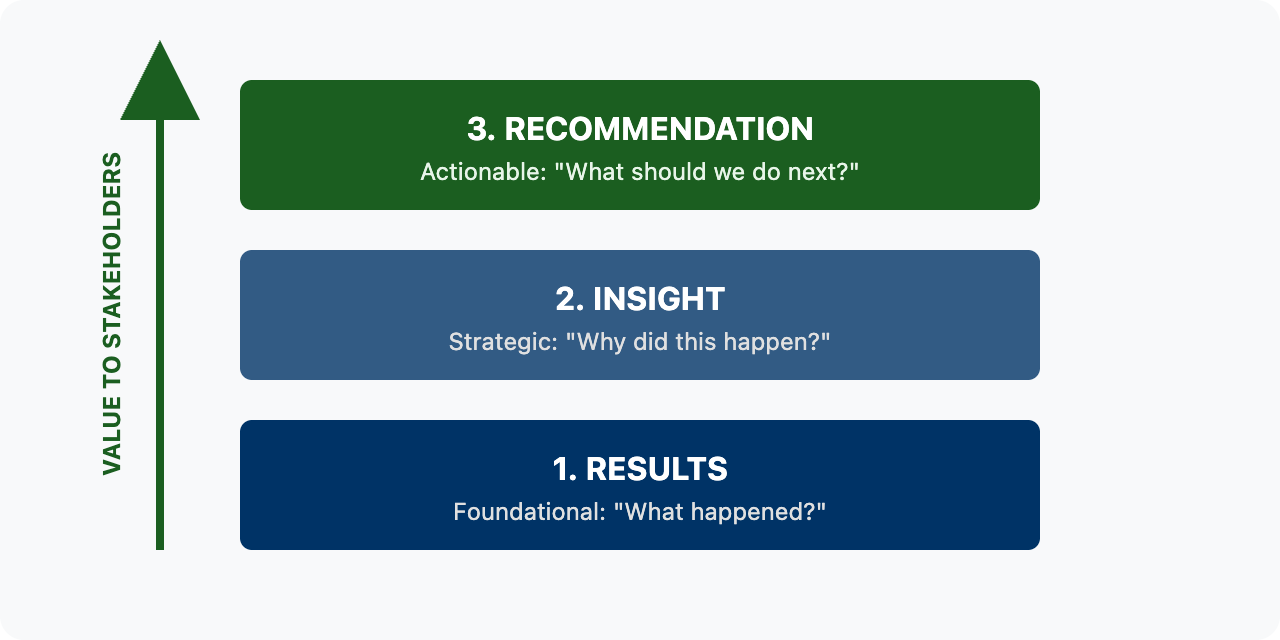
Here's the part most marketers skip: a pile of accurate metrics is not a report. It's raw material. The move that turns numbers into decisions is the Reporting Storyline: Results (what happened), Insights (why it matters), Recommendations (what to do next). Miss any of the three and the reader has to do your thinking for you.
Watch how quickly this reframes a report.
- Dan: The deck's done. Twelve slides, every metric from the quarter.
- Nova: Twelve slides for the exec review? What do you actually want them to do after reading it?
- Dan: Approve next quarter's budget, I guess.
- Nova: Then lead with that. One headline result, why it happened, what you're asking for. The other nine slides are backup.
- Dan: So Results, then the insight, then the recommendation, and push the rest into an appendix.
- Nova: Right. A metric dump isn't a report. It's homework you're handing the reader.
Notice Nova never argues the data is wrong. Her point is that data without a "why it matters" and a "what next" forces the audience to build the story themselves, and busy people simply won't. The insight is the bridge: it's where you explain that a soft conversion number came from a landing-page mismatch, not a dead campaign. Skip it and your recommendation looks like a guess.
Landing on Next Steps That Fit the Audience
If the story ends without a recommendation, you've written a history book, not a report. But whose next step? This is where audience and storyline meet. The same insight, say, "mobile traffic is converting at half the desktop rate," produces a different recommendation depending on who's reading.
For the executive, it's a decision framed in business terms: "We're leaving revenue on the table on mobile; approve a small budget to fix the mobile funnel and we project a lift next quarter." For the client, it's the same idea with a bit more reassurance and context. For the team, it's a task list: rebuild the mobile checkout, shorten the form, retest. Ask yourself before you send anything: what is the one action I want this specific reader to take, and have I made it obvious?
The single takeaway: reporting is persuasion, not documentation, and the Results → Insights → Recommendations spine is how you persuade the right person to act. Three practices sit ahead. First, a quick sorting exercise to sharpen your instinct for which content belongs to executives, clients, or team members. Then a live session defending a real story to a skeptical stakeholder who'll probe for spin. Finally, an executive summary you could genuinely send. As you move through them, keep one question close: am I reporting to inform myself, or to move someone else to decide?
