Comparing Group Percentages
Introduction
Welcome back to Percentages in News and Statistics! You've reached lesson four out of six, so you're already well past the halfway point in this course. So far, we've learned how to calculate percent changes, how to identify the group behind a reported percentage, and how to estimate actual counts from those percentages. In this lesson, we'll focus on a situation that comes up constantly in news and everyday conversation: comparing percentage claims that come from groups of very different sizes. As we'll see, the same percentage can mean very different things depending on how large each group is.
Why Group Size Matters
Imagine two headlines side by side:
- "30% of employees at Company A are remote workers."
- "30% of employees at Company B are remote workers."
At first glance, these two companies look identical on the remote-work front. But what if Company A has 100 employees and Company B has 5,000? Then Company A has just 30 remote workers, while Company B has 1,500. The percentage is the same, yet the real-world picture is completely different.
This is the core idea behind today's lesson: percentages describe proportions, not quantities. To compare actual quantities, we always need to know the size of each group.
From Percentages to Counts
As you may recall from our earlier work on estimating counts from reported percentages, converting a percentage into a raw number is straightforward. We multiply the group total by the percentage expressed as a decimal:
For example, if a city of 80,000 residents reports that 12% commute by bicycle, the number of bicycle commuters is:
This simple step is the key tool for everything that follows. Whenever we want to compare what percentages actually represent across groups, we convert each percentage to a count first.
Comparing Two Groups Side by Side
Let's walk through a realistic example. Suppose two surveys report the following results about shopping preferences:
| Survey A | Survey B | |
|---|---|---|
| Group size | 400 people | 2,000 people |
| "Prefer online shopping" | 45% | 30% |
At first, Survey A seems to show a stronger preference for online shopping because 45% is larger than 30%. But let's find the actual counts:
- Survey A: people
- Survey B: people
The contrast is easier to see in a visual:
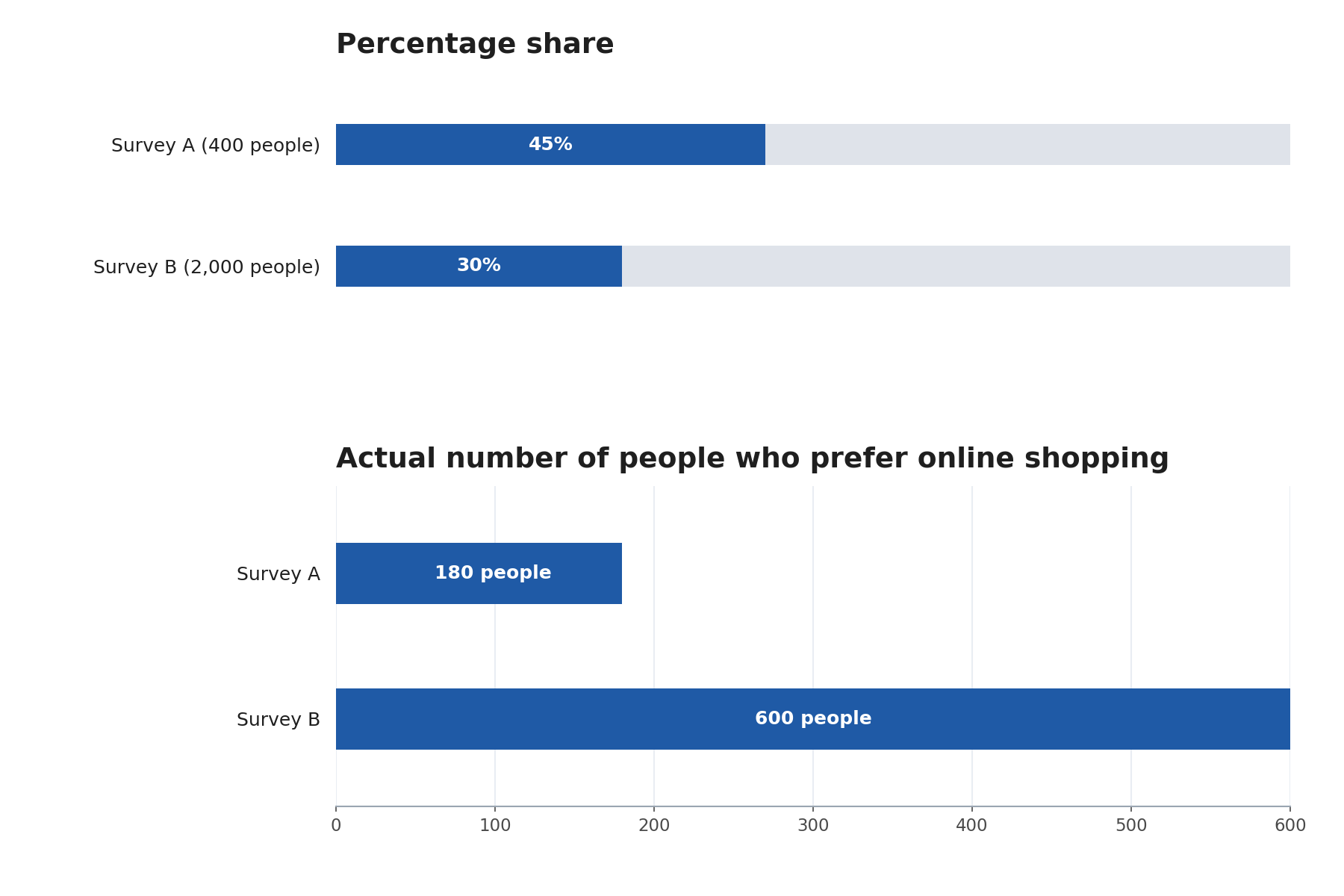
Even though Survey A reports a higher percentage, Survey B has more than three times as many people who prefer online shopping. If someone claimed "more people in Survey A prefer online shopping," that statement would be incorrect. The percentage was higher, but the count was far lower.
