Welcome back to Percent Foundations for Everyday Life! We are now on Lesson 7 of 8, so the finish line for this course is just around the corner. In the previous lesson, we learned how to find a part when we already knew the whole and the percent. Today, we flip that question around: given a part and a whole, what percent is the part of the whole?
This skill comes up constantly in daily life. Think about a quiz score (we got 18 out of 25 correct — what percent is that?), a survey result, or a budget review. By the end of this lesson, we will have a reliable method for answering any "what percent?" question, including cases where the answer turns out to be surprisingly small or larger than 100%.
Turning the Problem Around
In Lesson 6, our core formula looked like this:
Part=100Percent×Whole
We knew the percent and the whole, and we solved for the part. Now we know the part and the whole, but the percent is the missing piece. If we rearrange that same relationship, we get:
Percent=WholePart×100
In other words, we divide the part by the whole to get a decimal, then multiply by 100 to express it as a percent. That is really all there is to it: one division and one conversion.
The Step-by-Step Method
Here is the procedure we will use every time:
Identify which number is the part and which is the whole (the base).
Divide the part by the whole.
Multiply the result by 100 (or, equivalently, move the decimal point two places to the right) to get the percent.
Let's try a quick example. Suppose we scored 18 out of 25 on a quiz. The part is 18 (what we got) and the whole is 25 (the total possible).
2518=0.72⟶0.72×100=72%
We scored 72%. Two simple operations, and we have our answer.
Clean Whole-Number Examples
Let's build confidence with a few more straightforward pairs where the result comes out to a neat percent.
Example 1 — 27 is what percent of 60?
Divide: 27÷60=0.45. Multiply by 100: 0.45×100=45%.
Example 2 — 14 is what percent of 50?
Divide: 14÷50=0.28. Multiply by 100: 0.28×100=28%.
Example 3 — 9 is what percent of 20?
Divide: 9÷20=0.45. Multiply by 100: 0.45×100=45%.
Notice that Examples 1 and 3 give the same percent even though the numbers are different. That makes sense: 6027 and 209 are equivalent fractions. As we may recall from earlier lessons, different part-whole pairs can represent the same proportion.
Join the 1M+ learners on CodeSignal
Be a part of our community of 1M+ users who develop and demonstrate their skills on CodeSignal
Before we reach for a calculator, the most important step is deciding which number plays which role. The whole (also called the base) is the reference amount — the total, the original, or whatever the percent is "of." The part is the piece we are comparing to that whole.
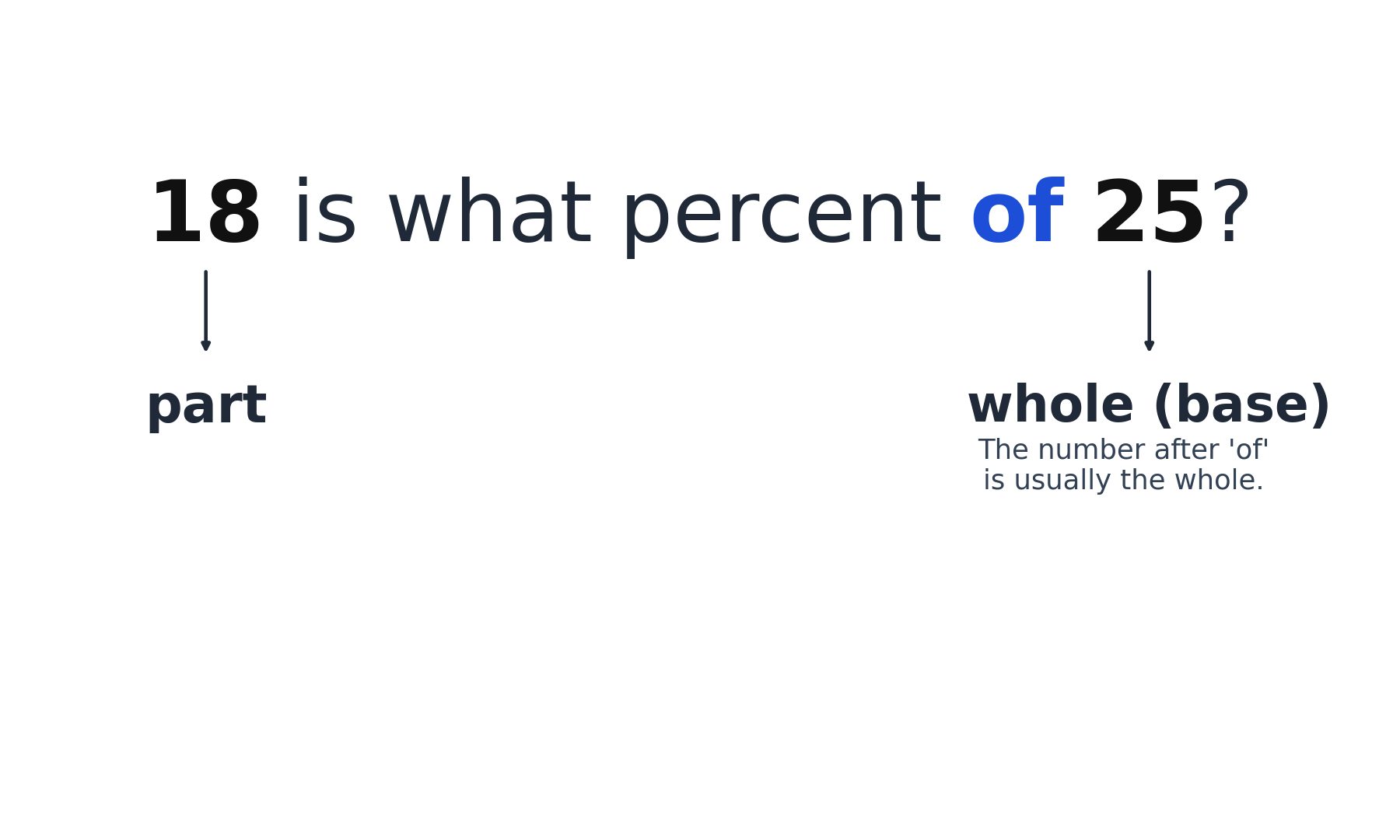
A helpful trick is to look for the word "of" in the problem. Whatever follows "of" is usually the whole. For instance, in "18 is what percent of 25," the number 25 is the whole. In "what percent of 400 is 52," the number 400 is the whole. Getting this backwards is the single most common mistake in this type of problem, so it is worth pausing for a moment to confirm our choice before computing.
Sometimes the part is very small compared to the whole, and the resulting percent dips below 1%. The method stays exactly the same; only the size of the answer changes.
Example 4 — 3 is what percent of 5,000?
Divide: 3÷5,000=0.0006. Multiply by 100: 0.0006×100=0.06%.
The answer, 0.06%, is perfectly valid. As we discussed in Lesson 1, percents below 1% appear in contexts like rare side effects or trace ingredients. If the math leads us there, we can trust it.
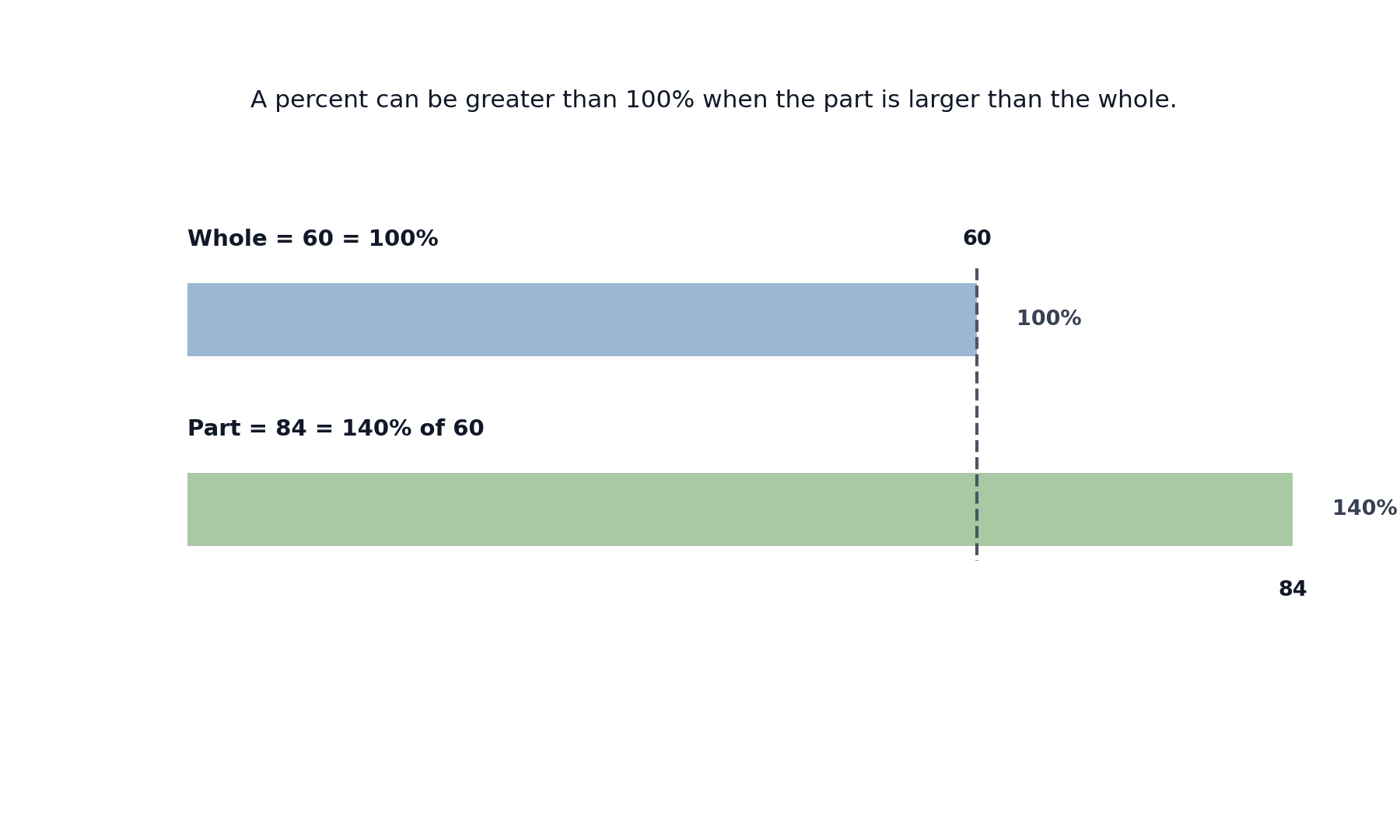
On the other end of the spectrum, when the part is larger than the whole, the percent will be greater than 100%. This happens more often than we might expect.
Example 5 — 84 is what percent of 60?
Divide: 84÷60=1.4. Multiply by 100: 1.4×100=140%.
A result of 140% means that 84 is 1.4 times the size of 60. We might see this when this year's sales exceed last year's total, or when actual spending overshoots a budget. As long as we have correctly identified the part and the whole, there is nothing wrong with a percent above 100.
Let's apply this skill to a realistic data situation. Imagine a workplace survey in which 250 employees were asked to choose among three benefit plans.
Plan
Responses
Plan A
47
Plan B
118
Plan C
85
To report each plan's share as a percent of all respondents, the whole is 250 (the total number surveyed).
Plan A:25047=0.188→0.188×100=18.8%
Plan B:250118=0.472→0.472×100=47.2%
Plan C:25085=0.34→0.34×100=34%
A quick sanity check: 18.8+47.2+34=100%. The shares add up to 100%, which confirms we used the correct whole and accounted for every response. Writing a clear statement like "Plan A was chosen by 18.8% of the 250 respondents" keeps the base visible so anyone reading the result knows exactly what the percent refers to.
In this lesson, we learned to answer "what percent?" questions using a simple and reliable method: divide the part by the whole, then multiply by 100. The crucial first step is correctly identifying which number is the part and which is the whole — look for the word "of" to find the base. We also saw that the method works equally well whether the answer falls below 1%, lands between 1% and 100%, or climbs above 100%.
Now it is time to put this skill into action. The practice exercises ahead will walk us through identifying parts and wholes, computing clean percents, tackling those unusual under-1% and over-100% cases, and finishing with a real survey scenario where we report the result in a complete sentence. Let's dive in!