There was one row of unfinished business at the end of the last lesson. We built a small table of possible final lines, and while 0=−6 and 5=11 got full explanations, the row containing 0=0 was marked "coming in the next lesson." This is that lesson — the second of five in One, None, or Infinitely Many Solutions.
The setup is going to feel familiar. We solve, both variables cancel, and only numbers remain. What changes is the verdict: this time the leftover numbers agree, and that single difference flips the answer from "no solutions" all the way to infinitely many.
Two Equations That Say the Same Thing
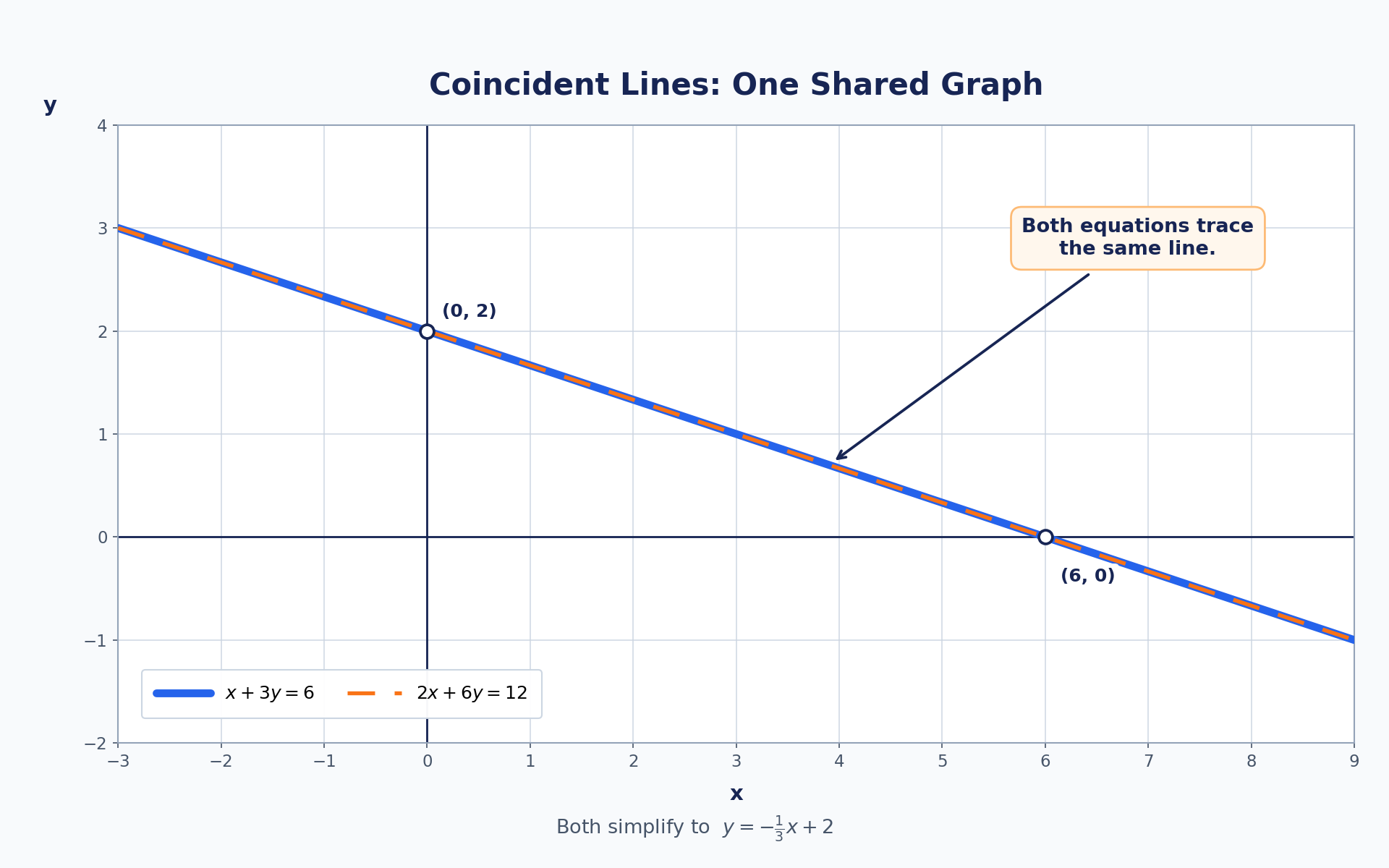
Two lines on a flat page have exactly three options. They can cross at one point, they can run parallel and never meet, or one can lie perfectly on top of the other.
That third option is easy to miss, because our eyes report a single line. But there really are two equations in play — they just happen to trace the same path, point for point.
When that happens, every point on the line satisfies both equations at once. A line contains infinitely many points, so the system has infinitely many solutions. Our job now is to learn how the algebra announces this situation, since we usually meet the equations before we ever see a graph.
When Everything Cancels and the Numbers Agree
Here is a system that looks completely ordinary:
{x+3y=62x+6y=12
To eliminate x, multiply the first equation by −2, which gives −2x−6y=−12, then add that to the second equation:
(2x+6y)+(−2x−6y)=12+(−12)
The x terms cancel, the y terms cancel, and what remains is 0=0.
Just as in the no-solution case, both variables disappeared together, so we never reached a point where we could solve for anything. The entire difference between the two cases lives in the numbers that survived.
Reading the True Statement
A line like 0=0 is called an identity: a statement that is true no matter which values we choose for x and y. Nothing went wrong, and this is not a half-finished answer. It is the system reporting that the second equation added no new restriction.
Here is the reasoning. Every elimination step we used was a legal, truth-preserving move, and those moves turned the second equation into something the first equation already guaranteed. Look closely and you can see why: 2x+6y=12 is just x+3y=6 multiplied by 2.
So we do not really have two conditions on two unknowns — we have one condition stated twice. One condition is not enough to pin down a unique pair, and every point satisfying x+3y=6 satisfies the whole system.
Join the 1M+ learners on CodeSignal
Be a part of our community of 1M+ users who develop and demonstrate their skills on CodeSignal
The method we choose never changes the message, so let us confirm with substitution. Solving the first equation for x gives x=6−3y, and putting that into the second equation:
2(6−3y)+6y=12⟹12−6y+6y=12⟹12=12
Both variables vanished again, and the statement left standing is true. Note that an identity does not have to read literally 0=0; any true numeric equation, such as 12=12 or −5=−5, carries the same meaning. Here is the full map we have now assembled:
Final line
What it tells us
y=4
One variable survived; back-substitute for a single solution
0=−6 or 5=11
False statement; no solution (parallel lines)
0=0 or 12=12
True statement; infinitely many solutions (same line)
As you may recall from the previous lesson, slope-intercept form is the fastest way to see the geometry. Our first equation, x+3y=6, becomes 3y=−x+6, so y=−31x+2. The second, 2x+6y=12, becomes 6y=−2x+12, so y=−31x+2 as well.
Same slope, same y-intercept, same line. Lines like these are called coincident, and they overlap everywhere instead of at one point or nowhere.
Compare that with the parallel case from last lesson. Equal slopes tell us there is no unique crossing point, and then the intercepts settle the matter: matching intercepts stack the lines on top of each other, while different intercepts keep them apart forever.
In the example above, the multiplier was easy to spot. Real systems are not always so polite:
{4x−6y=10−6x+9y=−15
The coefficients 4 and −6 share no obvious relationship, so we scale both equations. Multiplying the first by 3 gives 12x−18y=30, and multiplying the second by 2 gives −12x+18y=−30. Adding them:
(12x−18y)+(−12x+18y)=30+(−30)⟹0=0
An identity, so the system has infinitely many solutions. And sure enough, both equations reduce to y=32x−35. The second equation is the first one multiplied by −23 — a factor that was hiding in plain sight, and one the elimination found for us without our having to hunt for it.
When we land on an identity, writing x=0 or y=0 would be wrong, and writing "no solution" would be the opposite of the truth. What we should do is describe the whole set of pairs that work. Any of these does the job:
"Infinitely many solutions."
"The system is consistent and dependent," meaning solutions exist and the second equation depends on the first.
"The solution set is all points on the line x+3y=6," or in symbols, {(x,y)∣x+3y=6}.
The strongest answers pair the algebra with the reason, for example: "Elimination gives 0=0, a true statement, so the two equations describe the same line and every point on it is a solution."
If you want to demonstrate a few solutions, pick any x and compute the matching y. For x+3y=6, the pairs (6,0), (0,2), and (3,1) all check out in both equations — and so do endlessly many others.
Imagine you find two receipts from the same bakery. The first says 3 muffins and 2 coffees came to $12; the second says 6 muffins and 4 coffees came to $24. Letting m and c be the prices, we get 3m+2c=12 and 6m+4c=24.
Solving this system produces 0=0, because the second receipt is nothing more than a doubled copy of the first. It confirms that the pricing is consistent, but it hands us no fresh information, so the individual prices stay out of reach.
Muffins at $2 with coffees at $3 fits both receipts. So does $1.50 and $3.75. "Infinitely many solutions" is the honest answer, and it is genuinely useful: it tells us we need a truly different receipt, not a bigger version of the same order, before we can narrow anything down.
Three slips show up often now that both special cases are on the table:
Mixing up the two signals. Both cases lose their variables, so the only question left is whether the leftover statement is true or false. False means no solution; true means infinitely many.
Reporting zero as the solution. The line 0=0 says nothing at all about x or y, because neither variable appears in it anymore.
Naming one pair as "the" solution. Finding that (3,1) works is a fine check, but it is one point among infinitely many. The answer is the entire line.
In this lesson, we learned the algebraic fingerprint of a system with infinitely many solutions. When substitution or elimination cancels both variables and leaves a true statement such as 0=0 or 12=12, the two equations are multiples of each other and describe the very same line, so every point on that line solves the system. Geometrically, the lines are coincident: same slope, same intercept, overlapping everywhere.
The habit from last lesson still holds, with one extra beat added — when the variables vanish, stop, read the numbers, and let their agreement or disagreement decide between "infinitely many" and "no solution." In the exercises ahead, you will pick the identity out of a lineup of finished attempts, push an elimination all the way down to a true line, and graph a system to watch two equations settle into one single line, before explaining the whole idea in your own words.