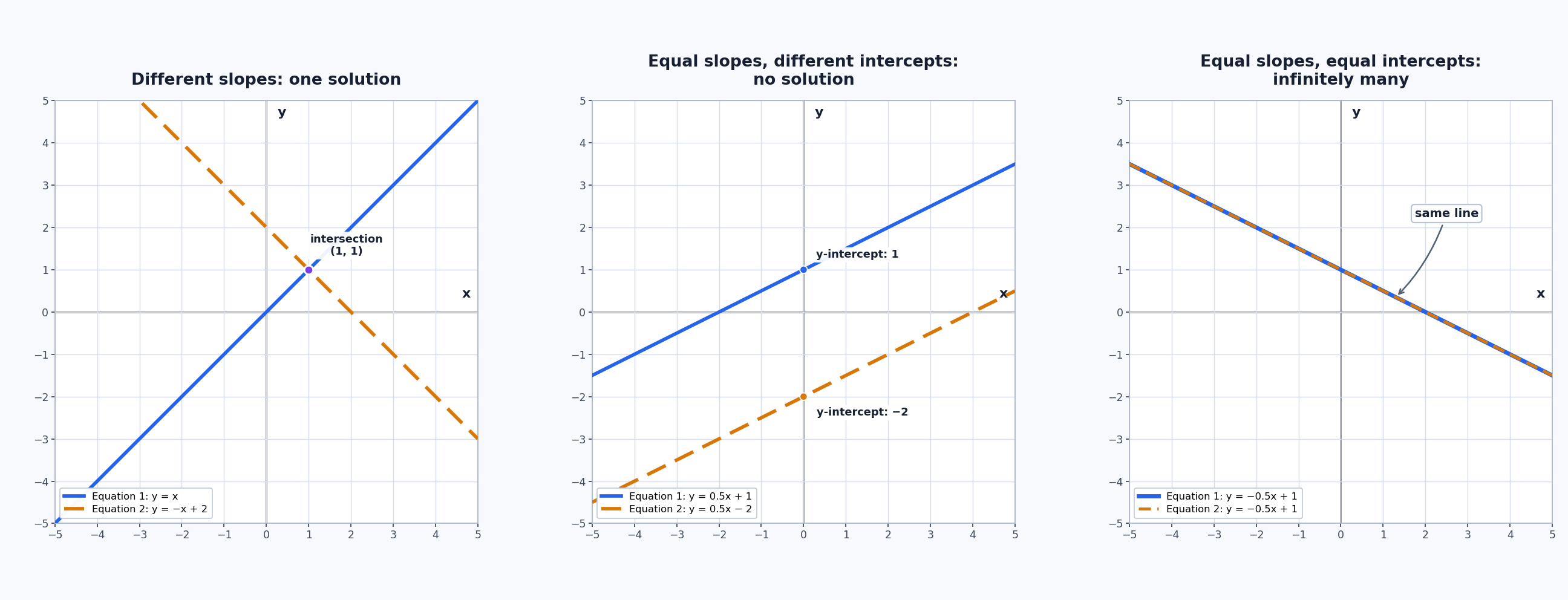
For two lessons now, we have been reading the answer at the end of the work. Solve, watch both variables cancel, then squint at the leftover numbers to decide between no solution and infinitely many. It works, but it means committing to a full round of algebra before we learn what kind of answer was waiting.
This third of five lessons in One, None, or Infinitely Many Solutions reverses that order. We will look at a system, spend about thirty seconds rewriting it, and name the solution type before a single substitution or elimination step. The tool that makes this possible is one we have already leaned on twice in passing: slope-intercept form.
Slopes, Intercepts, and What They Decide
Recall that slope-intercept form is written as
y=mx+b
where m is the slope (how steep the line is and which way it tilts) and b is the y-intercept (the height at which the line crosses the vertical axis). Together, those two numbers pin a line down completely — hand someone an m and a b, and they can draw exactly one line, no ambiguity.
That fact is the whole engine behind today's shortcut. If two numbers fully describe a line, then comparing two lines is nothing more than comparing two pairs of numbers.
Think of the slope as the direction a line is heading and the intercept as where it starts. Lines heading in different directions have to cross somewhere. Lines heading in the same direction either stay apart forever or lie on top of each other, and their starting heights break that tie.
Getting Both Equations Into Form
Most systems arrive in standard form, such as 3x+2y=8, so our first job is a rewrite. The routine is short and always the same:
Move the x term to the right side.
Divide every term on both sides by the coefficient of y.
Read off m and b.
Let us run it on 3x+2y=8. Subtracting 3x gives 2y=−3x+8, and dividing all three pieces by 2 gives
y=−23x+4
So m=−23 and b=4. Fractions are perfectly acceptable here — we are not trying to make the numbers pretty, only exact enough to compare.
The Three-Case Test
Once both equations are in y=mx+b form, the classification is a two-question checklist. First compare the slopes. If they differ, we are done. If they match, compare the intercepts.
Slopes
Intercepts
Lines
Solutions
Different
(no need to check)
Cross at one point
Exactly one
Equal
Different
Parallel
None
Equal
Equal
Coincident
Infinitely many
The middle and bottom rows should feel like old friends, since they are the parallel and coincident cases from the last two lessons, now spotted from the front instead of the back. What is new is the top row: different slopes guarantee a single intersection point, no matter how far off the visible page that crossing happens to be.
Join the 1M+ learners on CodeSignal
Be a part of our community of 1M+ users who develop and demonstrate their skills on CodeSignal
Case One: Different Slopes
Case Two: Equal Slopes, Different Intercepts
Case Three: Equal Slopes, Equal Intercepts
A Messier System, Same Two Questions
One Form That Needs a Sidestep
Why Predict First
Knowing the solution type in advance changes how we work. If the slopes differ, we can begin substitution or elimination confident that a single ordered pair is waiting at the finish. If the slopes match, we already know both variables will vanish, so an all-numbers line becomes a confirmation instead of a surprise.
The payoff shows up outside of homework too. Suppose two phone plans charge the same rate per gigabyte but different monthly fees: their cost lines share a slope and differ in intercept, so we can state immediately that the plans never cost the same amount, no computation required. That one glance can settle a decision that would otherwise look like it needs a spreadsheet.
The first equation becomes y=−2x+7 in one step. For the second, subtract x to get −y=−x+2, then divide by −1 to get y=x−2.
The slopes are −2 and 1. They differ, so the lines tilt differently and must cross exactly once: one solution. Notice that we never looked at the intercepts, and we still have no idea where the crossing sits. Prediction tells us how many answers exist, not what they are.
{3x+2y=86x+4y=5
We converted the first equation above: y=−23x+4. The second gives 4y=−6x+5, so
y=−23x+45
Both slopes are −23, but the intercepts 4 and 45 disagree. Two lines with identical steepness that start at different heights keep the same gap forever, so they are parallel and the system has no solution. Running elimination instead would have produced a false statement such as 0=−11 — the same news, just delivered several steps later.
{x−2y=4−3x+6y=−12
From the first equation, −2y=−x+4, and dividing by −2 gives y=21x−2. From the second, 6y=3x−12, so y=21x−2 as well.
Same slope, same intercept, same line: the two equations trace one line twice, so the system has infinitely many solutions. Watch the signs carefully in a step like −2y=−x+4, because dividing by a negative flips the sign of both terms on the right, and one missed sign can turn a true match into a false mismatch.
Decimals do not change the method; they just ask for a little more care.
{0.5x−1.5y=32x−6y=15
For the first equation, −1.5y=−0.5x+3, and dividing every term by −1.5 gives y=31x−2. For the second, −6y=−2x+15, and dividing by −6 gives y=31x−2.5.
Equal slopes of 31, intercepts of −2 and −2.5: parallel lines, no solution. Two coefficient pairs that looked unrelated at first glance turned out to describe exactly the same steepness, which is precisely the kind of disguise this method strips away.
A vertical line such as x=4 has no slope-intercept form, since y never appears and the slope is undefined. That is not a breakdown of the method, only a special case worth naming so it does not trip you up.
The comparison still works, we just make it directly on the equations. Two vertical lines like x=4 and x=−1 are parallel, so there is no solution, while x=4 paired with itself is one line and gives infinitely many. And if one line is vertical while the other is not, such as x=4 with y=2x−1, they must cross exactly once.
Three slips account for most wrong predictions here:
Dividing only part of the equation. In 2y=−3x+8, the constant 8 must be divided by 2 as well. Skipping it corrupts the intercept and can flip a "no solution" into an "infinitely many."
Comparing standard-form coefficients directly. The system 3x+2y=8 and 6x+4y=5 has different-looking coefficients but identical slopes. Convert first, then compare.
Stopping at the slopes when they match. Equal slopes rule out a single solution but do not choose between none and infinitely many. The intercepts make that call, so always finish the checklist.
In this lesson, we learned to classify a system before solving it. Rewrite both equations as y=mx+b, then ask two questions in order: are the slopes different, and if not, are the intercepts different? Different slopes mean one solution, equal slopes with different intercepts mean no solution, and equal slopes with equal intercepts mean infinitely many.
The real value of this habit is speed and confidence, since a quick conversion tells us what kind of answer to expect before we commit to any algebra. In the exercises ahead, you will convert equations on your own, match systems to their line relationships, call the solution type straight from slope-intercept forms, and test a prediction against an actual graph before explaining your reasoning in full.