Welcome to One, None, or Infinitely Many Solutions! This is the first lesson of the course, and it marks a shift in how we think about systems of equations.
Up to this point in the path, every system we touched eventually handed over an answer. We substituted or eliminated, pinned down one variable, back-substituted, and walked away with a single ordered pair. But some systems have no such pair to give, and when that happens the algebra behaves in a way that looks alarming at first: the variables disappear and a strange numeric line is left behind.
Our task in this lesson is to learn to read that line calmly and correctly, starting with the case where a system has no solution at all.
What a Solution Really Means
Before we look at systems that fail, let us restate what success looks like. A solution to a system of two equations is a pair of values that makes both equations true at the same time. Graphically, each equation is a line, and the solution is the point where those two lines cross.
Now ask a simple question: must two lines always cross? On a flat sheet of paper, we can easily draw two lines that run side by side forever and never touch. If a system describes a pair of lines like that, then no point lies on both lines, so no pair of values satisfies both equations at once.
Such a system has no solution. The interesting part is how the algebra announces it.
The Algebra Runs Out of Variables
Here is a system where the trouble shows up almost immediately:
{2x+y=52x+y=11
Let us eliminate by subtracting the second equation from the first, subtracting the left sides and the right sides just as we did in the elimination course:
(2x+y)−(2x+y)=5−11
The x terms cancel, the y terms cancel, and we are left with:
0=−6
Notice what happened here. We never solved for a variable, because both variables vanished together. What remains has no variables in it at all, only numbers, and those numbers do not match.
Reading the False Statement
A line like 0=−6 is called a contradiction: a numeric statement that is false no matter what x and y we pick. This is not a sign that we slipped up. It is the answer, written in a form we need to learn to interpret.
The reasoning runs like this. We assumed some pair (x,y) satisfied both equations, and we used only legal moves — multiplying an equation by a nonzero number, adding or subtracting equations, substituting equals for equals. Those moves preserve truth, so a true assumption could never lead to a false conclusion.
Since our assumption led straight to 0=−6, the assumption must have been wrong: no such pair exists. We can even see the conflict in the original system, where the expression 2x+y is asked to equal both 5 and 11. The algebra simply made that impossible demand impossible to overlook.
Join the 1M+ learners on CodeSignal
Be a part of our community of 1M+ users who develop and demonstrate their skills on CodeSignal
The method we choose does not change the outcome. Let us confirm with substitution. From the first equation, y=5−2x, and substituting into the second gives:
2x+(5−2x)=11
Combining like terms on the left leaves 5=11 — another false statement, with both variables gone again. Here is how the possible final lines compare:
Final line
What it tells us
x=3
One variable survived; keep going and back-substitute
0=−6
Contradiction; the system has no solution
5=11
Contradiction; the system has no solution
0=0
A true statement; a different special case, coming in the next lesson
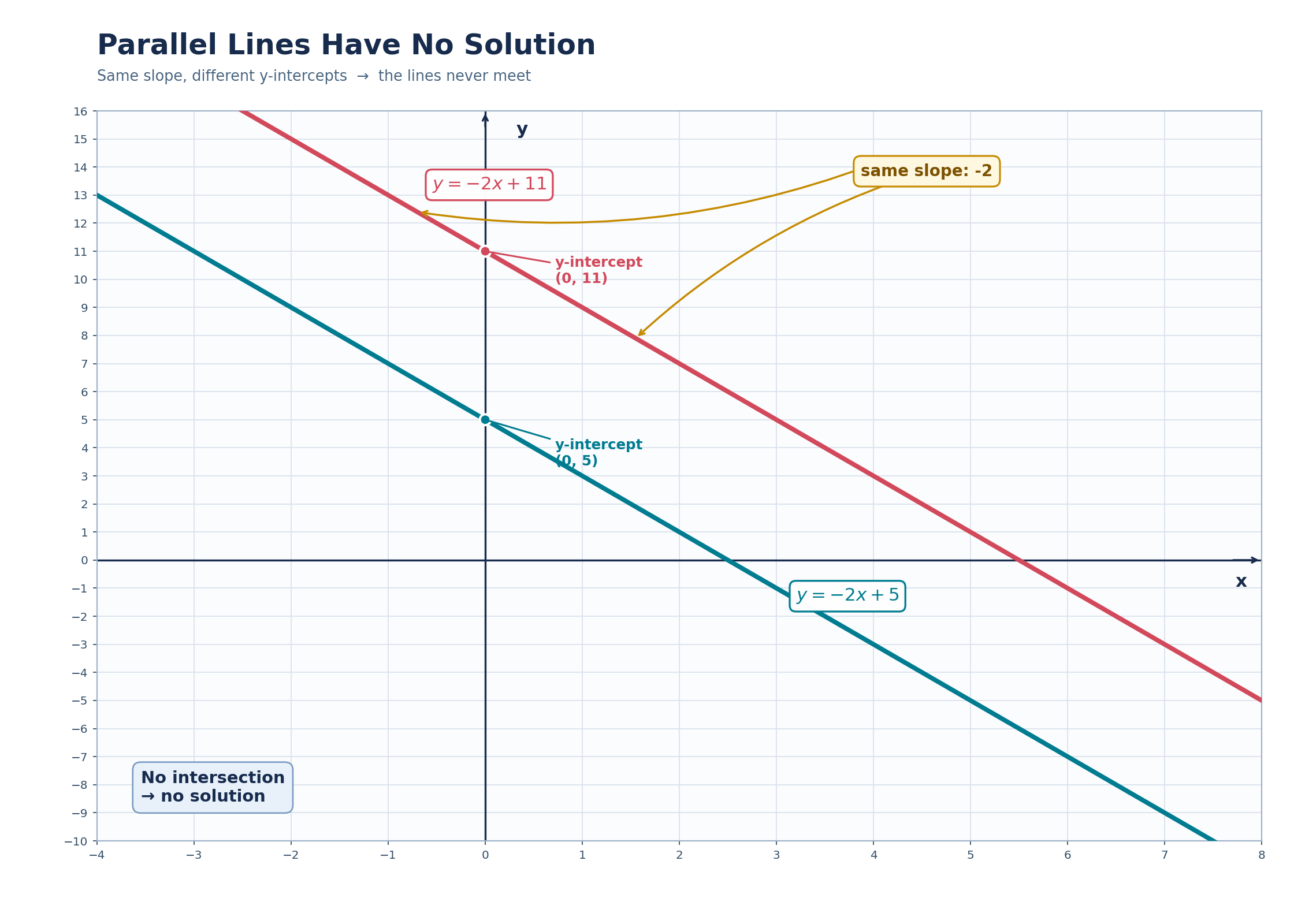
Let us connect the algebra to the picture. Rewriting both equations of our system in slope-intercept form, 2x+y=5 becomes y=−2x+5, and 2x+y=11 becomes y=−2x+11.
Both lines have slope −2, so they climb (or in this case fall) at exactly the same rate, but their y-intercepts differ: one crosses the y-axis at 5, the other at 11. Two lines with equal slopes and different intercepts are parallel. They stay a constant distance apart and never intersect, which is the geometric version of the contradiction we found.
That gap of 6 between the intercepts is not a coincidence, by the way. It is exactly the mismatch that surfaced as 0=−6 during elimination — the algebra exposed the difference in y-intercepts between two lines that were never going to meet.
Not every no-solution system is as transparent as the one above. Consider this pair, where the coefficients look unrelated at first glance:
{3x−6y=9−x+2y=4
Multiply the second equation by 3 so the x terms become opposites, giving −3x+6y=12. Adding that to the first equation:
(3x−6y)+(−3x+6y)=9+12⟹0=21
Both variables vanished and the numbers disagree, so this system has no solution too. A quick check in slope-intercept form confirms the geometry: the first equation gives y=21x−23 and the second gives y=21x+2. Equal slopes, different intercepts, parallel lines.
Contradictions are not just a classroom curiosity. Suppose two scooter services in your city both charge 0.30 per minute, but one has a $1 unlock fee and the other charges $3. Writing cost c as a function of minutes t gives c=0.3t+1 and c=0.3t+3.
If we ask when the two rides cost the same, elimination hands us 0=2. The reason is easy to feel: the two services accumulate charges at an identical rate, so the $2 head start never closes, not at one minute and not at a thousand. "No solution" here is a genuine piece of information, not a dead end — one option is simply always cheaper by exactly two dollars.
When we reach a contradiction, we should not write x=0, or y=21, or leave the page blank, since each of those claims something false. Instead, we state the conclusion plainly. Any of these phrasings works:
"No solution."
"The system is inconsistent."
"The solution set is empty," written in symbols as ∅ or {}.
A strong response pairs the algebra with the reason, for example: "Elimination gives 0=21, a false statement, so the lines are parallel and the system has no solution."
Three slips come up often when learners first meet this case, and spotting them in advance saves real frustration:
Treating the contradiction as an error. A result like 0=7 feels like something went wrong, so the temptation is to redo everything hoping for a nicer answer. Check the arithmetic once, and if the steps are sound, trust the contradiction.
Reporting zero as the solution. The line 0=−6 does not say x=0. It says nothing whatsoever about x, because x is no longer in the equation.
Confusing a false statement with a true one. Ending at 0=0 is a completely different situation and does not mean no solution.
In this lesson, we learned the algebraic fingerprint of a system with no solution. When substitution or elimination makes both variables cancel and leaves a false numeric statement such as 0=−6 or 5=11, no pair of values can satisfy both equations. Geometrically, the two equations describe parallel lines: same slope, different intercepts, never intersecting. The habit to carry forward is simple — when the variables vanish, stop and read the numbers, and if they disagree, report "no solution" with confidence rather than suspicion.
Time to put this into practice. In the exercises ahead, you will spot contradictions among finished solving attempts, drive an elimination all the way down to a false line yourself, and graph a stubborn system to watch its two parallel lines refuse to meet. After that, we turn to the other special outcome, the one where the final line is true.