Imagine an engineer checking the shape of a skate ramp. A sketch may show where the ramp is lowest, but a safety calculation needs the exact location and height. A quadratic equation can provide that point directly.
This is Lesson 5 of 6 in Nonlinear Graphs and Key Features, with only the final lesson remaining after this one. In Lesson 4, you learned to read extrema from a graph; now you will calculate a quadratic extremum from its equation and decide whether a domain restriction changes the result.
By the end of this lesson, you will be able to:
Read the vertex from vertex form.
Calculate the vertex from standard form.
Classify the vertex as a minimum or maximum.
Interpret a quadratic extremum in context.
Check a restricted domain and compare the vertex with endpoints.
Connect the Vertex to the Equation
The graph-reading method from the previous lesson gives us a starting point: a quadratic has one main direction change, located at its vertex. The new skill is to find that point exactly without relying on a graph or an estimate.
A vertex is written as an ordered pair:
V=(xv,yv),yv=f(xv).
The input xv tells you where the extremum occurs, while yv tells you the minimum or maximum output. The vertical line x=xv is also the quadratic's line of symmetry.
This symmetry explains why the vertex can be calculated. Points the same distance to the left and right of the symmetry line have the same output, so the vertex sits at the center of the parabola.
Read the Vertex Directly in Vertex Form
A quadratic in vertex form is written as
f(x)=a(x−h)2+k,a=0.
The squared expression becomes zero when x=h. Therefore, the vertex is
V=(h,k).
For example,
f(x)=3(x+2)2−7=3(x−(−2))2−7.
Here, h=−2 and k=−7, so the vertex is
V=(−2,−7).
Be careful with the sign inside the parentheses: (x+2)2 means (x−(−2))2, so the horizontal coordinate is −2, not 2. Similarly, g(x)=−2(x−5)2+9 has vertex (5,9).
Calculate the Vertex from Standard Form
A quadratic in standard form is written as
f(x)=ax2+bx+c,a=0.
The x-coordinate of the vertex is calculated with
xv=−2ab.
After finding xv, substitute it into the original function:
yv=f(xv).
The formula comes from rewriting standard form as vertex form by completing the square:
ax2+bx+c=a(x+2ab)2+(c−4ab2).
The squared expression is zero at x=−2ab, which is why that value gives the axis of symmetry and the vertex's input.
Consider
f(x)=2x2−12x+11.
The coefficients are
a=2,b=−12,c=11.
First, calculate the input of the vertex:
xv=−2(2)−12=3.
Now substitute x=3 into the original function:
yv=f(3)=2(3)2−12(3)+11=18−36+11=−7.
Therefore, the vertex is
V=(3,−7).
Join the 1M+ learners on CodeSignal
Be a part of our community of 1M+ users who develop and demonstrate their skills on CodeSignal
Classify the Extremum with the Leading Coefficient
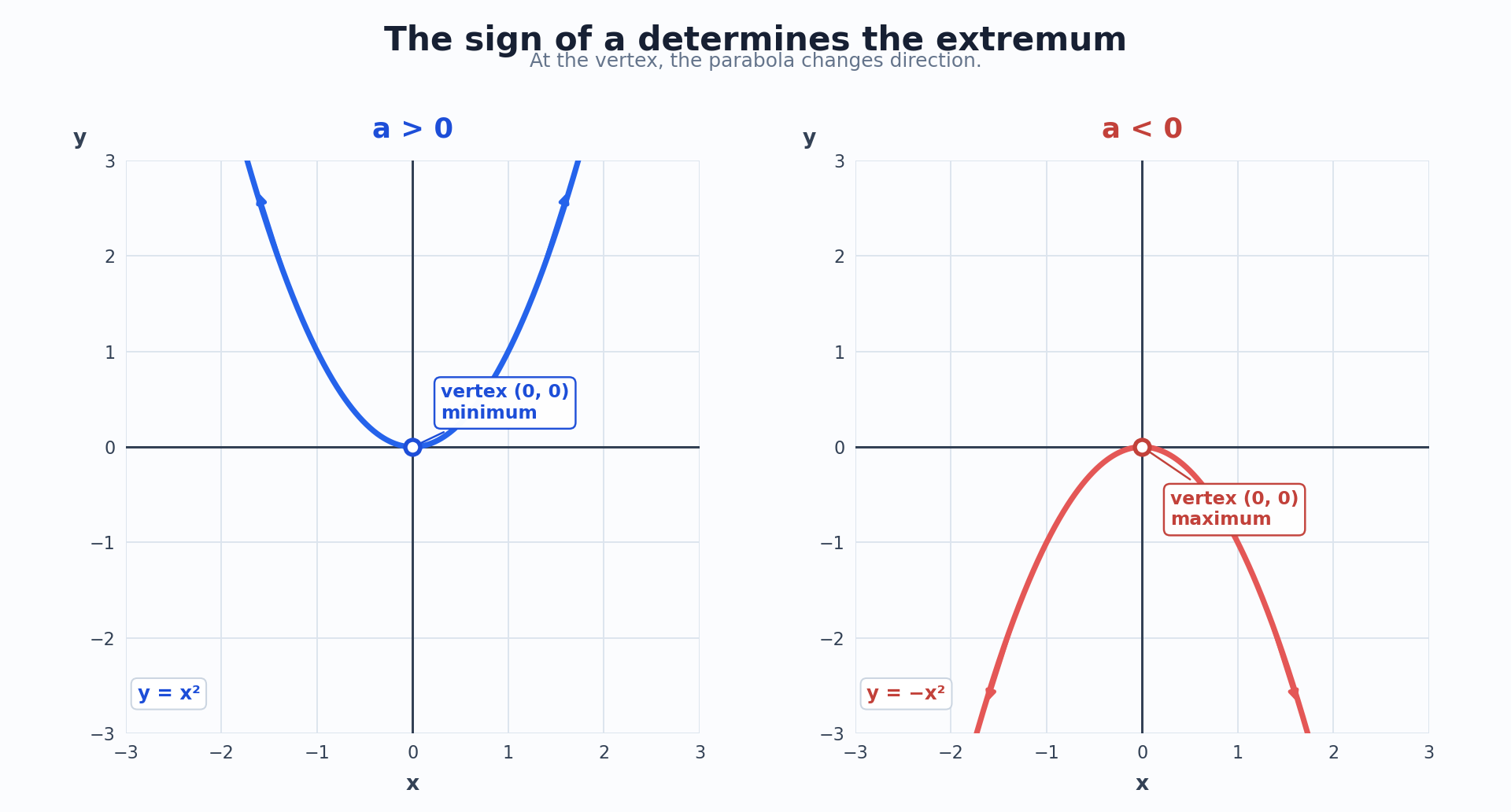
The leading coefficient is a, the coefficient attached to x2. Its sign tells you whether the parabola opens upward or downward. Since a squared quantity is never negative, multiplying it by a positive or negative number determines whether the vertex is the lowest or highest point.
If a>0, the parabola opens upward, so the vertex is a minimum.
If a<0, the parabola opens downward, so the vertex is a maximum.
Do not use the sign of yv to classify the extremum. A minimum can have a positive or negative output, and the same is true of a maximum. On the domain of all real numbers, the vertex is an absolute minimum when a>0 and an absolute maximum when a<0; a restricted domain requires an additional check.
The coordinates of a vertex become more useful when you connect them to the quantities in a situation. Suppose the height of a ball is modeled by
h(t)=−16t2+48t+5,
where t is the number of seconds after launch and h(t) is the height in feet.
Here, a=−16 and b=48, so the time at the vertex is
tv=−2(−16)48=1.5.
Evaluate the height at that time:
h(1.5)=−16(1.5)2+48(1.5)+5=−36+72+5=41.
The vertex is therefore (1.5,41). Because a<0, the parabola opens downward, so the ball reaches a maximum height of 41 feet after 1.5 seconds, assuming the model applies during that time.
Part of the vertex
Meaning in the model
tv=1.5
The ball reaches its highest point 1.5 seconds after launch
h(tv)=41
The highest point is 41 feet above the reference level
The input tells you when or where the extremum occurs, while the output tells you how much or how high. Always include both values and their units when explaining a real-world answer.
A quadratic equation describes a full parabola, but a real situation may use only part of it. If the domain is a closed interval, compare the vertex when it is included and the included endpoints.
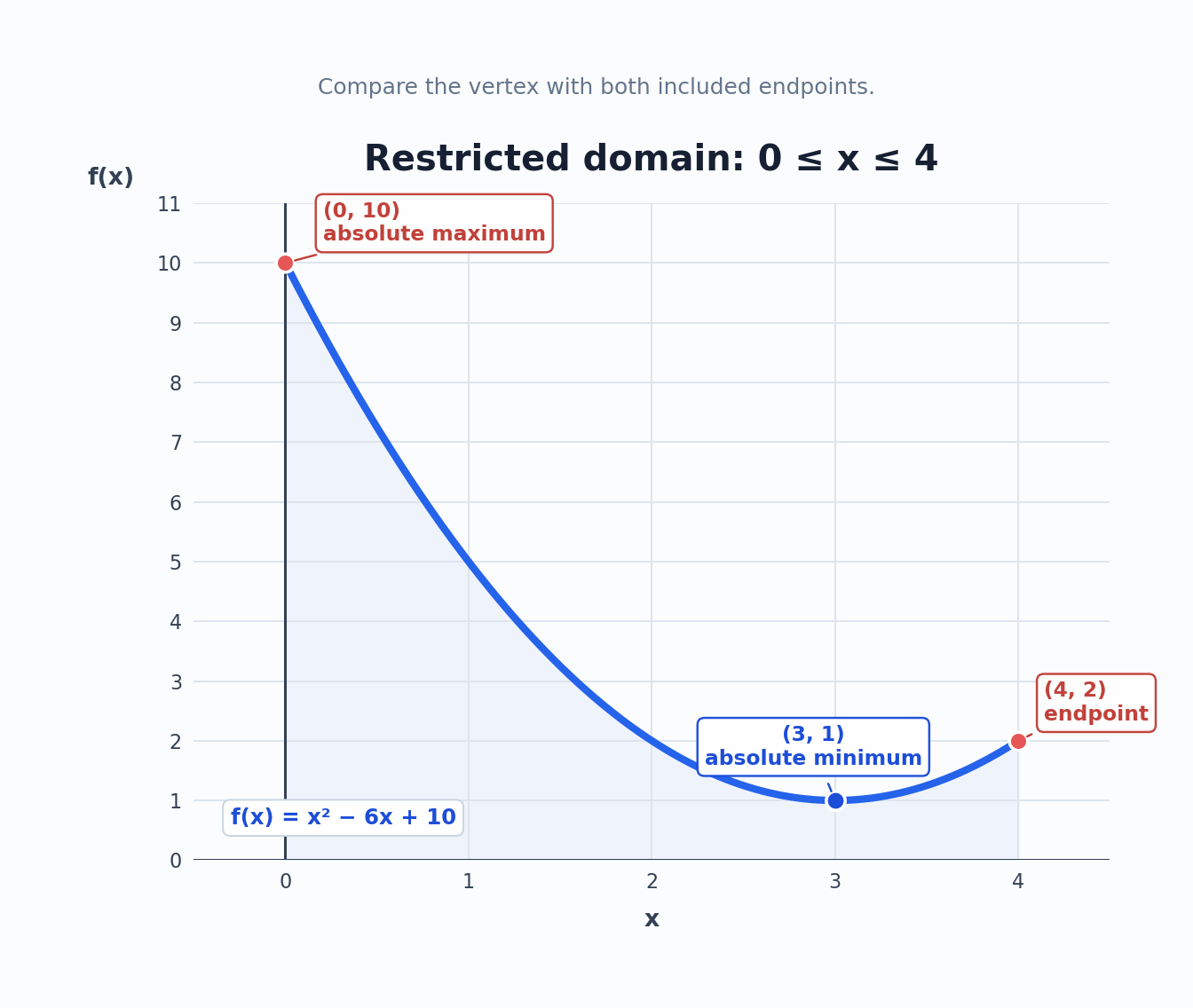
Consider
f(x)=x2−6x+10,0≤x≤4.
The vertex input is
xv=−2(1)−6=3,
and its output is
f(3)=32−6(3)+10=1.
The vertex (3,1) is allowed because 3 is in the domain. Check the endpoints as well:
Candidate point
Output
(0,10)
f(0)=10
(3,1)
f(3)=1
(4,2)
f(4)=2
Because the parabola opens upward, (3,1) is the absolute minimum on the restricted domain. The largest listed output is 10, so (0,10) is the absolute maximum.
If the same function had the domain 4≤x≤6, the vertex input x=3 would not be allowed. In that case, compare the endpoints: f(4)=2 and f(6)=10, so the restricted graph would have a minimum at (4,2) and a maximum at (6,10). The vertex of the full parabola still exists, but it is not part of this restricted graph.
When calculating a quadratic extremum, work through the following routine:
Identify the form. In vertex form, read h and k; in standard form, identify a, b, and c.
Find the vertex input. Use xv=h in vertex form or xv=−2ab in standard form.
Find the output. Substitute xv into the original function to calculate yv.
Write the complete point. Record the vertex as (xv,yv).
Classify the full parabola. Use a>0 for a minimum and a<0 for a maximum.
Check the domain. If the domain is restricted, compare the allowed vertex with the included endpoints.
Explain the result. State what both coordinates mean and include units when appropriate.
Most errors in this topic come from signs, substitution, or domain restrictions rather than difficult algebra. Use these checks before finalizing your answer.
In vertex form, the sign inside the parentheses is reversed: (x+2)2 has h=−2.
The standard-form formula includes a negative sign: xv=−2ab.
The denominator is 2a, not 2b; use parentheses when a is negative.
In standard form, c is the y-intercept when x=0 is in the graph, not usually the vertex's output.
Finding xv is only half the task; substitute it to find yv.
Use the sign of a, not the sign of yv, to classify the extremum.
If the vertex lies outside the domain, do not report it as an extremum of the restricted graph.
Avoid rounding xv before calculating yv when an exact or more accurate answer is possible.
In vertex form, f(x)=a(x−h)2+k, the vertex is (h,k).
In standard form, f(x)=ax2+bx+c, calculate the vertex input with xv=−2ab and then find yv=f(xv).
If a>0, the vertex is a minimum; if a<0, it is a maximum.
The sign of the vertex output does not determine the type of extremum.
On a restricted domain, compare the allowed vertex with included endpoints.
A complete interpretation includes the vertex coordinates, their meanings, and their units when available.
You can now calculate a quadratic's exact vertex instead of estimating it from a graph. Read the coordinates directly in vertex form, or use xv=−2ab in standard form and then evaluate the function. Use the sign of a to classify the extremum and the domain to decide whether it is absolute.
In the practice section, you will calculate vertices from standard-form quadratics, classify each extremum, and interpret the coordinates in realistic settings. Show the substitution used to find yv so that each answer is easy to check and explain.