Tracing Prediction Pathways
Tracing Inputs Toward a Prediction 🧭
In the last lesson you saw how a tool builds meaning in layers, from small details up to a final judgement. Now we follow a single case all the way through: one customer request arrives, and a few moments later a destination pops out. When someone asks you "why did it do that?", this is the walk you'll take them on. Your job in this lesson is not to know the machinery. It is to describe the journey in words a colleague can repeat.
In this lesson, you will learn to:
- Trace how a request moves forward to one prediction
- Explain activation as learned patterns responding more or less strongly
- State what one prediction does and does not tell you
Information Moving Forward to One Answer ➡️
Here is the whole idea in one sentence you can borrow: the request comes in at one end, passes through a series of stages that each summarise what they were handed, and comes out the other end as a single best guess. That one-way trip is what a data team calls a forward pass. Nothing goes backwards during it. Nothing gets debated. The information simply moves forward until it becomes one answer.
It helps to picture a message being passed down a line of colleagues. The first person reads the whole thing and jots a few notes. The second person never sees the original, only those notes, and writes a shorter summary. By the time it reaches the last person in the line, what arrives is not the customer's words at all. It is a compressed impression of them, and the last person turns that impression into a decision: send this to billing.
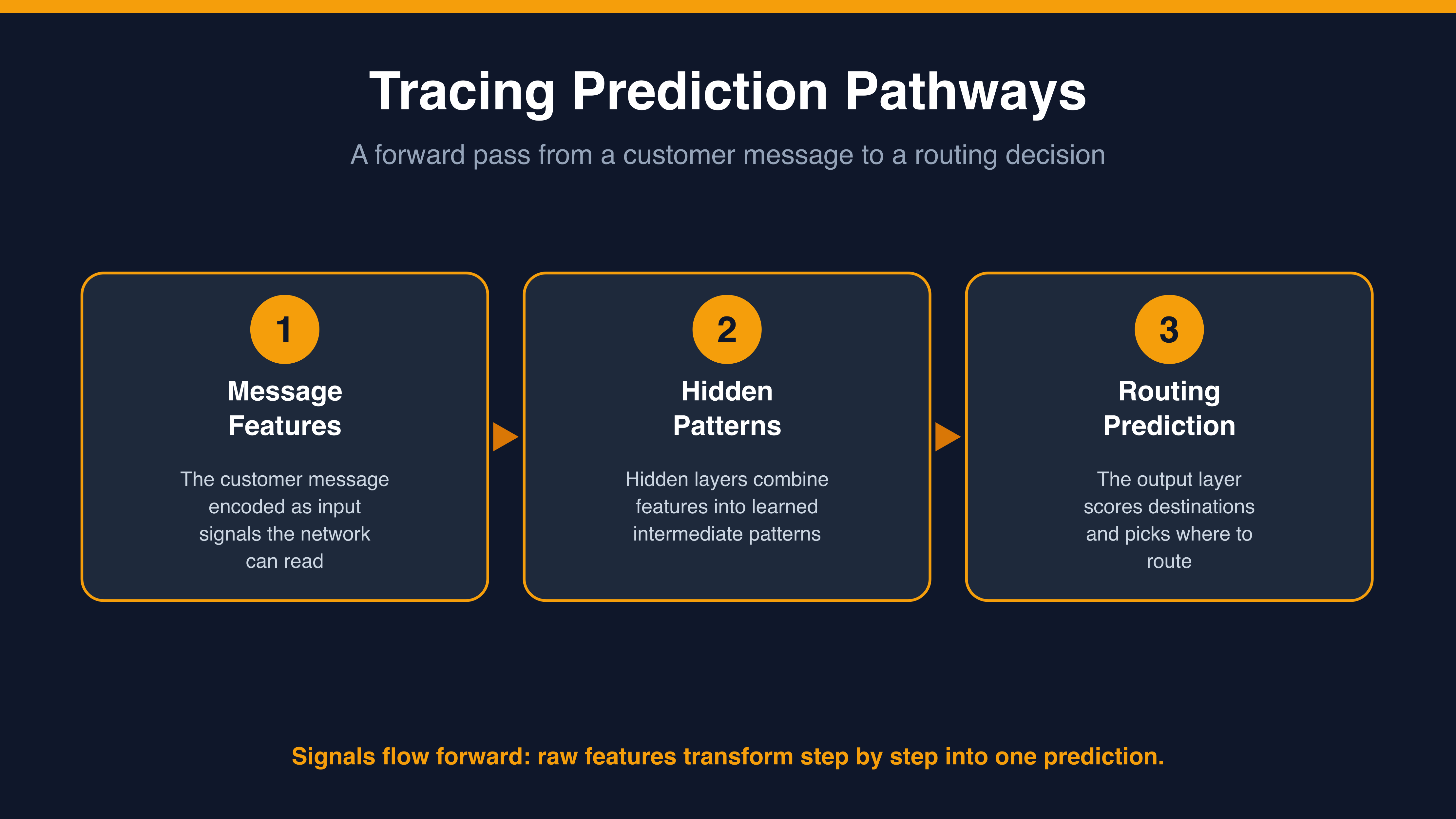
Two things follow that are worth saying out loud when you explain this. First, the output is one choice, not a report. Second, every stage transformed what it received into a new internal representation, emphasizing some patterns more than others. That is not a flaw. It is how the thing works, and it is exactly why a prediction can be reasonable and still miss something obvious to a human reading the original message.
Some Signals Get Louder, Others Fade 🔊
At each stage, some learned patterns respond more strongly to the input while others respond weakly. A useful way to picture this is a volume dial: some internal patterns become more active and others stay quieter. This level of response is what people mean by activation: not a switch that is on or off, but a signal that can be louder or quieter. This is an intuition for activation, rather than a literal ranking of individual words by importance.
This is the sentence that usually unlocks the conversation for a sponsor: the tool is not weighing importance the way you would. It is amplifying whatever patterns have been useful for this particular decision in the past. For example, patterns associated with invoice numbers and billing language may contribute strongly to a billing prediction, while urgency-related patterns may contribute less if they have not helped distinguish destinations in past cases. A phrase like "third time asking" may carry enormous weight for a human and almost none for a routing tool, simply because it appears across every kind of request and never helped separate one queue from another.
Victoria, an account lead, tests the explanation with Nova, the data colleague coaching her on how to describe the routing decision.
- Victoria: So it decided the customer wasn't angry?
- Nova: It never asked that question. It was only ever sorting for destination, and the strongest signals in that message were an invoice number and the word "charge."
- Victoria: And "this is now urgent"? That was right there in the second line.
- Nova: It faded. Urgency wording shows up in requests headed to every queue, so it has almost never helped separate one from another. Billing terms have.
- Victoria: So it's not that it disagreed with me about the customer. It just wasn't looking at that at all.
- Nova: That's exactly it. Say it that way to the account manager.
Notice what Nova does not do. She never defends the outcome and she never says the tool "thought" anything. She replaces a judgement story with a signal story, and Victoria ends up with a sentence she can actually send.
