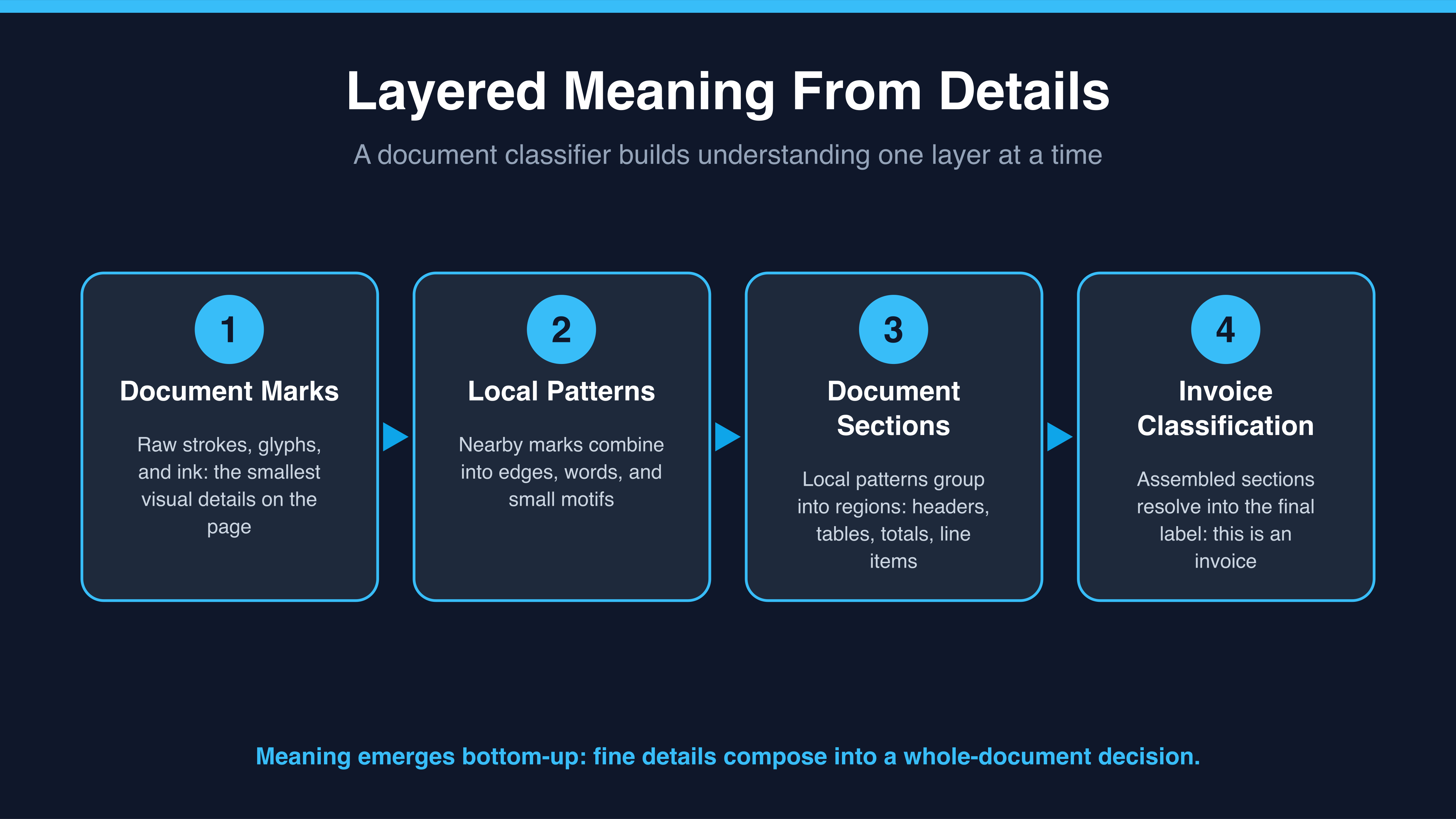
Layered Meaning From Details
Welcome to the Course 🎉
You don't need to build a neural network to be responsible for one. What you do need is a mental picture accurate enough that you can explain the tool to your team, ask the data team a sharp question, and know when an impressive result deserves scepticism. Above all, the skill this course builds and assesses is explaining neural networks to sponsors and holding a clear recommendation — not building them. This course gives you that picture in everyday language, with no equations and nothing to memorise.
By the end of this course, you'll be able to:
- Explain in plain words how a system builds meaning layer by layer, from simple details to a useful judgement
- Trace how one real case travels from raw input to a single prediction, and say what that prediction does not tell you
- Recommend a defensible next step when a system looks excellent on familiar cases and fails on unfamiliar ones
This first lesson starts at the foundation: the layered idea, and how to say it out loud so a colleague actually remembers it.
In this lesson, you will learn to:
- Explain how simple details combine into richer patterns
- Trace a document from marks to an invoice classification
- Teach the layered-representation idea without overstating what the tool understands
Simple Details Combining Into Larger Patterns 🧩
Here's the whole idea in one sentence: the system doesn't look at something and instantly know what it is; it notices very small things first, then notices which small things tend to appear together, then which of those groupings tend to appear together, until something meaningful emerges at the end.
Think about how you recognise a colleague walking toward you from the far end of a corridor. You are not consciously identifying a face. At that distance you are picking up a height, a gait, a coat colour. Those simple details combine into a rough shape, the shape combines with a walking rhythm you have seen a thousand times, and only then does "that's Priya" arrive. Nobody handed you a rule that said "if coat is navy and stride is quick, then Priya." You built it up from small pieces without ever writing the pieces down.
That's what people mean by layered representation. Each layer works with what the layer before it produced, and each layer's output is a little richer, a little more meaningful, and a little further from the raw material. The critical part for you as a leader is what this implies: the meaningful judgement at the end is not something the system was told; it is something that was assembled. Which means it can be assembled wrongly, and you'll rarely be handed a clean reason why.
This is how Tom, a business lead, checks his understanding with Nova, the data colleague helping him explain the tool accurately.
- Tom: So when the tool says a document is an invoice, what part of it decided that?
- Nova: No single part. The early layers only see edges and marks. The next layers notice those marks form boxes and number blocks. The layers after that notice a block in the corner behaves like a total, and a paragraph behaves like payment terms.
- Tom: And the answer comes at the end?
- Nova: Right. The last layer is only looking at those bigger patterns, not at the page. It's a stack of small observations turning into one conclusion.
- Tom: So if it gets it wrong, it's not a broken rule I can go and fix.
- Nova: Exactly. That's the honest part to tell your team.
Notice what Nova avoided: she never said the tool "reads" or "understands." She described a build-up, which is both accurate and repeatable by someone who wasn't in the room.