Understanding Loss and Backpropagation
Explaining Error and Adjustment 🎯
So far you've walked a request forward: in one end, through the stages, out as a single answer. The obvious question a sponsor asks next is the one you now need a plain answer for: "Fine, but how does it get better?" This lesson gives you that answer in language you can say out loud, without a single formula. And it protects you from the most common misunderstanding in the room, which is that improving one of these tools works like fixing a broken rule.
In this lesson, you will learn to:
- Explain loss as the gap between a prediction and a known outcome
- Describe backpropagation as tracing that gap backward for small adjustments
- Set realistic expectations for improvement across many training rounds
How Wrong Was It? The Simple Idea Behind Loss 📏
Start with the smallest piece. Every time the tool makes a prediction during training, someone already knows the right answer, because these are past cases with recorded outcomes. So you can compare the two: what it guessed, and what actually happened. The gap between those is what a data team calls loss. That's all it is: a measure of how wrong one prediction was.
Two things make that idea more useful than it first sounds. First, it isn't a yes or no verdict. It carries a sense of how far off the guess was, so being slightly wrong and being wildly wrong are not treated the same. Second, it is calculated on one case at a time. There is no grand assessment of the tool's character, just a running series of small verdicts: this one was close, this one was miles out, this one was fine.
Here's a borrowable sentence for your next sponsor conversation: "After every guess, it gets told the right answer and how far off it was. That gap is the only feedback it ever receives." Say it that way and you've quietly killed the idea that the tool is being reasoned with, argued with, or corrected by an engineer's judgement. It is being scored, case by case.
Tracing the Gap Backward to Find What to Nudge ↩️
Now the interesting part. Knowing the answer was wrong doesn't tell you what to change. So the tool works the gap backward through the stages it just came forward through, asking at each one: how much did what happened here contribute to that gap, and which direction should this be nudged to shrink it? That backward trace is what people mean by backpropagation. Nothing mystical, just error attribution, running in reverse.
The analogy that lands best with business audiences is coaching, and it's worth having ready. A sales rep makes an attempt at a pitch. You compare what happened with what you wanted. You trace back which choices contributed to the gap: opened with pricing before value, talked past the buying signal, skipped the close. Then you change two or three small things before the next attempt. You do not rebuild the rep.
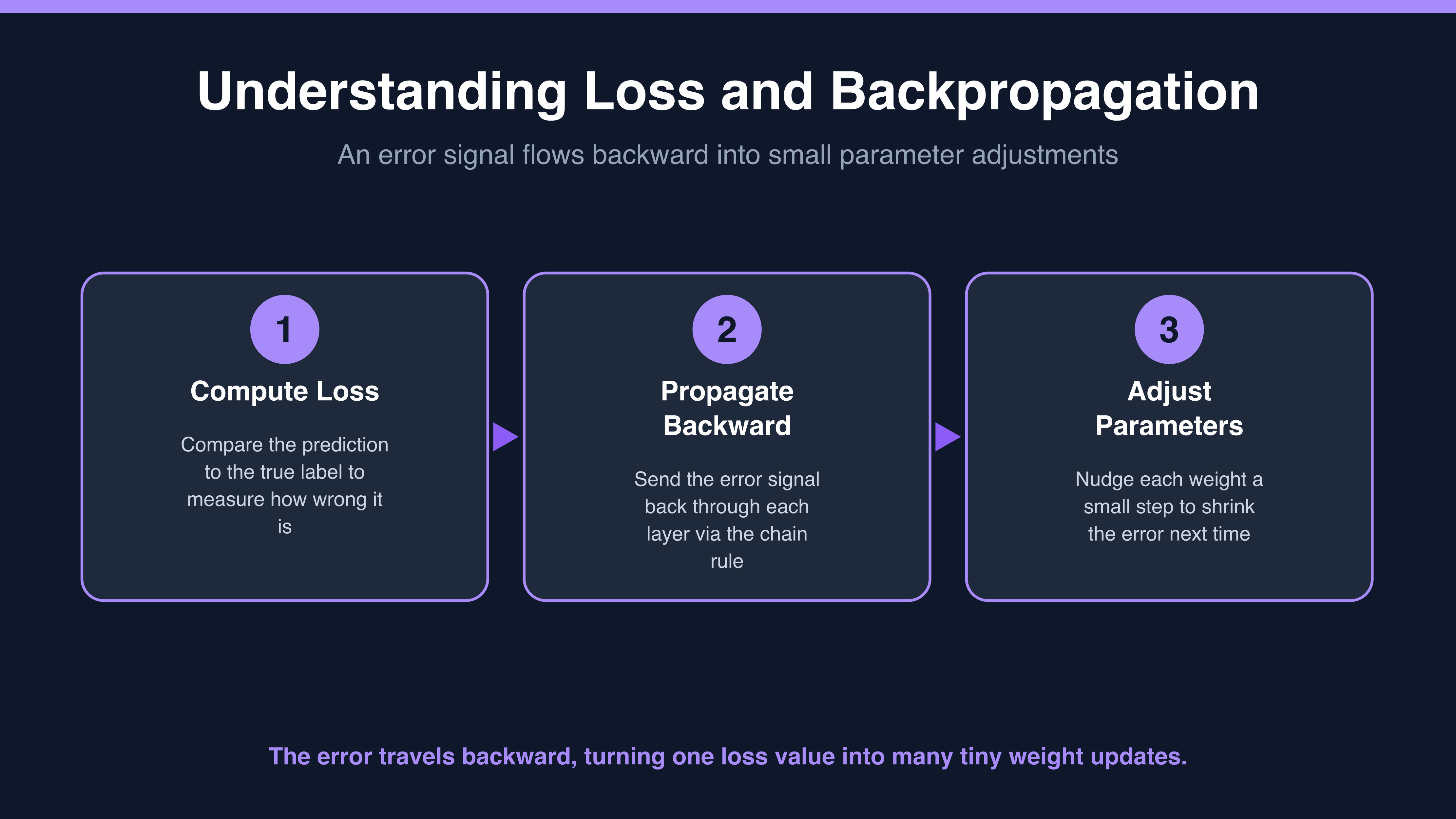
Natalie, a sponsor testing the explanation, asks Ryan, the data colleague who owns the routing tool's training loop, to make the adjustment process concrete.
- Natalie: So when it gets one wrong, someone goes in and corrects it?
- Ryan: No one goes in at all. It compares its answer to the recorded one, sees how far off it was, then works that gap backward through each stage to see which parts pushed it in the wrong direction.
- Natalie: And then it fixes those parts.
- Ryan: It nudges them. Very slightly. Same as coaching a rep after one call: you don't rewrite their whole approach off a single conversation, because that one call might have been unusual.
- Natalie: Because you'd overreact to a bad day.
- Ryan: Exactly. Small nudge, next attempt, look again.
Notice that Ryan never says the tool "realises" or "understands" anything. He keeps every verb mechanical, and when Natalie reaches for "fixes," he swaps in "nudges" without making it a correction. That word swap is doing most of the work.
