Welcome back to Multiplying Signed Numbers: Why the Rules Work! With three lessons behind us, we are now on Lesson 4 of 5 — nearly at the finish line. So far, we learned how to expand and factor expressions using the distributive property, and then we proved that multiplying any number by −1 simply produces its opposite.
Today we take the next step: what happens when we multiply a positive number by any negative number, not just −1? We will answer this question from three angles — repeated addition, number patterns, and the distributive property — so that by the end, the result will feel both inevitable and well understood.
Connecting to What We Already Know
In the previous lesson, we showed that (−1)×a=−a for every value of a. That result is actually the key ingredient for everything ahead. Any negative number can be written as −1 times a positive number — for instance, −4 is the same as (−1)×4, and −7 is the same as (−1)×7.
So when we write a product like 3×(−4), we are really multiplying 3 by a quantity that already has −1 baked into it. Keeping that connection in mind will make each approach below feel like a natural extension of what we have already proven.
Repeated Addition
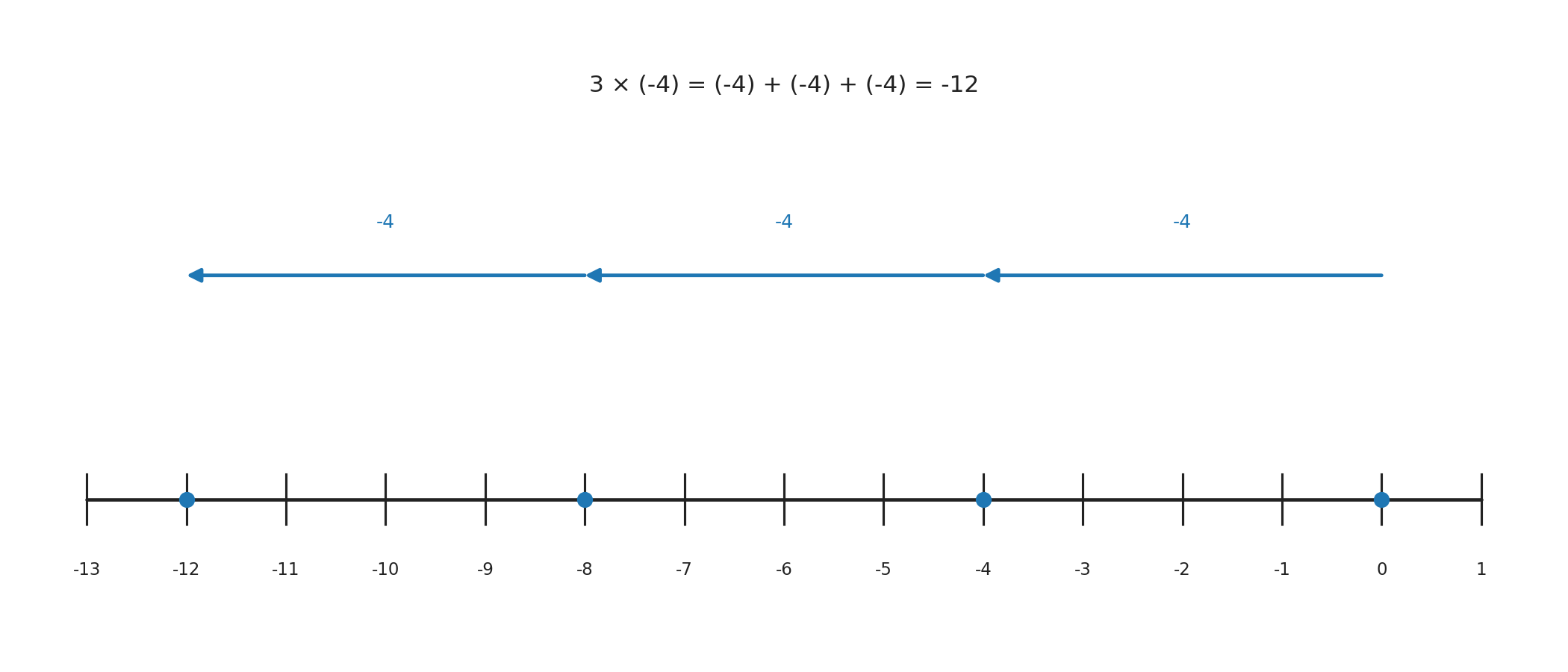
One of the earliest ways we learn about multiplication is as repeated addition: 3×4 means "add 4 three times." The same idea works perfectly well when the number being added is negative. If we write 3×(−4), it means "add −4 three times":
3×(−4)=(−4)+(−4)+(−4)=−12
Each time we add another −4, we move four more units to the left on the number line. Three such moves land us at −12.
Here is another example with 5×(−2):
5×(−2)=(−2)+(−2)+(−2)+(−2)+(−2)=−10
Notice the emerging rule: the size of the answer is just the ordinary product of the two absolute values (3×4=12, or 5×2=10), and the sign is always negative. Repeated addition makes this feel natural because adding a negative value over and over can only pull us further below zero.
Join the 1M+ learners on CodeSignal
Be a part of our community of 1M+ users who develop and demonstrate their skills on CodeSignal
Spotting the Pattern
The Distributive Property Proof
What if the negative number comes first?
A Real-World View
Conclusion and Next Steps
In this lesson, we established that the product of a positive number and a negative number is always negative. We arrived at this result three different ways: repeated addition showed that adding a negative value multiple times pulls the total further below zero, a descending pattern revealed that products must keep decreasing through zero, and the distributive property proved that the product is always the opposite of the positive magnitude, regardless of which factor comes first.
Now it is time to put this knowledge into practice! Up next, you will identify product signs at a glance, complete number patterns that cross into the negatives, compute products on your own, and model a real-world recurring-cost scenario using positive-times-negative reasoning. Let's jump in and make these ideas stick.
Repeated addition gives us a hands-on feel for the result, but a simple number pattern makes it even harder to deny. Start with products we already trust and watch what happens as the second factor decreases by one each time:
Expression
Product
3×3
9
3×2
6
3×1
3
3×0
0
Each time the second factor drops by 1, the product drops by 3. If multiplication is going to follow a consistent pattern, that same decrease must continue:
Expression
Product
3×(−1)
−3
3×(−2)
−6
3×(−3)
−9
The products keep falling by 3, passing right through zero and into the negatives. There is nothing special about the number 3 here — you could build the same descending pattern with any positive first factor and reach the same conclusion. A positive number times a negative number must be negative for the pattern to stay unbroken.
Patterns and repeated addition are persuasive, but the distributive property gives us a rock-solid proof. Let's show that a×(−b) is negative whenever a and b are both positive.
Start with the fact that b+(−b)=0. Multiply both sides by a:
a×(b+(−b))=a×0=0
Now expand the left side using the distributive property:
a×b+a×(−b)=0
Since a and b are both positive, a×b is a positive number. For the sum to equal zero, a×(−b) must be its opposite:
a×(−b)=−(a×b)
This tells us two things at once: the sign of the product is negative (the − in front), and the magnitude is just the ordinary product a×b. For example, 6×(−5)=−30.
If we have a product like (−5)×6, we can use the distributive property again to show the result is the same:
(5+(−5))×6=0×6=0
Expanding this gives 5×6+(−5)×6=0. For the sum to be zero, (−5)×6 must be −30. This confirms that the commutative property—the rule that the order of factors doesn't change the product—still holds true even when one of the numbers is negative.
All three approaches agree on the rule, so let's see why a negative product makes sense in everyday life. Imagine a gym membership that charges $7 per week, automatically deducted from your account. Each weekly charge changes your balance by −7 dollars. After 3 weeks, the total change is:
3×(−7)=−21
Your balance has dropped by $21. The positive factor (3) counts how many times the charge repeats, and the negative factor (−7) captures the direction of each change — money leaving your account. The product −21 tells us the overall effect: a $21 loss. A positive answer here would suggest you gained money from being charged, which clearly makes no sense!
This pattern shows up whenever a loss or decrease happens repeatedly: temperature falling a certain number of degrees each hour, a fuel tank losing liters per trip, or points deducted per wrong answer on a quiz. In every case, the positive factor counts the repetitions and the negative factor represents the per-event change, making the product negative.