Multiplying by Negative One
Introduction
Welcome back to Multiplying Signed Numbers: Why the Rules Work! In the first two lessons of this course, we built a solid toolkit: we learned how to expand expressions with the distributive property and then how to factor them by reading that same property in reverse.
Now, in this third lesson, we put those skills to work and bring negative numbers into the picture for the first time. Specifically, we will explore what happens when you multiply any number by . The answer is surprisingly clean, and the distributive property you have been practicing will tell us exactly why it must be true.
What Does "Opposite" Mean?
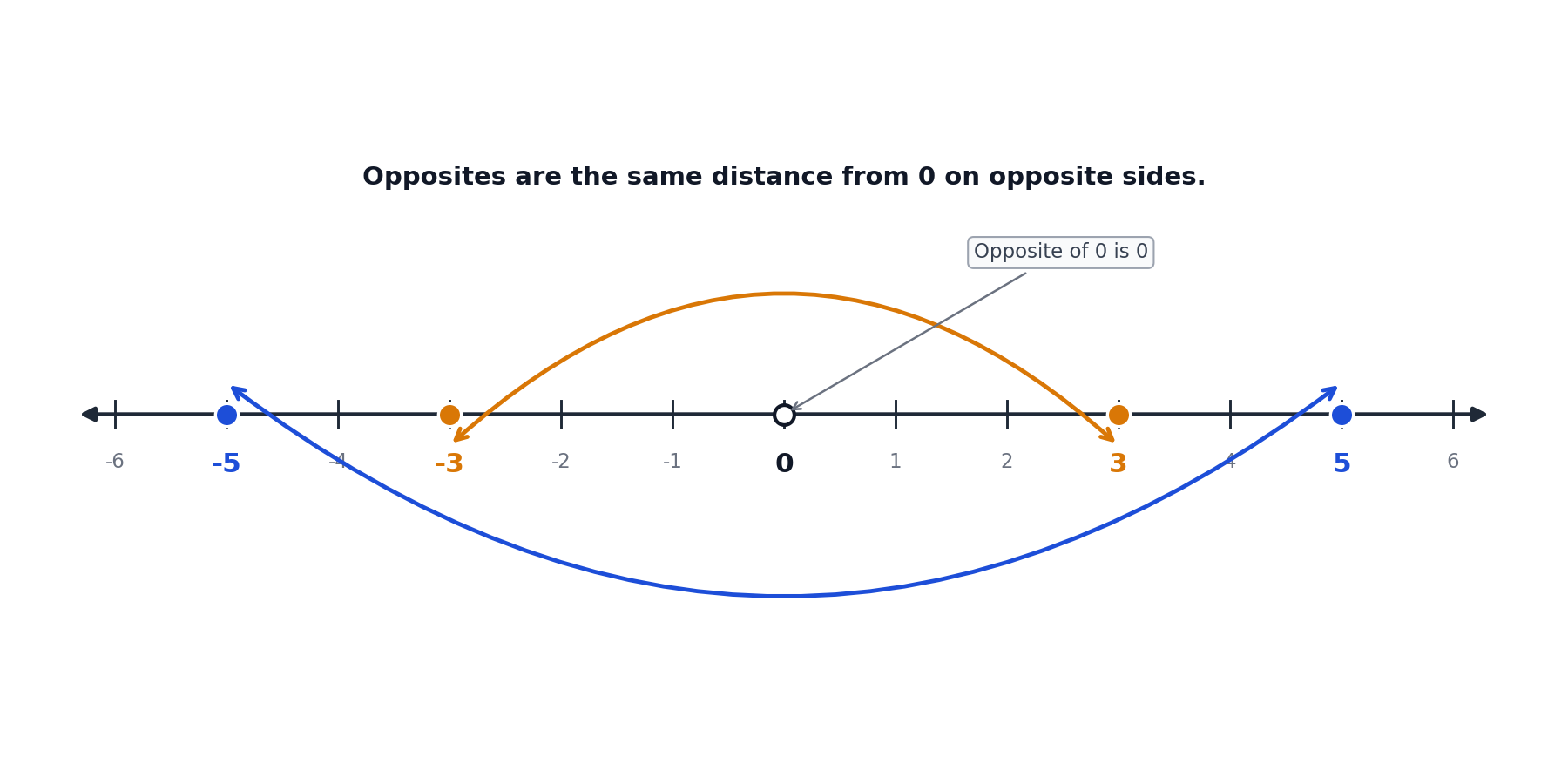
Before we dive into multiplication, let's make sure we share a clear understanding of the word opposite in mathematics. The opposite of a number is the value that sits the same distance from zero on the number line but on the other side.
The opposite of is , and the opposite of is . The opposite of is simply itself, since zero is neither positive nor negative.
We often write the opposite of a number as . That notation can be tricky at first, because does not always mean "a negative number." If happens to be , then , which is positive. The symbol simply means "whatever is on the other side of zero from ."
Discovering the Rule with the Distributive Property
With the idea of "opposite" in hand, let's figure out what must equal for any number . We only need two facts we already know:
- The distributive property:
Start with the expression . Since , the whole product equals zero:
Now expand the expression using the distributive property:
We know that , so this simplifies to:
What number, when added to , gives zero? That number is the opposite of , which is . Therefore:
In plain language: multiplying any number by produces its opposite.
By deriving the rule this way, we ensure that multiplication remains consistent. If we want properties like the distributive property and commutativity (the rule that the order of multiplication doesn't change the result, such that ) to keep working with signed numbers, then has no choice but to equal .
