Factoring Numerical Expressions
Introduction
Welcome back to Multiplying Signed Numbers: Why the Rules Work! In Lesson 1, we learned how to expand expressions like into using the distributive property. That was reading the property from left to right.
In this second lesson, we flip the direction. Starting from a sum like , we will rewrite it as the product . This reverse process is called factoring, and it is just as important as expanding. Mastering it now will give us a powerful tool for reasoning about signed multiplication in the lessons ahead.
Reading the Distributive Property Backward
Recall that expanding means rewriting it as . But what if we start with instead? If we notice that both 15 and 20 share the factor 5, we can "pull it out" and write .
We have not changed the value at all — we have simply read the distributive property from right to left. That is the core idea behind factoring: spotting a shared multiplier in a sum and repackaging the expression as a single product.
Pulling Out a Common Factor
When we factor a sum, we rewrite it as a product. Formally, factoring reverses the distributive property:
The shared multiplier is called the common factor, and the terms inside the parentheses are what remain after we divide each original term by .
Let's try this with . Both numbers are divisible by 6, so we write . A quick check confirms: . ✓
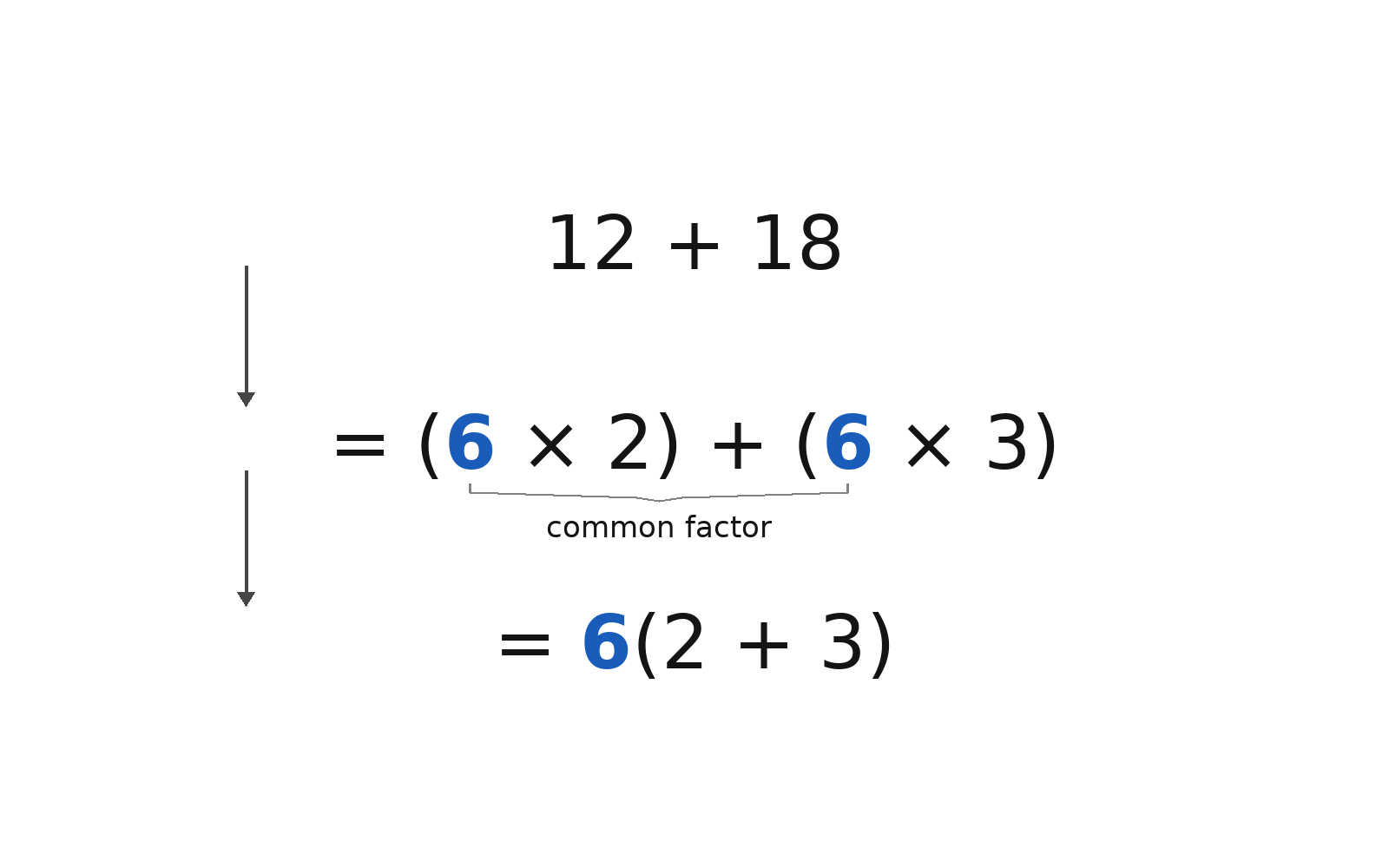
Notice that 6 is not the only factor we could pull out. We could also write or , and both would be correct. When multiple common factors exist, we prefer the greatest common factor (GCF) — the largest number that divides evenly into every term. For , the GCF is 6, making the most complete factored form.
If the only common factor between terms is 1, we say the terms are relatively prime. In these cases, the expression cannot be factored further using whole numbers. For example, in the expression , the numbers 7 and 10 share no common factor other than 1, so the expression is already in its simplest form.
