The Distributive Property
Introduction
Welcome to Multiplying Signed Numbers: Why the Rules Work! This is the first lesson of the course, and we are starting from the ground up. Over the coming lessons, we will build a solid understanding of why the rules for multiplying positive and negative numbers work the way they do, rather than just memorizing them.
Before we can explore signed numbers, though, we need one key tool in our toolkit: the distributive property. In this lesson, you will learn how to expand numerical expressions like into , verify that both forms give the same result, and understand why this property is so important that it must always hold true.
Splitting a Purchase
Imagine you are buying 4 gift bags, and each bag contains a $5 toy and a $2 candy bar. How much do you spend in total?
One natural approach is to figure out the cost of one bag first: dollars. Then multiply by 4 bags: dollars.
But there is another way. You could calculate the total cost of all the toys () and the total cost of all the candy bars (), then add those together: dollars. Both approaches give the same answer, and that is no coincidence.
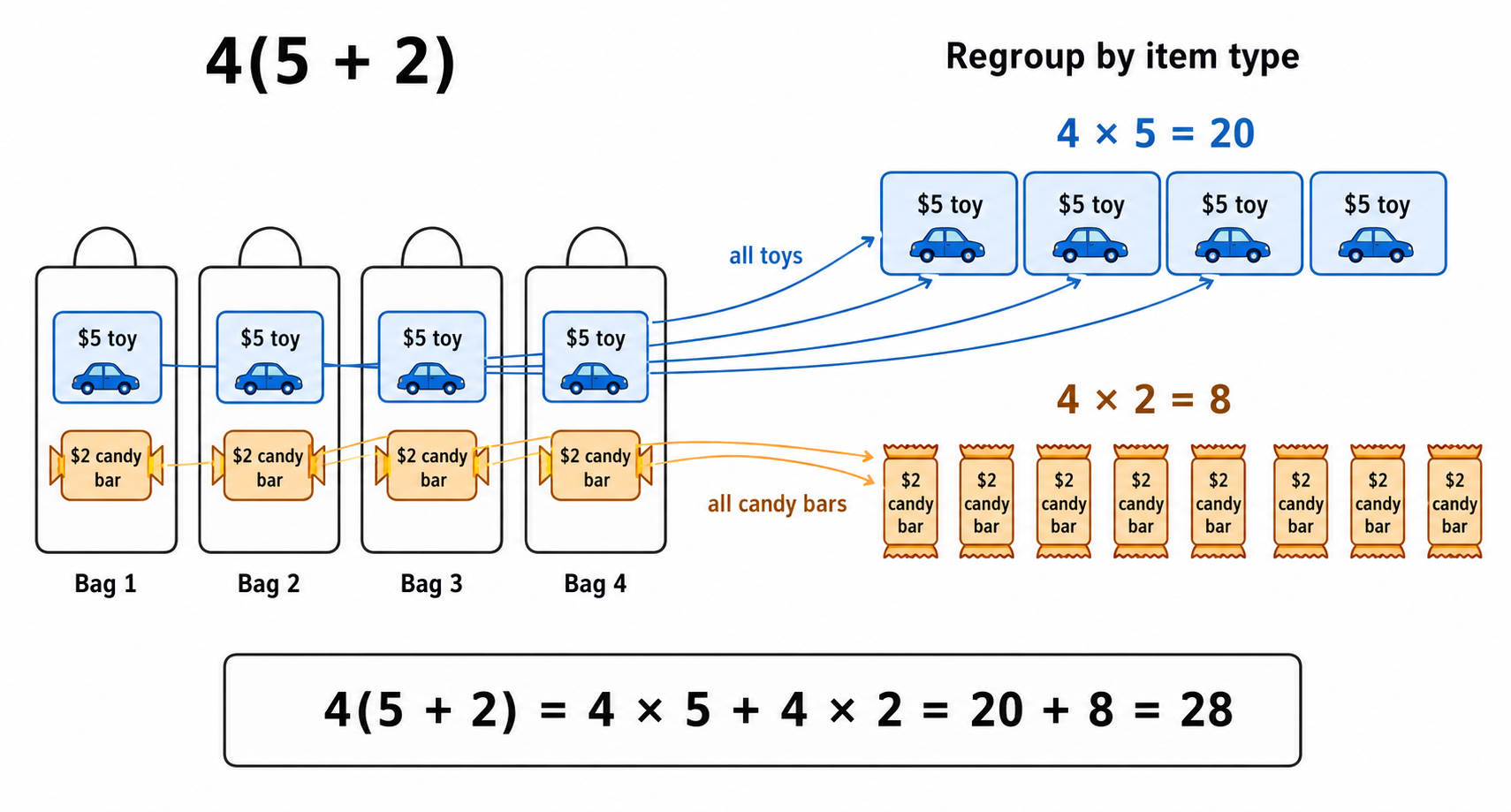
This idea of "multiplying the whole thing" versus "multiplying each part and adding" is exactly what the distributive property captures.
The Distributive Property
The distributive property states that for any numbers , , and :
In words: multiplying a number by a sum is the same as multiplying it by each part of the sum separately and then adding the results. The two sides of this equation are simply two different ways of computing the same value.
Let's see this with a concrete example. Consider :
- Left side (add first):
- Right side (distribute first):
Both paths land on 36. The distributive property guarantees this will always happen, no matter which numbers you choose.
