Why Two Negatives Positive
Introduction
Welcome back to Multiplying Signed Numbers: Why the Rules Work! This is the fifth and final lesson of the course, and it is where everything we have built comes together. Over the previous four lessons, you developed a solid foundation: the distributive property, factoring, what happens when you multiply by , and why a positive times a negative is always negative. Now we are ready to tackle the big question the entire course has been leading toward: why must a negative times a negative be positive?
The Question Worth Asking
Before we jump into the proof, let's appreciate why this question matters. Many people memorize that "two negatives make a positive," but few can explain why that rule exists. The answer is not something mathematicians chose on a whim — it is a consequence forced by the very properties we have been studying throughout this course.
If negative times negative were anything other than positive, the distributive property would break down. Our goal in this lesson is to reconstruct that argument step by step, so you can see exactly why the result is unavoidable.
Starting Point: Additive Inverses
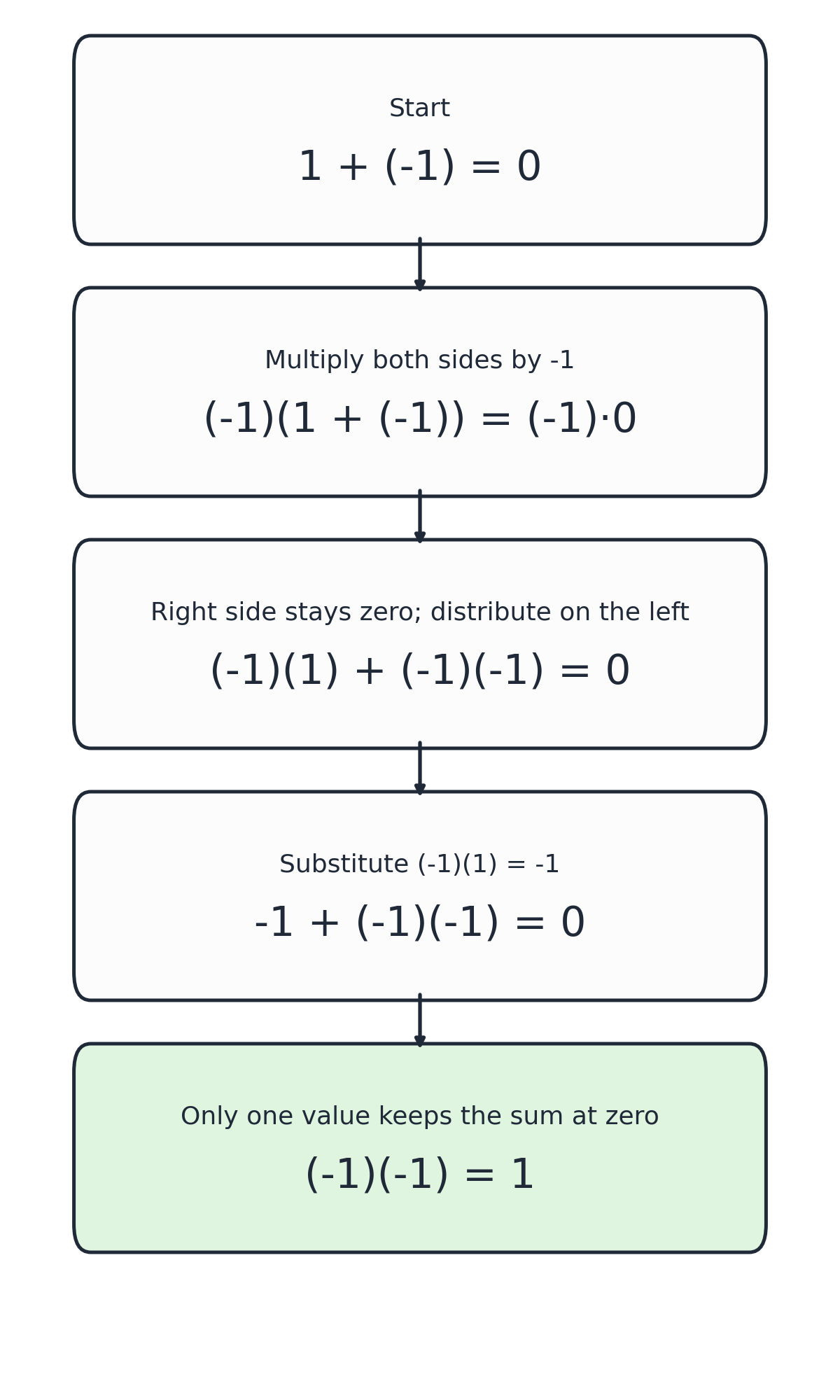
Recall from Lesson 3 that multiplying any number by gives its additive inverse, or opposite. In particular, and are additive inverses, which means their sum is zero:
This simple, familiar equation is the launchpad for our entire proof. Everything that follows comes from asking one question: what happens when we multiply both sides of this equation by ?
The Distributive Proof
Let's work through this carefully. We start with and multiply both sides by :
Right side first. Any number times zero is zero, so . The right side stays .
Now the left side. We apply the distributive property to expand :
From Lesson 3, we know that . Substituting that in gives us:
Here is the key moment. We need to be a number that, when added to , gives . The only number that satisfies this is , so: