Translate Situations into Expressions
🎉 Introduction
Welcome to Model Situations with Expressions! In the previous course, you built a solid foundation: identifying variables, reading expressions in context, and deciding whether a situation calls for an expression, equation, or inequality. As you may recall, an algebraic expression is a combination of numbers, variables, and operations that represents a quantity. Now it is time to put that understanding to work.
This course focuses on translating everyday language into math by writing expressions from scratch, starting with simple one-operation translations and gradually building toward more complex, multi-step models. Think of it like translating between two languages. The phrase "five dollars more than the original price" and the expression say the same thing, just in different languages.
The goal is to learn the common patterns so you can move from everyday words to precise math quickly and confidently. In this lesson, you will learn to:
- Identify signal words that correspond to addition, subtraction, multiplication, and division.
- Translate tricky phrases like "more than," "less than," and "fewer than," paying special attention to order in subtraction phrases.
- Choose the right mathematical operation based on the real-world action being described.
Addition and Subtraction in Context ➕/➖
Many everyday situations describe a quantity going up or going down by some amount. Here are the key signal words to watch for:
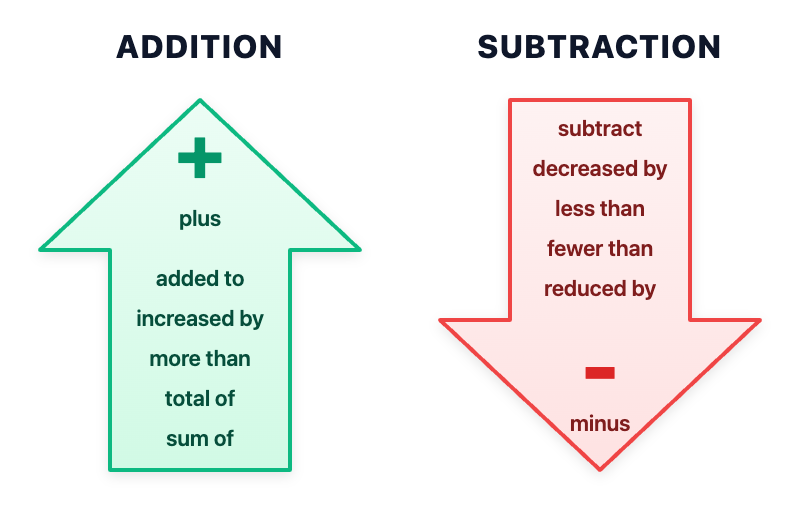
- Addition words: plus, added to, increased by, more than, total of, sum of
- Subtraction words: minus, subtract, decreased by, less than, fewer than, reduced by
For example, suppose a store charges a base fee of $9 and then adds an extra charge of dollars. The total charge is simply:
If instead a coupon takes $4 off the price of an item, the new price is:
Each phrase maps neatly onto one operation. The key is identifying which quantity increases or decreases, and by how much.
Watch the Order in Subtraction Phrases 👀
Some phrases with the word “than” are truly order-sensitive because subtraction is not commutative. Compare these two phrases:
- "7 less than "
- " less than 7"
They sound similar, but they produce different expressions.
In phrase 1, you start with and subtract 7, so the expression is: .
In phrase 2, you start with 7 and subtract , so the expression is: . If phrase 2 sounds like an inequality (), remember that the key difference is the word "is". While " is less than 7" describes an inequality, the phrase " less than 7" without the "is" simply tells you to subtract.
The word "than" is the signal: the quantity that comes after "than" is written first in the expression.
| Phrase | Preferred expression | Note |
|---|---|---|
| 7 less than | Order matters | |
| less than 7 | Order matters | |
| 10 more than | is equivalent |
Tip: For less than and fewer than, the quantity after “than” is written first. For more than, we usually write the starting quantity first, but either addition order represents the same total.
Multiplication: Repeated Groups and Per-Unit Rates ✖️
Multiplication shows up whenever you have repeated equal groups or a per-unit rate. Here are two common scenarios:
- Repeated groups: "3 boxes with items each" means (three groups of ).
- Per-unit rates: "A rideshare app charges $1.80 per mile for miles" means .
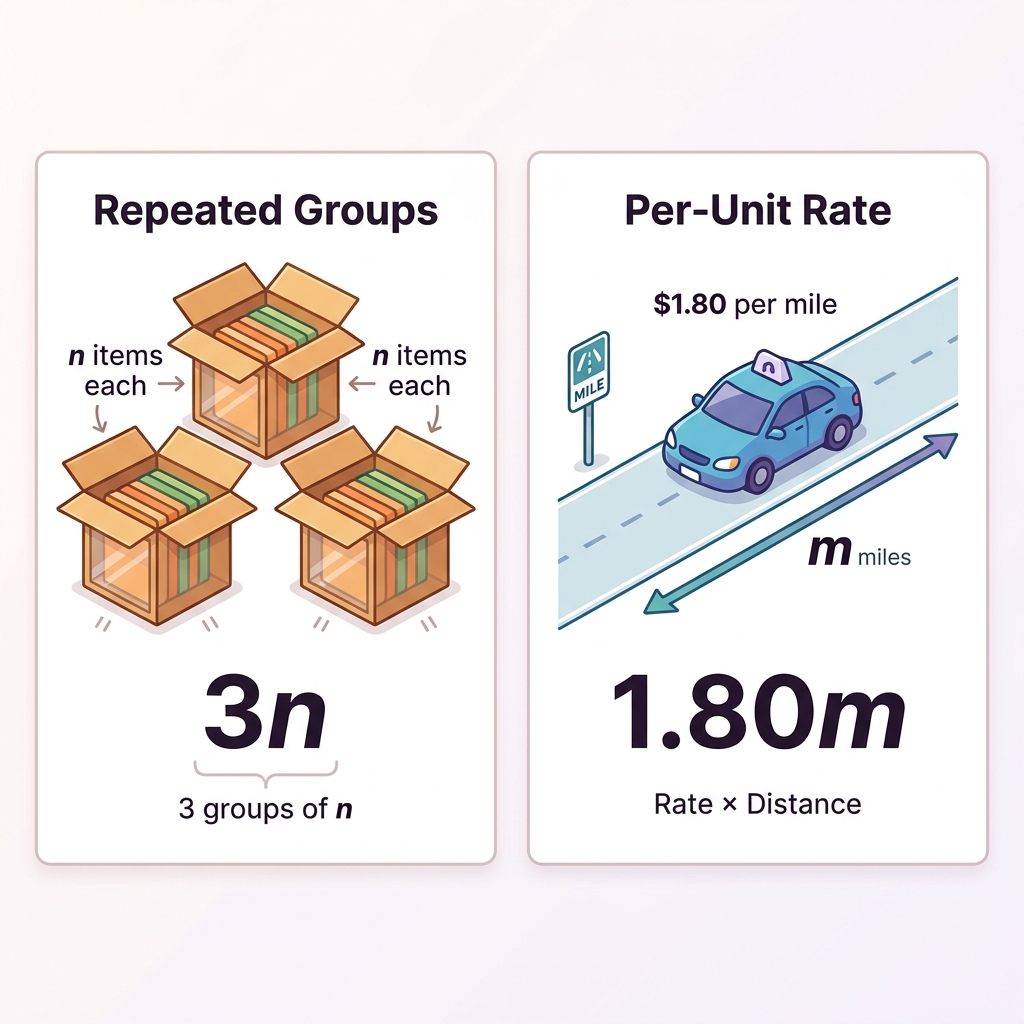
In both cases, the structure is the same: one factor tells you how many (or the rate), and the other tells you the quantity it applies to. Written as an expression, multiplication often appears without a visible sign, so means .
Rates deserve a moment of extra attention. When you see the word "per", it almost always signals multiplication: dollars per hour, cost per item, points per game. The rate is the coefficient (the fixed number), and the variable represents how many units you have. So "earning $12 per hour for hours" becomes:
The coefficient tells you the rate, and tells you the number of hours.
Division: Splitting and Sharing ➗
Division appears less often in casual language, but it follows a clear pattern: splitting, sharing equally, or distributing. For instance, "a total of dollars shared equally among 4 friends" becomes:
Watch for phrases like divided by, split among, shared equally, and per each (in the sense of distributing a total). Notice that order matters here too. " divided by 4" means , not . The quantity being divided always goes in the numerator.
Choosing the Right Operation 🤔
With all four operations in your toolkit, the real skill is reading a phrase and deciding which operation fits. Let's walk through one more example. Imagine you are ordering food online: the menu item costs dollars and the app adds a flat delivery fee of $3. The total you pay is:
Now imagine the same app, but instead of a flat fee it charges $2 per item and you order items. The delivery charge alone would be . Each situation uses just one operation, but picking the right one depends on reading the context carefully.
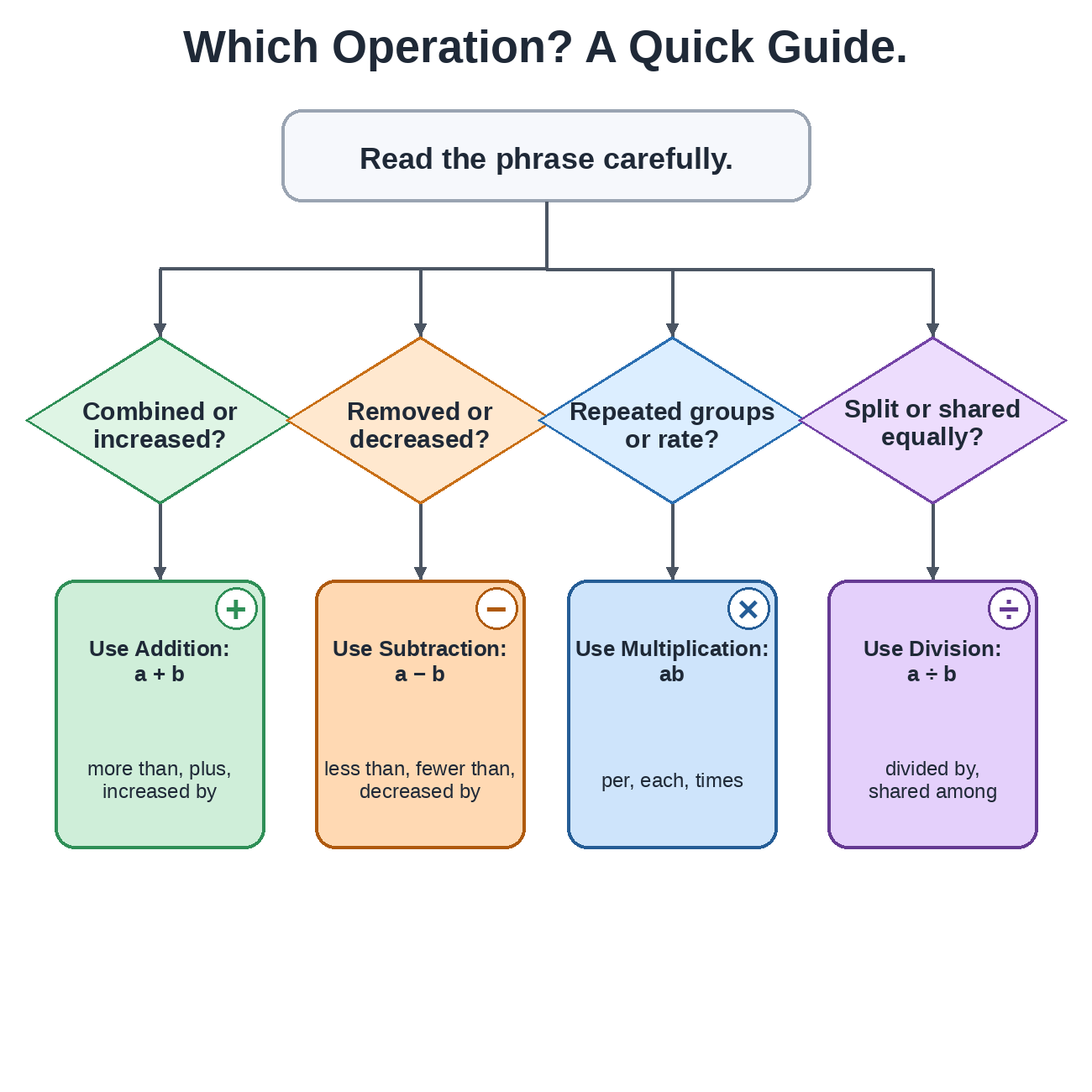
Here is a quick-reference summary of the four operations and their common signal words:
| Operation | Common Phrases | Example Expression |
|---|---|---|
| Addition | plus, added to, more than, increased by | |
| Subtraction | minus, less than, fewer than, decreased by | |
| Multiplication | times, per, each, of, product of | |
| Division | divided by, split among, shared equally |
Conclusion and Next Steps
In this lesson, you learned how to translate a single-operation verbal description into an algebraic expression. You explored addition and subtraction signal words, paid special attention to the tricky order of subtraction phrases, and saw how multiplication connects to repeated groups and per-unit rates. You also covered division as splitting or sharing.
The most important takeaway is to read for the action the phrase describes: is something being combined, removed, repeated, or split? Once you identify that action, the operation follows naturally — and for subtraction phrases like “less than” and “fewer than,” remember that the quantity after “than” is written first. For addition phrases like “more than,” we usually write the starting quantity first, although either addend order gives the same sum. Up next, you will put these ideas into practice with hands-on exercises that will sharpen your translation skills, so let's jump in!
