Build Multi-Step Expressions
🎉 Introduction
Welcome back to Model Situations with Expressions! In the previous lesson, we practiced translating single-operation phrases into expressions. We matched signal words like "more than," "per," and "split among" to the correct operation. That was an essential first step, and now we are ready to level up.
This lesson focuses on combining two or more operations into a single expression that captures a more complete, real-world situation. Think about the last time you paid a bill or looked at a receipt. Chances are, the total was not the result of just one calculation. A phone bill might include a flat monthly charge plus a per-minute fee. A paycheck might show an hourly wage times the hours you worked, minus a deduction. Real life tends to layer operations on top of each other. Each expression you write will use two operations, but it will still be a single, compact piece of math.
The goal is to learn the common patterns so you can move from everyday words to precise math quickly and confidently. By the end of this lesson, you will be able to:
- Combine two operations to model layered, real-world situations.
- Recognize the fixed-plus-variable pattern that frequently appears in multi-step expressions.
- Apply a simple three-step process—list, determine, assemble—to accurately build complex expressions.
The Fixed-Plus-Variable Pattern 🧩
One of the most common multi-step patterns in everyday life is a fixed amount combined with a variable amount. Here is a simple scenario:
A food delivery app charges a $5 delivery fee plus $3 per item you order.
Let's break this into parts. If represents the number of items:
- The delivery fee is a constant: .
- The per-item charge is a rate times a variable: .
Combining them gives us the total cost:
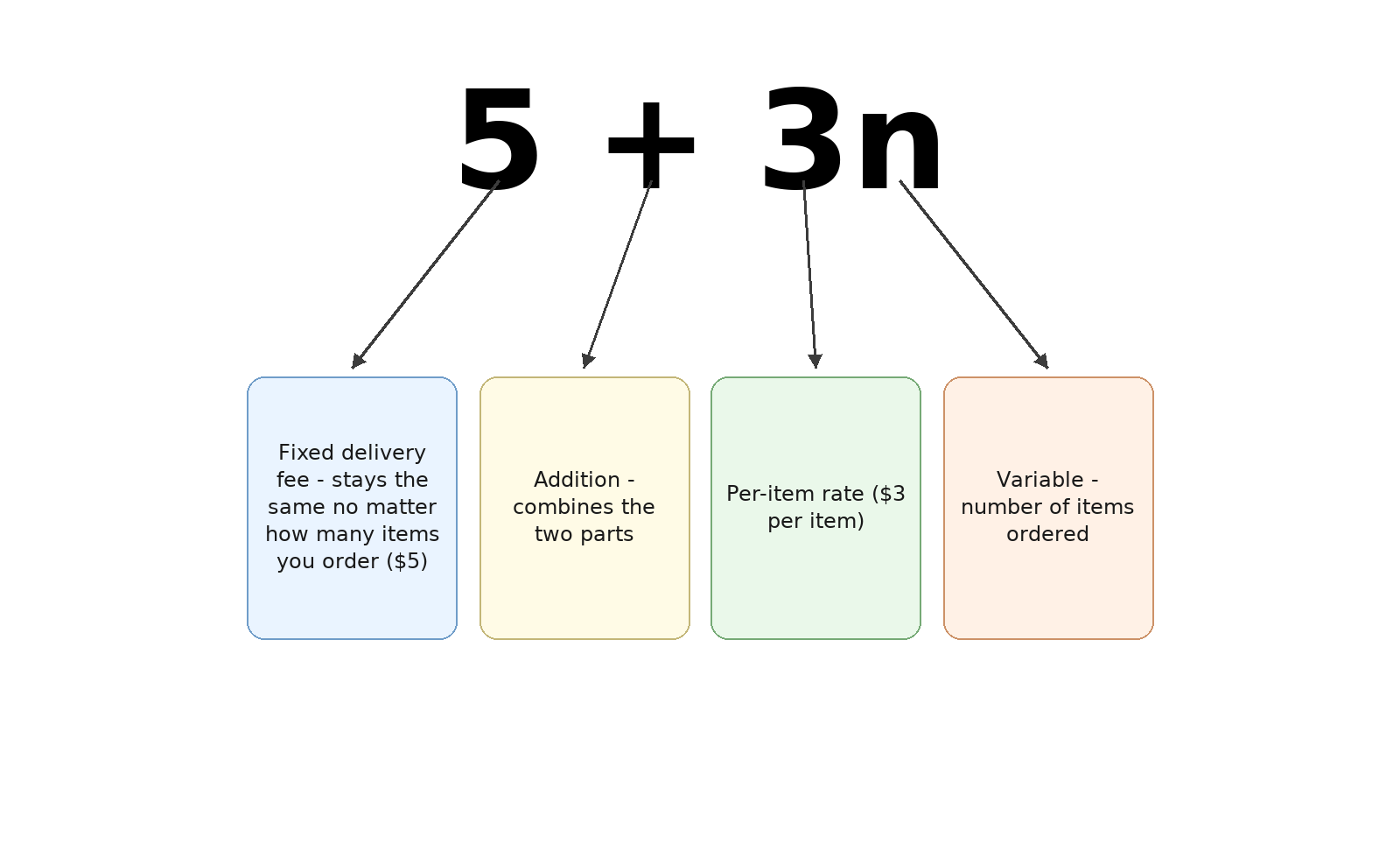
Notice what happened. We used addition to combine two amounts, and one of those amounts already involved multiplication.
That is what makes this a multi-step expression: it requires two operations working together.
More Examples of the Pattern 📋
This fixed-plus-variable structure shows up everywhere. Let's translate a few more situations so the pattern really sinks in.
Gym membership: A gym charges $40 per month plus $2.50 per class attended. If is the number of classes, the monthly cost is:
Sales job: A salesperson earns a $500 weekly base salary plus a $25 commission for each sale. If is the number of sales, the weekly earnings are:
Each example follows the same blueprint: find the part that stays constant, find the part that scales with a variable, and add them together. The table below puts all three side by side so you can see the pattern at a glance.
| Situation | Fixed Part | Variable Part | Expression |
|---|---|---|---|
| Delivery fee + per-item cost | |||
| Monthly membership + per-class fee | |||
| Base salary + commission per sale |
When a Term Is Subtracted ➖
Not every compound situation involves adding two amounts together. Sometimes one part of the expression is taken away from another. As you may recall, subtraction shows up when something is removed, deducted, or reduced.
Consider this scenario:
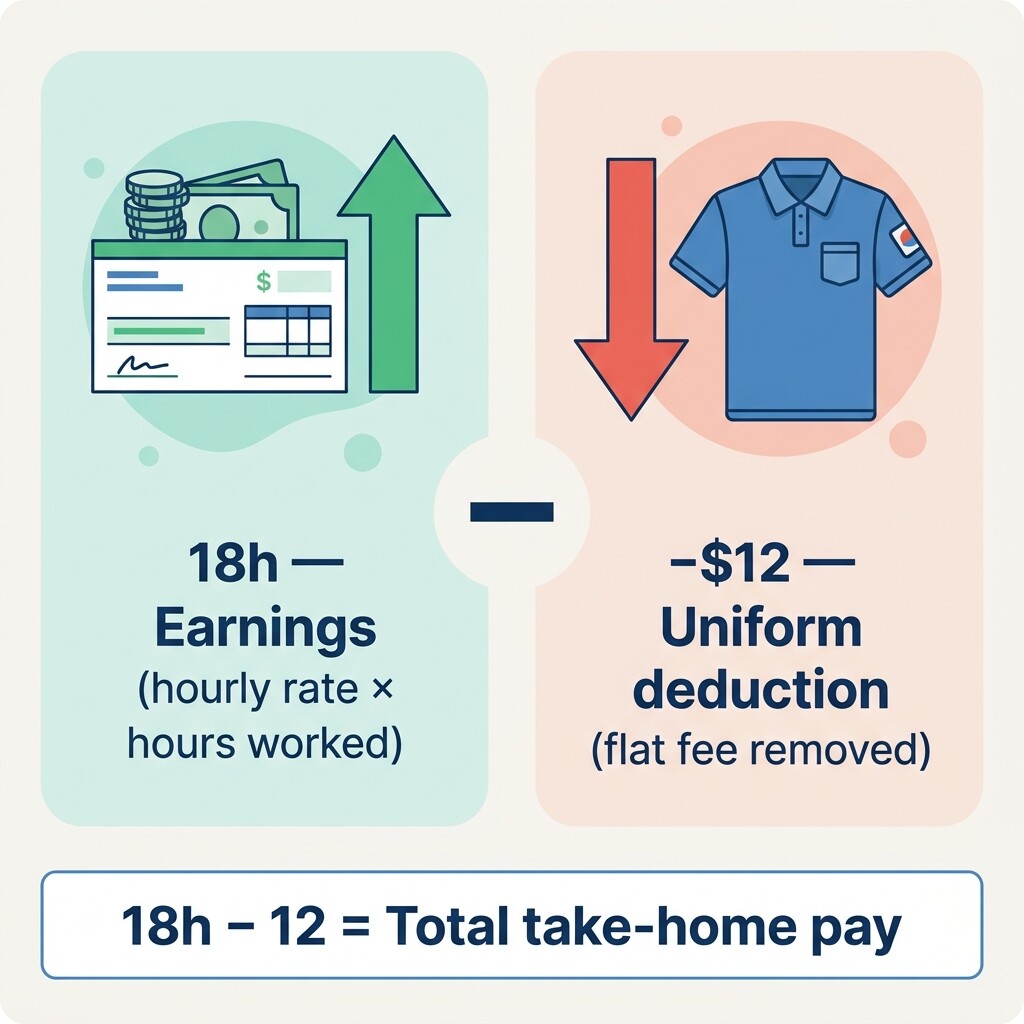
On your first paycheck, you earn $18 per hour for hours, but your employer deducts a one-time $12 uniform fee.
The earnings before the deduction are . The deduction is a fixed . Because the fee is subtracted from the earnings, the expression is:
Here is another example:
A gift card has $50 on it. You buy coffee that costs $4.75 per cup for cups.
The remaining balance is:
The key is to ask: Is this amount being added to the total, or taken away from it? Signal words like "deduction," "remaining," and "reduced by" still guide us, just as they did with single-operation translations. The only difference now is that we are combining subtraction with multiplication inside the same expression.
Building Expressions Step by Step 🏗️
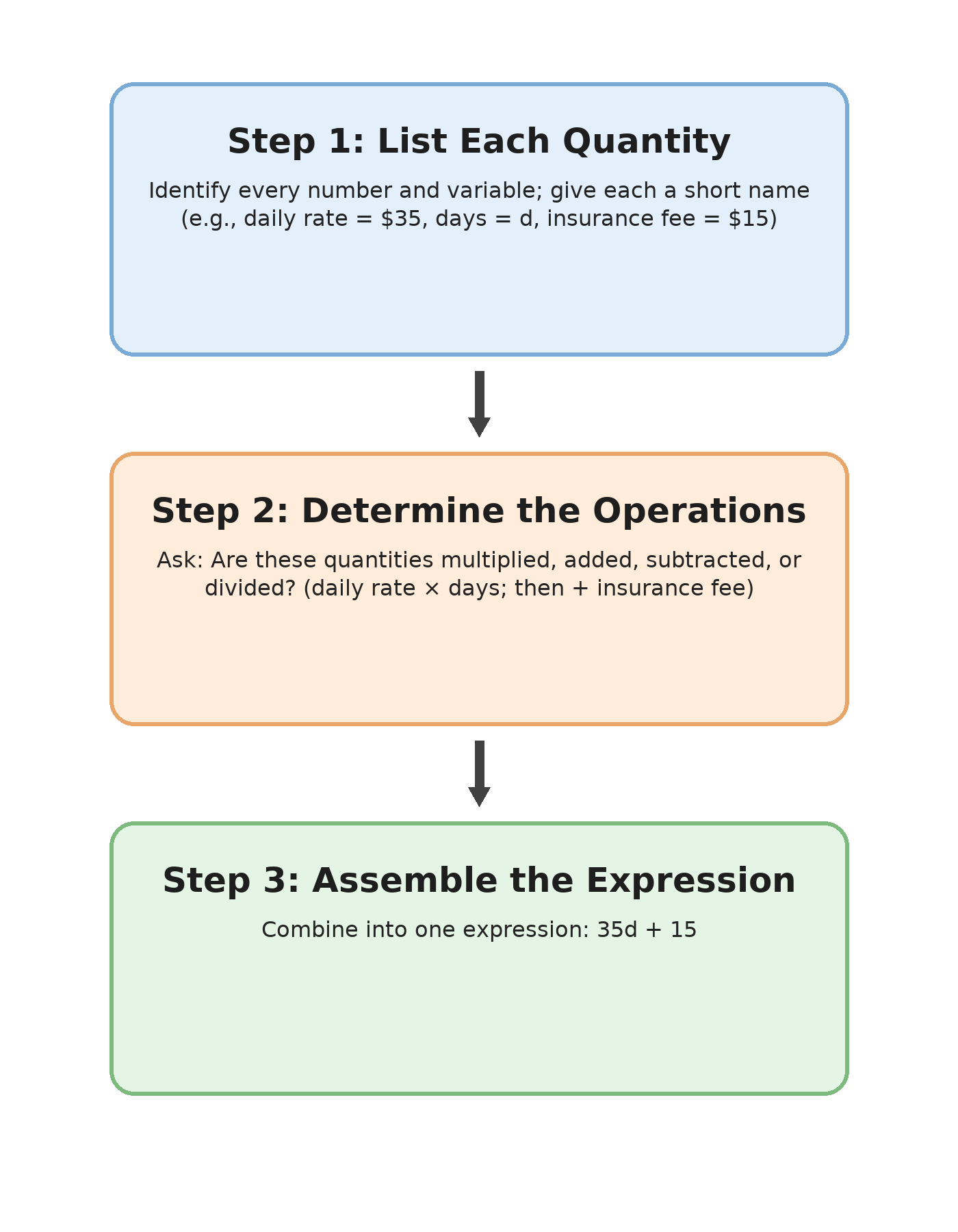
When a word problem feels complex, a simple three-step process can keep you on track:
- List each quantity. Write down every number and variable mentioned. Label each one briefly (e.g., "base fee," "hourly rate," "number of hours").
- Determine the operations. Decide whether each pair of quantities is connected by addition, subtraction, multiplication, or division.
- Assemble the expression. Combine everything into one expression, making sure the operations reflect the situation accurately.
Let's apply this to a new scenario:
A car rental company charges a $35 daily rate for days and adds a one-time $15 insurance fee.
- List: daily rate = $35, days = , insurance fee = $15.
- Determine: $35 times gives the rental cost; the insurance fee is added on top.
- Assemble:
Notice that the fixed part ($15) appears second here, and that is perfectly fine. The expressions and represent the same total because addition is commutative. This means that you can add terms in any order without changing the final result, just like is the same as . Multiplication is also commutative ( is the same as ), but keep in mind that standard algebraic convention dictates writing the number before the variable—so is preferred over . For the addition part, whether you prefer to write the variable term first or the fixed term first, both are mathematically correct.
As expressions get longer, a few errors tend to pop up. Being aware of them now will save trouble later.
- Leaving out a term. If a problem mentions a flat fee and a per-unit rate, the expression must include both. Writing just for the delivery example would ignore the $5 fee entirely.
- Using the wrong operation. A per-unit rate signals multiplication, not addition. Writing instead of changes the meaning entirely.
- Reversing a subtraction or division. Unlike addition, both subtraction and division are non-commutative, meaning the order of the terms completely changes the result. "Earnings minus a $12 deduction" is , not . Always ask which quantity is being reduced.
When in doubt, go back to the three-step process: list, determine, assemble. It keeps each piece visible so nothing gets lost or swapped.
Conclusion and Next Steps
In this lesson, you moved from single-operation translations to multi-step expressions that combine two operations in one statement. You explored the very common fixed-plus-variable pattern, saw how subtraction fits into compound expressions, and practiced a reliable three-step approach — list, determine, assemble — for building any multi-step expression from a word problem. You also flagged the most common mistakes so you know exactly what to watch for.
Up next, you will put all of this into practice with hands-on exercises covering delivery fees, memberships, paychecks, and even an electricity bill. These activities will ask you to build, complete, and troubleshoot compound expressions on your own — so let's dive in and start building!
