Pairing Distraction Responses
Matching Distractions to the Right Countermeasure
Last time you learned to name where a distraction comes from: either inside your own mind or outside in your environment. Naming the source was never the point on its own. It matters because each source needs a completely different fix, and reaching for the wrong one just burns effort while the distraction keeps winning. So now let's turn that distinction into action. The whole game here is picking the right tool for the right kind of interruption.
Pairing the Fix to the Source
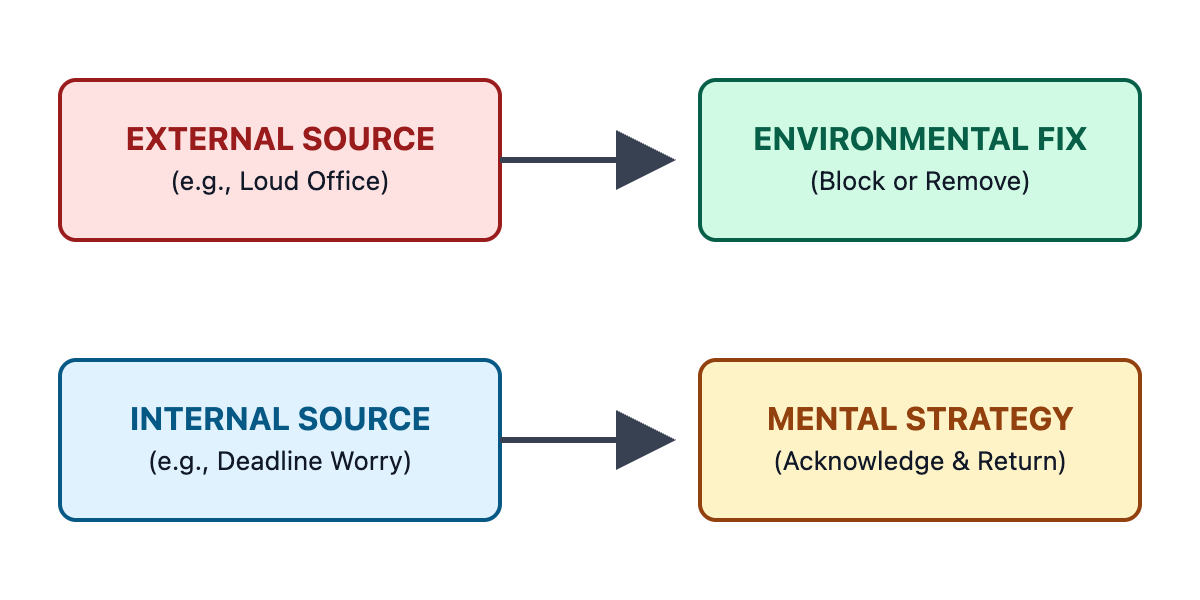
Here's the rule to build everything on. Call it Distraction Response Pairing: external distractions get environmental changes, and internal distractions get mental strategies.
Think about what each source actually is. An external distraction is a thing happening around you: a buzzing phone, chatter carrying across the room, a too-warm office. Because the cause is out there, the fix goes out there too. You put on headphones, close a door, flip the phone to airplane mode, move to a quieter spot, or nudge the thermostat down. You remove or block the thing.
An internal distraction is different. A looping worry, a nagging thought about an unanswered message, a daydream, a hunger pang: none of these are in the room. You cannot put headphones on your own brain. So the move is a mental strategy: acknowledge the thought, then gently steer your attention back to the task. A quiet mental note, a few slow breaths, a beat of mindfulness. These all support the same gentle turn back.
One warning here. The tempting move with an unwanted thought is to shove it away, but suppression backfires. If I tell you not to think about a pink elephant, guess what fills your head. Pushing a worry down only makes it louder and stickier. So you acknowledge it rather than wrestle it.
- Jessica: The room got loud, so I grabbed my headphones, but I still couldn't concentrate.
- Nova: Makes sense for the noise. What else was going on while you sat there?
- Jessica: Honestly, I kept spinning on whether I'd hit the deadline.
- Nova: That's the part headphones can't touch. The noise is external, so blocking it was right. But the deadline worry is internal, so it needs a different move: name it, then come back to the line you were on.
- Jessica: So the quiet was never going to fix the worry.
Notice that Jessica used a real fix, just on the wrong problem. The headphones were correct for the noise and useless against the anxiety.
Handling Both at Once
Real work sessions rarely hand you one tidy distraction. More often the room is loud and you're anxious at the same moment, and the two blur together into "I just can't focus." The instinct is to grab a single fix for everything, usually the environmental one, because it's the visible villain. You catch yourself thinking, "If it were just quiet, I'd be fine."
That belief is the trap. Quiet does nothing for the worry. When you face both at once, the move is to separate the two problems first, then apply the matching countermeasure to each. Diagnose the noise as external and handle it with an environmental change. Diagnose the anxiety as internal and handle it with a mental strategy. Two distractions of two different types means two fixes, running side by side. The most common error you'll catch (in yourself and others) is expecting silence to settle the mind. It won't.
Building a Two-Part Countermeasure
When you put together a plan, whether for your own next block or to hand a colleague, make both parts explicit so neither gets skipped. Name one environmental change for the external cue and one mental redirection for the internal one.
Made concrete, that might look like this. For a loud floor, book a quiet room or step into an empty one. That's your environmental half, and it kills the noise at the source. Then, for the deadline anxiety riding alongside it, use the mental half: note it plainly ("I'm worried about the deadline"), let it sit without a fight, and gently return to the sentence you were writing. Pairing them this way reassures you that the worry has its own handling, so you stop waiting for a silent room to do a job it was never going to do.
The one thing to carry out of this unit: match the fix to the source. Environment for what's around you, a mental strategy for what's in your head, and never expect one to solve the other. Before you use this live, try a fast pattern-spotting round: as you see phone alerts, nearby noise, a worry, or a daydream, tag each with its correct response type and notice how quickly your gut sorts them. Get that pairing automatic, and the in-the-moment moves get a lot easier.
