Identifying Distraction Sources
Welcome to the Course
Every day you sit down to do real work (a report, a proposal, a bit of focused thinking) and something pulls you off course. Sometimes it's obvious, like a buzzing phone or a coworker's voice carrying across the room. But just as often the interruption comes from inside your own head, and that's the part most people miss. This course helps you see both, so you can respond to each with the right move instead of guessing.
By the end of this course, you'll be able to:
- Distinguish internal distractions (from your mind) from external ones (from your environment)
- Match each type of distraction to the countermeasure that actually works on it
- Conduct a calm, nonjudgmental audit of what derailed a work session and when
- Pinpoint your personal vulnerability windows and the emotions that trigger them
- Design targeted defenses for a specific block of focused work
This first unit lays the foundation: learning to tell where a distraction is coming from, because that single distinction shapes everything you'll do to protect your attention later.
Telling Inside from Outside
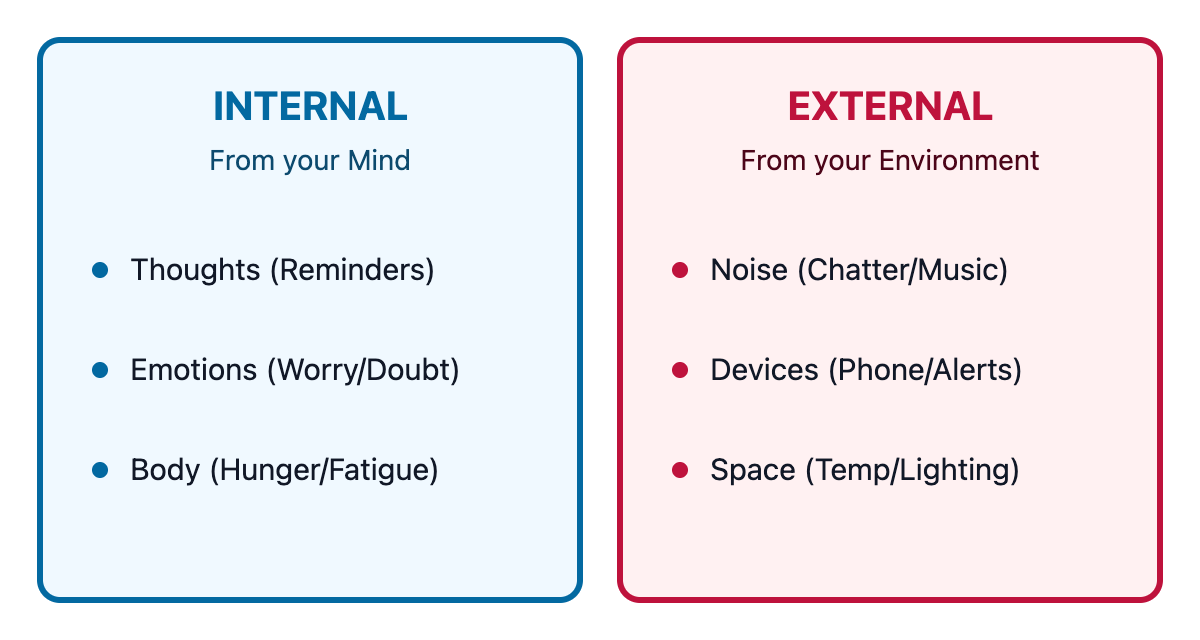 Here's the core idea, and it's simpler than it sounds. Every distraction has a source, and there are only two: it either comes from inside your mind or from your surroundings. We'll call these internal distractions and external distractions.
Internal distractions are the ones your own brain generates. They come in three flavors. There are thoughts, like suddenly remembering an email you never answered. There are emotions, like a spike of deadline anxiety or a nagging self-doubt about whether your plan is any good. And there are physical sensations, like hunger, fatigue, or a stiff back. Nothing in the room caused these. They rose up from within you.
External distractions, by contrast, come from your environment. Your phone buzzes. Two people start a loud conversation near your desk. Someone walks past. The room is too warm. These are things happening around you that your attention snaps toward.
Why does this matter so much? Because most of us are quick to blame the environment and slow to notice our own mind. The noise feels like the obvious villain. But the quiet worry looping in your head can steal far more of your focus, and you'll never fix it by putting on headphones.
- Dan: I got nothing done this morning. The open office was brutal, people talking nonstop.
- Nova: So the noise pulled you out. Anything going on in your own head while you were trying to work?
- Dan: I mean, I kept thinking about the deadline. And whether the plan was even right.
- Nova: That's worth noticing. The chatter came from the room, but the deadline worry and the self-doubt came from you.
- Dan: Huh. I blamed the noise, but my own head might've interrupted me more.
Notice how Nova didn't argue that the noise wasn't real. She just asked what was happening inside, and that one question surfaced two internal distractions Dan had been treating as background.
Diagnosing Where a Distraction Came From
Now let's turn that skill outward. When you're helping someone (or yourself) untangle a scattered work session, your job is to catch each interruption as it comes up and ask one question: did this come from your mind, or from your environment?
The move is to listen for the source, not the symptom. When someone says "I couldn't concentrate," that's a symptom. Your follow-up is what does the diagnostic work: "What was happening around you, and what was happening in your head?" Splitting the question into those two halves is the whole trick. The environment half surfaces the external stuff (the buzzes, the chatter, the movement). The head half surfaces the internal stuff (the worry, the doubt, the hunger).
Expect people to volunteer the external ones first, because they're easier to see and easier to blame. So gently press on the internal side. If someone mentions a deadline, ask whether they were worried about it while they worked. If they seem down on their plan, ask whether that doubt kept resurfacing. You're not accusing them of anything. You're helping them notice that their own mind was in the room too.
The tone matters here. This is a diagnosis, not a verdict. The goal is for the person to feel reviewed, not blamed, so keep it curious. When you name an internal distraction without judgment, people tend to relax and get honest, and that's when the real pattern shows up.
Assessing What Each Distraction Cost
Once you've sorted the interruptions by source, the last step is to weigh their impact. Not every distraction costs the same. A single phone buzz you ignored in two seconds is cheap. A worry that looped for twenty minutes and kept dragging your attention off the page is expensive.
So walk through each interruption and ask what it likely did to concentration and progress. How often did it recur? How long did it hold attention? External distractions often arrive in sharp, brief hits. Internal ones tend to be quieter but stickier, returning again and again without any outside cue. That's exactly why people underestimate them: a thought doesn't make a sound, so it doesn't feel like an event, even though it may have derailed the whole morning.
A strong assessment ends up saying something honest and useful, like: the office noise was real but occasional, while the deadline worry recurred constantly and did the most damage. That's the insight that changes how the next session gets planned.
The one takeaway to carry from this unit: before you fix a distraction, name its source, because internal and external interruptions need completely different responses. Next, you'll put that distinction to a quick test, sorting things like anxiety, hunger, phone alerts, nearby conversations, and room temperature into internal or external. Try tagging each one the instant you read it, and notice which category your gut reaches for first.
