Conducting a Distraction Audit
Conducting a Distraction Audit
So far you've learned to sort a distraction by its source and pair it with the right fix. But there's a step hiding underneath all of that. Before you can pair anything, you have to catch the real culprit, and the real culprit is often not the one you'd name off the top of your head. That's what a Distraction Audit is for: a calm, detective-style review of what actually pulled you off task, so your fixes land on the true problem instead of the obvious one. Think of it as building a "most wanted" list for your own attention.
Telling Obvious Focus Thieves from Sneaky Ones
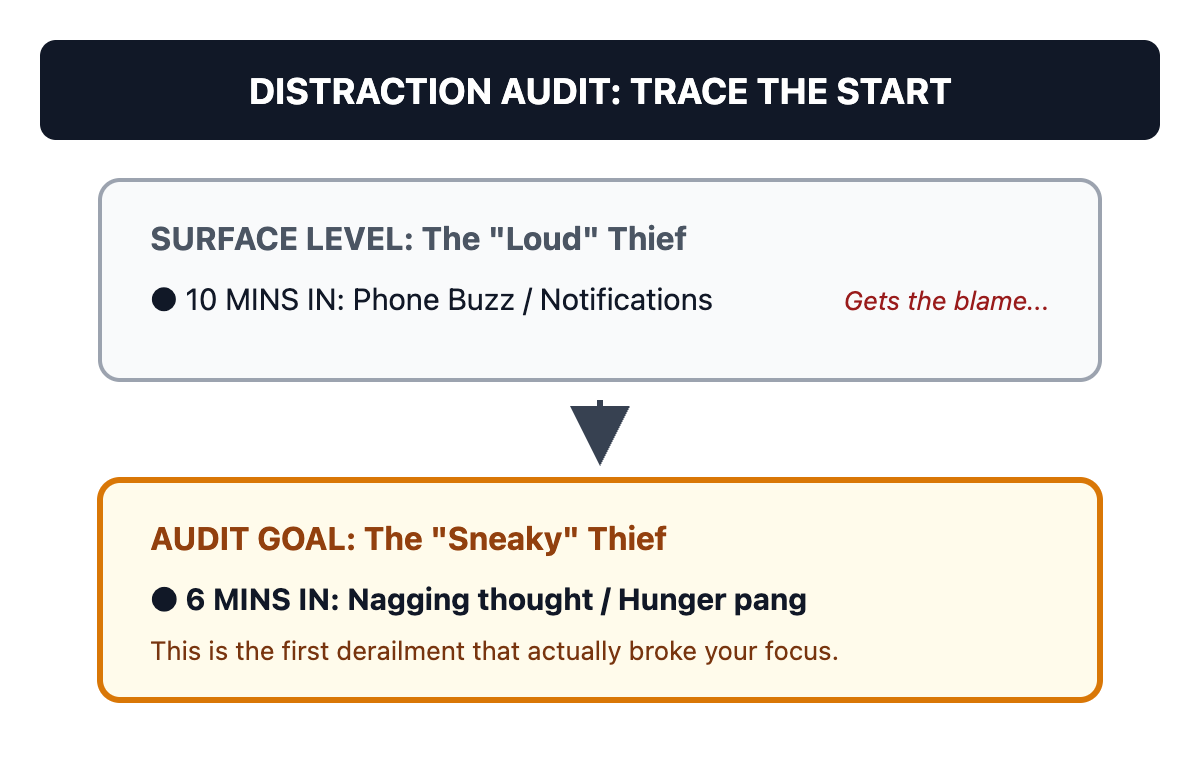
Not all distractions announce themselves. Some are loud and visible, and you'd catch them in a lineup instantly: a notification banner sliding across your screen, an autoplay video kicking in, an alert chiming from your phone. Call these the obvious focus thieves. You know they interrupted you because you felt the exact moment they did.
The trouble is that the loud ones aren't always the ones doing the most damage. There's a second category, the sneaky focus thieves, and these slip past you. A twinge of physical discomfort in your chair. A quiet "what should I grab for lunch?" drifting through. The lyrics of a song playing in the background that your brain starts following word by word. None of these feel like a real interruption in the moment, so you rarely register them as the reason your focus broke.
Why does this matter for the audit? Because if you only ever blame the obvious thieves, you'll keep fixing the wrong thing. You'll silence your phone and still lose the session to a hunger pang or a nagging thought you never named. Catching the sneaky ones is the whole edge of doing this well.
Reviewing What Interrupted You First, Without the Blame
Here's a number worth holding onto: most people are derailed within about six minutes of starting focused work. That's fast. It means the interruption that matters most is usually the very first one, the thing that broke your concentration before you'd even settled in. So the core move of the audit is to rewind to the start of a work block and ask one question: what genuinely pulled me off task first?
Two things make this hard. First, the first derailment is often a sneaky one, so you have to look past the loud, memorable interruptions to find it. Second, and this is the part people get wrong, the review has to be nonjudgmental. The instant it turns into "I have no discipline," your brain gets defensive and stops giving you honest data. You're a detective here, not a judge. Curiosity, not criticism.
- Nova: Walk me back to the start. What were you actually trying to do?
- Milo: Write the intro to the quarterly summary. But my phone blew up maybe ten minutes in.
- Nova: Before the phone, though. What was the very first thing that pulled you off the page?
- Milo: Huh. Now that you ask, I was already half-thinking about an email I never replied to. That was before the phone even buzzed.
- Nova: That's the one that counts. A quiet thought slipped in first, and it's easy to miss because the phone gets all the blame.
Notice how the phone looked like the villain but arrived second. The neutral, "what came first?" question is what surfaced the real culprit.
Documenting the Source, Timing, and Trigger
Once you've spotted the first interruption, write it down. A memory of a distraction fades; a record lets you spot patterns across days. Your "most wanted" entry captures six things: the intended task you sat down to do, the first interruption, its source (internal or external), its category (obvious or sneaky), when it occurred (roughly how many minutes in), and any emotional trigger sitting behind it, like stress or boredom.
That last field matters. Often the sneaky first interruption isn't random; it rides in on a feeling. Log enough of these and the pattern practically writes itself: you start seeing that a certain task, at a certain time, in a certain mood, gets you every time.
The one thing to carry out of this unit: your loudest distraction is rarely your first one, so audit calmly and catch what actually breaks your focus before you spend energy fixing the wrong thing. Next, you'll run a fast sorting round: obvious thieves versus sneaky ones. Try tagging each as it appears, and notice how quickly the sneaky ones start giving themselves away.
