Timing and Emotional Triggers
Diagnosing Vulnerability Windows and Emotional Triggers
In the last unit you built a "most wanted" list, catching the first thing that broke your focus and noting any feeling riding behind it. Now you'll zoom in on two quieter forces that set you up to be derailed before a single notification ever fires: when your attention is naturally fragile, and what mood cracks the door open. Catch these two, and you stop swatting at distractions one at a time and start defending the moments you're most likely to lose.
Telling Timing Patterns from Emotional Triggers
There are two separate lenses to look through here, and mixing them up is where most people go wrong. The first is Timing Patterns: predictable stretches of the day when your focus runs thin no matter what you're working on. Think of the morning brain-race, when your head is buzzing with everything on today's list and won't settle. Or the post-lunch dip, when energy sags and concentration gets slippery. Or end-of-day fatigue, when the tank is simply empty. These are about the clock and your body, not the task.
The second lens is Emotional Triggers: feelings that make escaping the work suddenly appealing. Stress, boredom, anxiety, and even excitement all do this. When a task feels heavy or dull, that restless, mind-wandering part of your brain (the "default mode network" you met earlier) goes looking for relief, and a quick check of your phone delivers it. So a timing pattern answers "when am I weak?" while an emotional trigger answers "what feeling pushes me out?" They are genuinely different, and you'll defend against them differently.
Seeing How Timing and Emotion Stack Up
Here's the part worth slowing down for: these two rarely act alone. They stack. A timing window lowers your defenses, and an emotion supplies the shove. The post-lunch dip on its own might just make you a little sluggish. Add stress from a project that's behind, and that sluggish moment becomes the exact instant you reach for your inbox for a hit of relief. The dip opened the door; the stress walked you through it.
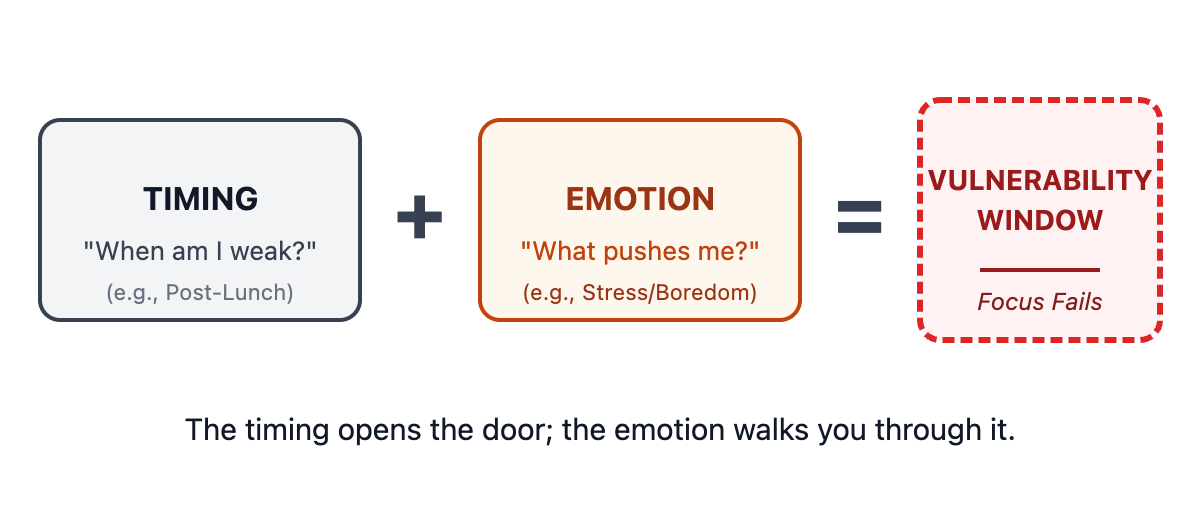
When you're coaching yourself or a colleague through this, the move is simple: don't accept a lumped-together complaint like "I lose focus in the afternoon." Split it. Ask what was happening on the clock, then ask what feeling was in the room.
- Nova: I keep losing focus right after lunch. Afternoons are just a write-off for me.
- Milo: Let's pull that apart. Is it the time of day itself, or is something weighing on you when it hits?
- Nova: Both, now that I say it. I'm groggy after eating, but it's way worse when a project's running late.
- Milo: So the grogginess lowers your guard, and the stress makes a quick scroll feel like relief.
- Nova: Exactly. The tiredness opens the door, and the stress walks me through it.
Notice that Milo refused the "afternoons are a write-off" story. He separated the clock from the feeling, then showed Nova how they reinforce each other, which is what turns a vague slump into something she can actually defend.
Matching Defenses to the Vulnerability Window
Once you've named both forces, you defend both, because a single fix aimed at one leaves the other wide open. Silence the room and the stress still finds you; take a breath and the sluggish 2 p.m. window still ambushes you tomorrow. So you pair one defense to each factor.
For the timing pattern, reach for an environmental change that blunts the low-defense window. For a stressful post-lunch block, that might mean muting or closing your messaging apps before you start, so the easy escape route is gone during the exact stretch you're weakest. For the emotional trigger, use a mental redirection: when the stress spikes, quietly name it ("that's project stress") and gently return to the work, rather than trying to shove the feeling away, which only makes it louder. One guards the moment; the other handles the mood. Together they cover the whole opening.
The single idea to carry out of this unit: your distractions aren't random, they cluster in predictable time windows and ride in on specific emotions, and naming both is what lets you defend the exact moment you're about to lose. Next you'll run a fast sorting round, tagging things like the post-lunch dip and end-of-day fatigue as timing patterns versus stress and boredom as emotional triggers, so the two lenses become automatic; after that you'll take it into a live conversation and a plan you could hand someone. For now, try this: think back to your last lost afternoon and ask which window it fell in and which feeling walked you out of it.
