Managing Your Boss Effectively
Note: This learning path will be retired on October 16th, 2026. Please be sure to finish any lessons in progress before then.
Welcome to the Course 📣
Welcome to Managing Up to Build a Partnership with Your Boss! Throughout this course, you'll discover how to transform your relationship with your boss from a traditional reporting structure into a dynamic partnership that benefits both of you. This isn't about manipulation or playing politics—it's about understanding what makes your boss tick, aligning your goals with theirs, and building the trust necessary for mutual success.
As a people manager, you face unique challenges in managing up. You're not just representing yourself; you're advocating for your entire team while navigating organizational complexities and competing priorities. Once you master the skills in this course, you'll be able to secure better resources for your team, gain valuable career sponsorship, and create an environment where both you and your boss can thrive.
Over the next several lessons, you'll explore practical frameworks from the HBR Guide to Managing Up and Across including best practices from renowned experts. You'll learn how to meet and exceed your boss's expectations, adapt your approach when you get a new boss, understand different decision-making styles, and even build strategic relationships with your boss's boss. Each lesson combines essential concepts with real-world application, preparing you to handle everything from routine check-ins to high-stakes negotiations. We begin with a focus on how to manage your boss effectively with insights from authors Linda A. Hill and Kent Lineback.
Meeting Your Boss's Core Expectations 🔑
Your relationship with your boss is actually one of mutual dependence. Your boss depends on you just as much as you depend on them. The foundation of this partnership rests on meeting three core expectations that every boss has, whether they explicitly state them or not.
1. Produce Results: The first and most fundamental expectation is producing results. This seems obvious, but it's not just about hitting your numbers, it's about how you achieve them. If you deliver on your revenue targets but your boss receives constant complaints about how you railroad other groups or create tension with peers, you're not truly meeting expectations. Your performance encompasses both the outcomes you achieve and the relationships you maintain while achieving them.
2. Keep Your Boss Informed: Equally important is keeping your boss informed about progress, challenges, and opportunities. Different bosses have varying information needs. Some bosses prefer to know every detail while others want just the highlights. The key is discovering the right balance through experience and explicit agreement. Generally, they advise erring on the side of overinforming because no boss likes to be surprised or seem ignorant of something they should know.
3. Demonstrate Support and Loyalty: The third core expectation involves demonstrating support and loyalty to your boss and their agenda. However, this doesn't mean blind agreement or becoming a yes-person. Those who only speak up when disagreeing typically have less influence than those who've demonstrated prior support. When you disagree, frame it as wanting to help them succeed.
Fulfill Your Boss's Undocumented Expectations 🕵️
Beyond the documented goals in your performance plan, there are several undocumented expectations that separate good managers from indispensable ones. These expectations are rarely written down but profoundly impact how your boss views your potential and value to the organization.
1. Lead Initiatives: One of the most important undocumented expectations is your willingness to lead initiatives, particularly those that cross functional boundaries and carry some risk. Your boss expects you to see beyond your immediate team's needs and champion efforts that benefit the broader organization. For instance, when there's an opportunity to pilot a new customer service approach that requires coordination with three other departments, volunteering to lead it demonstrates strategic thinking.
2. Develop Your People: Another critical yet unwritten expectation centers on developing your people. Your boss assumes you'll take as active an interest in your employees' development as you do in your own—if not more. This means providing specific, candid feedback when team members need it, not just during annual reviews. You should go out of your way to criticize and praise your people when they need it.
3. Be a Player for All Seasons: Perhaps the most challenging undocumented expectation is being a player for all seasons. This is about maintaining positive behaviors even during difficult times. When budgets are cut, reorganizations loom, or strategies shift, your boss needs managers who can sustain their ability to motivate and inspire your own people no matter what's going on around you. While others complain about new directions or resist changes, you find ways to help your team see opportunities amid challenges.
Establish Real Trust with Your Boss
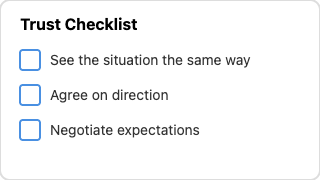
Real trust, the kind that gives you autonomy and influence, emerges from being able to ask yourself and answer three questions. Without these, you'll find yourself constantly second-guessed, micromanaged, or working at cross-purposes with your boss. The three questions are:
- Do you both see the current situation the same way?: Ensuring you and your boss see the current situation the same way is critical. If you believe your team needs fundamental transformation while your boss thinks minor tweaks will suffice, you're headed for inevitable conflict. You must make this alignment explicit by sharing your assessment of challenges, opportunities, and constraints openly and honestly. For example, if you see employee burnout as a critical risk while your boss views it as normal workplace stress, you need to surface this disconnect immediately.
- Do you agree about where the group is going?: A plan is critical, but more important is that your boss knows your goals and plans and agrees with them. You must stress that ideally your boss also had a hand in creating the plans jointly with you. This doesn't mean your boss dictates every detail, but rather that you've collaborated on the direction together.
- Do you negotiate expectations when you’re given an assignment?: Rather than passively accepting whatever comes your way. Be careful to avoid becoming someone who simply accepts whatever is passed down without discussion. If expectations are unrealistic, you'll have no one to blame but yourself when your team fails. This means having honest conversations about resources, timelines, and trade-offs.
Consider how this negotiation might unfold in practice:
- Victoria: Chris, I need your team to implement the new customer portal by end of next month. Marketing has already announced it to clients.
- Chris: I understand the urgency, Victoria. Let me think through what this means for our current commitments. To deliver the portal by then, we'd need to pause the inventory system upgrade that's halfway complete. Is that trade-off acceptable?
- Victoria: The inventory upgrade is critical too. Can't your team handle both?
- Chris: I've looked at our capacity, and with our current resources, taking on the portal means either delaying the inventory project by three weeks or bringing in two contractors for $15,000. Which approach aligns better with your priorities?
- Victoria: I hadn't realized the inventory project was that far along. What if we pushed the portal launch by two weeks? Could you do both then?
- Chris: With a two-week extension, yes—we could complete the inventory upgrade first and then shift everyone to the portal. That would actually reduce risk since we'd avoid context-switching. Should I update marketing about the revised timeline?
- Victoria: Yes, I'll support that decision. Document our agreement and copy me so I can back you up if marketing pushes back.
Notice how Chris doesn't simply accept the assignment despite its urgency. Instead, he helps Victoria understand the trade-offs, proposes alternatives, and works collaboratively to find a solution that sets both of them up for success. This negotiation isn't about pushing back—it's about ensuring realistic expectations that benefit everyone involved.
Document these agreements so you both remember what was decided. This negotiation isn't about being difficult—it's about setting yourself and your boss up for mutual success.
The upcoming role-play sessions will give you the opportunity to practice these essential skills in realistic scenarios. You'll navigate complex conversations where you need to balance transparency with professionalism, demonstrate loyalty while addressing challenges, and build trust through authentic dialogue. Get ready to put these concepts into action!
