How Successful Leaders Think
Think Like an Integrative Leader 🧩
When you look at standout leaders, it’s easy to zero in on the bold actions they take. But as Roger Martin details in the HBR Guide to Critical Thinking, the real difference is in how these leaders think, not just what they do. The best leaders get comfortable holding two opposing ideas in their minds at once—and rather than forcing a choice between them, they find creative ways to move forward that blend the strongest features of both. This pattern, called integrative thinking, is not a rare talent. It’s a mindset—and one that you can build.
That mindset starts with embracing, not avoiding, complexity. Most people reflexively filter out factors to make decisions easier, often narrowing their focus so much that they overlook what matters to others involved. Integrative thinkers pause and ask, “Could I be missing something important here? Is there another perspective or element I’ve dismissed too soon?” By hunting for less obvious but potentially important factors, they make peace with “messy” problems because they believe those are where better answers hide.
See the Full Decision-Making Process 🔄
Integrative thinkers don’t just look at a problem and jump to an answer—they move through four distinct stages of decision-making, always keeping the big picture in mind. Here’s how these stages work:
-
Salience – Deciding what matters: Instead of narrowing their view to what’s obvious, integrative thinkers cast a wider net. They’re curious about factors other people ignore, whether that’s someone else’s perspective, an organizational culture quirk, or a ripple effect that usually gets overlooked.
-
Causality – Figuring out how things connect: Rather than assuming there’s a simple cause-and-effect behind every challenge, they look for the deeper dynamics. They ask, “How might these factors influence each other over time? Are there loops, side effects, or unexpected consequences if I push on one lever?”
-
Architecture – Understanding how choices fit together: Integrative thinkers don’t solve parts of a problem in isolation. They sketch out how all the moving parts fit, just like an architect plans the whole building rather than designing each room in a vacuum. They consider what happens when one decision interacts with another, planning for alignment rather than surprise friction.
-
Resolution – Pushing for creative outcomes: Instead of settling for a trade-off, they circle back to earlier steps and look for ways to create better alternatives. If none of the current options work, they aren’t afraid to revisit their assumptions, reconsider what’s truly important, or redesign the architecture of their solution.
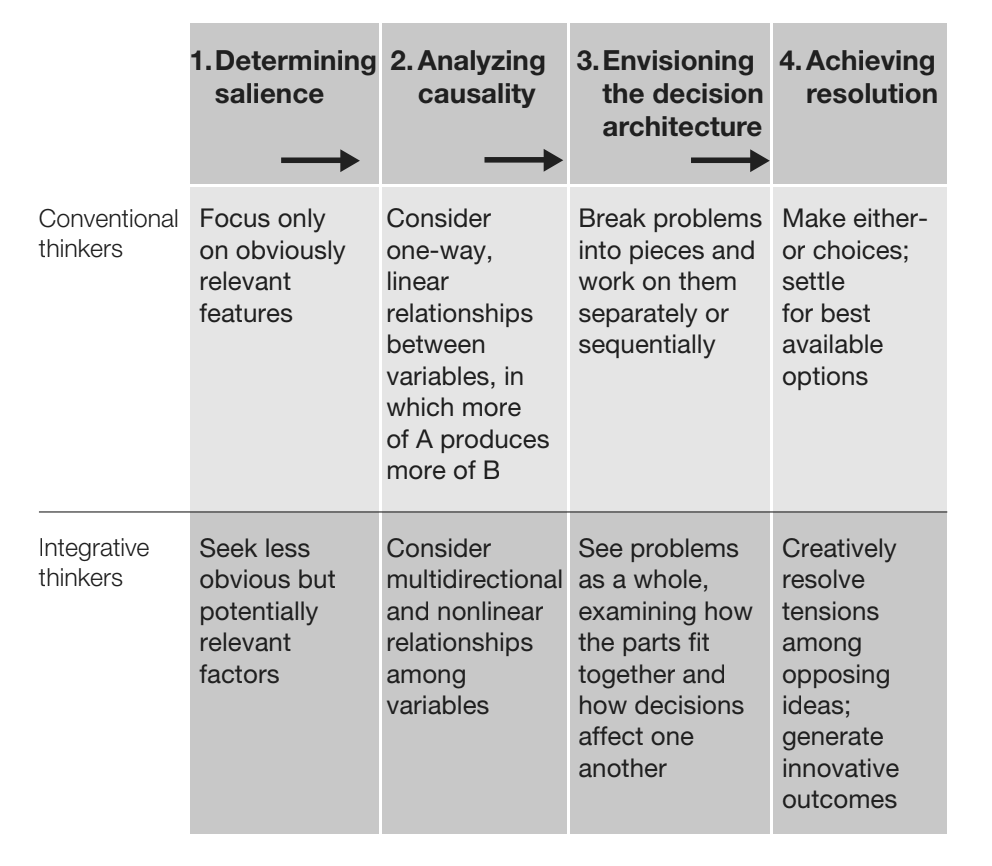
By moving through all four stages, integrative thinkers surface new options and spot connections that single-step, linear decision-making misses. This approach doesn’t just produce more robust decisions; it also builds your capacity to see beyond quick fixes and find creative possibilities others overlook.
Stretch Beyond Trade-offs for Better Options 🌱
Most tough choices get framed as trade-offs: speed or quality, cost-cutting or investment, option A or option B. The usual reaction? Settle for the “least bad” option and move on. Integrative thinkers do the opposite. Instead of asking, “Which bad compromise should I accept?” they push for better by going back to what both sides truly need and searching for options that don’t just split the difference—they actually improve on both.
Here’s how this looks in action:
- Nova: We're stuck. Either we rush the project and risk quality issues, or we push back the deadline and lose the client's trust. Neither option is great.
- Marcus: What if we don't have to choose between those two?
- Nova: What do you mean? Those are the only realistic options.
- Marcus: I've been thinking how the client’s main concern is the product launch. What if we deliver the core features by their deadline, and complete the rest with full quality next week?
- Nova: A phased delivery... We'd meet their launch needs without sacrificing quality on either phase.
- Marcus: Exactly. Instead of accepting one bad trade-off, we found a third option that preserves what matters most to everyone.
Notice how Marcus refuses to accept the limited either/or framing. By unpacking what both sides truly value, he helps the team find a creative third option that honors both speed and quality, rather than sacrificing one for the other.
Building this habit takes practice, but it’s possible for anyone. Over time, if you challenge your first instincts, invite more complexity, and refuse to settle for simple trade-offs, you’ll spot connections and invent solutions others miss. In the practices ahead, you’ll get hands-on experience developing these habits—so, when it really counts, you can lead your team to better answers.
