Using Probability to Make Real-Life Decisions
Introduction 🎉
Welcome back to Make Sense of Everyday Probabilities! This is the fourth and final lesson of the course, and you have come a long way. In the first three lessons, you learned how to place events on the 0-to-1 probability scale, how to read percent chances as frequencies out of 100, and how to convert between percentages, "1 in N," and odds. Now it is time to put all of that knowledge to work.
This lesson focuses on the real purpose behind understanding probability: making better everyday decisions. We will explore what probability can and cannot tell us, how to pair likelihood with consequences, and why even a small probability sometimes deserves serious attention.
By the end of this lesson, you will be able to:
- Explain what probability does and does not tell us in a real-world situation.
- Use probability together with consequences to make more informed everyday decisions.
- Recognize when a small probability still deserves serious attention because the outcome could be important.
🔦 From Numbers to Choices
Knowing that there is a chance of rain or a chance of a side effect is useful, but only if we do something sensible with that information. Probability is not just a number to read and forget — it is a tool for weighing our options.
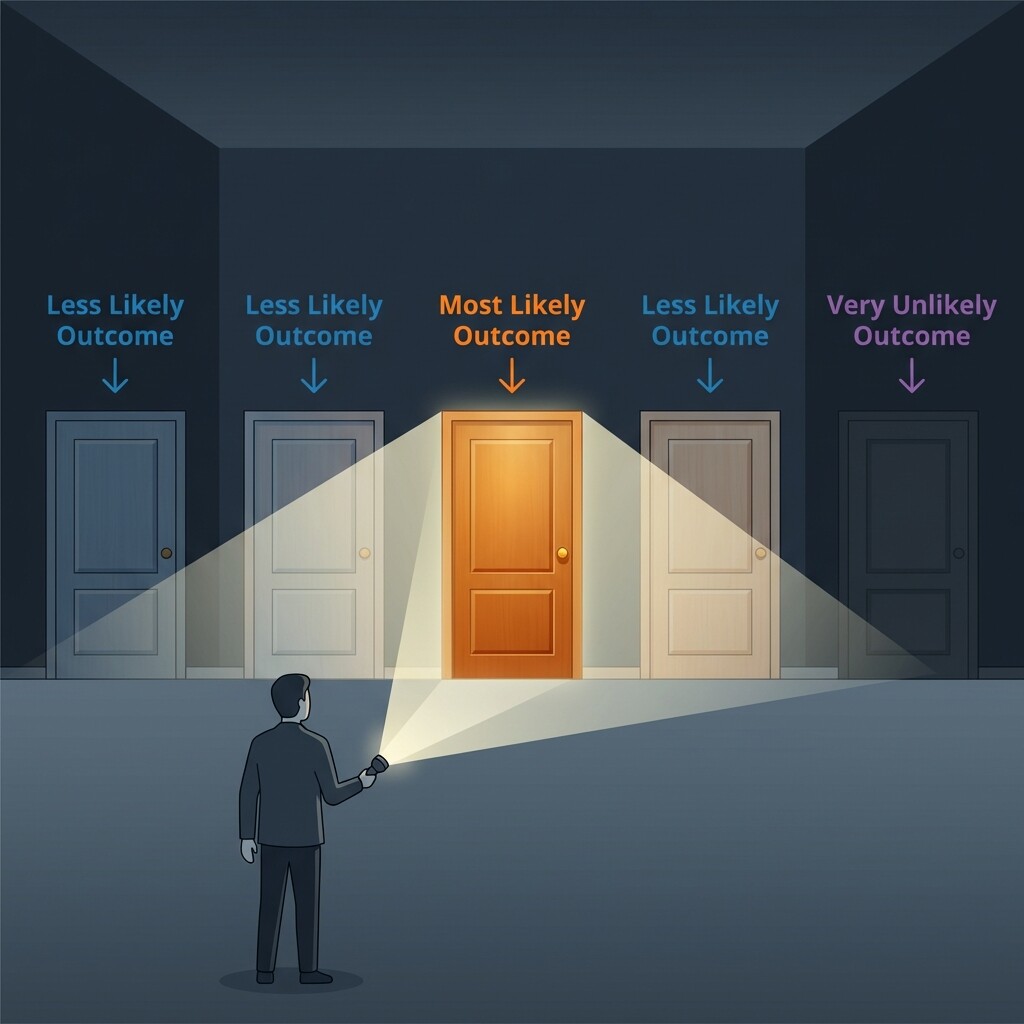
Think of probability as a flashlight in a dark room. It does not show us exactly what will happen, but it lights up which outcomes are more likely and which are less likely. The better we read that light, the better choices we can make.
💬 What Probability Tells Us (and What It Does Not)
One of the most important ideas in this course is simple to state but easy to forget: probability describes how likely something is, not whether it will definitely happen. Let us look at a few common statements and see why this matters.
| Statement | Correct? | Why? |
|---|---|---|
| "A 70% chance means it will happen." | No | It means the event happens roughly 70 times out of 100. It fails about 30 times. |
| "A 10% chance means it won't happen." | No | It still happens about 10 times out of 100. That is not zero. |
| "A 50% chance means we have no idea." | Not quite | It means the event is equally likely to happen or not — that is useful information. |
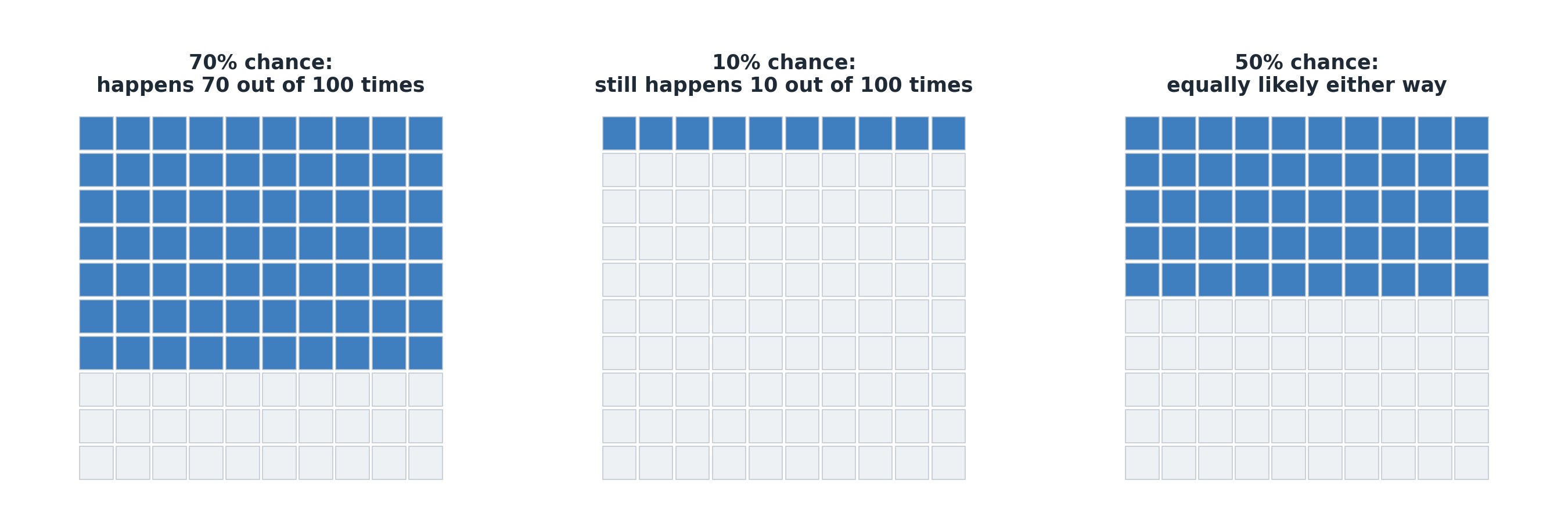
As you learned in earlier lessons, a percent chance tells us what to expect across many similar situations, not what will occur in one specific case. A weather forecast of rain does not mean "it probably won't rain." It means that in 100 days with similar conditions, rain would show up on roughly 40 of them, which is common enough to grab an umbrella.
🧠 Turning Probability Into a Decision
So how do we actually use a probability when making a choice? A helpful approach is to ask two questions:
- How likely is it? (the probability itself)
- What happens if it does occur? (the consequence)
Imagine a forecast of a chance of heavy thunderstorms on the day of an outdoor wedding. The probability is not high, but the consequence of being caught unprepared — drenched guests, ruined decorations — could be significant. Renting a backup tent makes sense even though the storm is more likely not to happen.
This framework applies across every probability format you have learned. Suppose a sports analyst lists your team at 4-to-1 odds against winning the championship. That translates to the team losing roughly 4 out of every 5 times and winning only 1 out of 5. If you are considering a large bet, those odds tell you the loss scenario is far more likely than the win, and pairing that probability with the financial stakes helps you decide whether the wager is worth it.
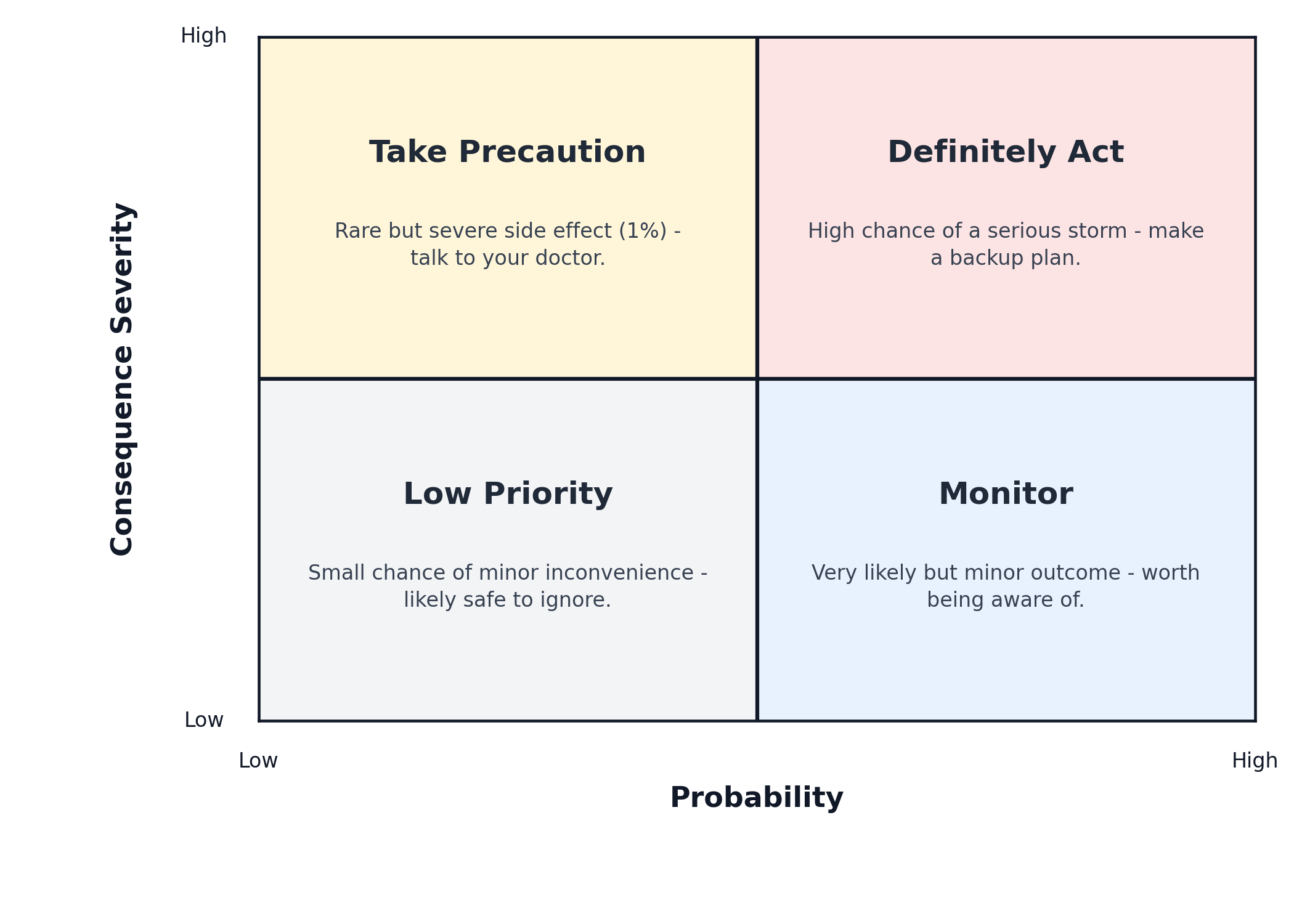
The key insight is that we pair the size of the probability with the weight of the outcome. A chance of something trivial may need no action at all, while a chance of something serious very well might.
🚨 When Small Probabilities Deserve Serious Attention
It is tempting to dismiss low-probability events as "that won't happen to me." But small does not always mean ignorable. Consider a few real-world examples:
- Identity theft might affect roughly 3 out of every 100 people in a given year. That is only , yet the financial and emotional damage can take months to resolve. Using strong passwords and monitoring your accounts is a low-cost precaution against a costly outcome.
- Losing checked luggage happens to roughly 1 in 200 bags on some airlines. Packing medications and important documents in a carry-on is a simple step against an unlikely but disruptive event.
- A rare medication side effect at still means about 1 person in every 100 will experience it. If that side effect is severe, a conversation with your doctor is well worth having.
Notice a pattern: in each case the cost of preparing is low, but the cost of the bad outcome is high. That mismatch is exactly why small probabilities can matter. You do not need to live in fear of every unlikely event, but taking reasonable, affordable steps to protect against the ones that could truly hurt is sound thinking.
🧱 Building Better Probability Habits
After working through this entire course, three habits will help you think more clearly about probability in daily life:
- Read the number carefully. Use the probability scale, percentages, or odds to understand the actual likelihood — not a vague feeling.
- Resist all-or-nothing thinking. A chance is not a guarantee, and a chance is not impossible. Most real-life probabilities live in the gray area between and .
- Weigh likelihood against consequences. Pair what you know about the probability with what you know about the stakes before deciding how to act.
These habits do not require complex calculations. They simply ask you to pause, think clearly, and let the numbers inform your choices rather than ignoring them or over-interpreting them.
Conclusion and Next Steps
In this lesson, you learned how to move from understanding probability to using it. Probability is a guide for decision-making, not a crystal ball: it tells you how often to expect something across many similar situations, not whether it will happen in any single case. We also saw that pairing a probability with the seriousness of its consequences is the key to making smart choices — and that small risks with big downsides still deserve your attention.
Up next, you will put these ideas into practice with exercises that ask you to evaluate probability statements, interpret real-world forecasts and odds, and decide when a low-probability risk is worth taking seriously. This is your chance to see how far your new probability-thinking skills can take you!
